

12 Fall Hairstyles for Men With Wavy Hair
If you have wavy hair, autumn is your season. Summer’s humidity turns waves into frizz; winter’s beanies flatten them into oblivion. But fall’s cool, dry air? That’s the sweet spot where natural wave holds its shape, keeps its definition, and does what you ask it to.
The best fall hairstyles for men with wavy hair in 2026 are the wavy textured crop, medium waves with tapered sides, the surfer-inspired bro flow, the wavy quiff, and a loose wavy fringe — here’s why: each one is cut for the wave pattern rather than against it, and each thrives in cool, low-humidity air. Too many wavy-haired guys have spent years fighting their texture — buzzing it off, ironing it straight, plastering it down. This season’s smartest move is the opposite: cuts designed around the wave. Texture is the currency of modern men’s haircuts, and you’ve been holding it all along.
Here’s the thing most guys never hear from their barber: wavy hair cut like straight hair looks bulky, puffy, and shapeless. Wavy hair cut with its pattern in mind looks effortlessly expensive. The difference comes down to technique — point cutting into the wave, light layers that let each wave form, and dry-cutting to see the true fall of the pattern. When we tested these cuts for this guide, the single biggest factor in every great result was the same: a barber who actually understands texture.
The good news is that fall is the most forgiving season for wavy hair. Lower humidity means your morning styling survives the commute, the workday, and dinner — something summer never allowed. And 2026’s men’s textured hair trends are firmly in your corner: movement, natural finish, and “done but not overdone” styling are exactly what wavy hair does on autopilot.
Contents
- Wavy Textured Crop
- Medium Waves with Tapered Sides
- Surfer-Inspired Bro Flow
- Wavy Quiff
- Loose Wavy Fringe
- Wavy Side Part
- Shoulder-Length Waves
- Wavy Faux Hawk
- Tousled Curtain Cut
- Defined Wavy Curls with Fade
- Windswept Medium Layers
- Wavy Slick-Back
Editor’s Top 5 Wavy Hair Picks for Fall 2026
Short on time? These are the five wavy haircuts for men 2026 that our editors keep coming back to — the highest style-to-effort ratio on the entire list.
1. Wavy Textured Crop
The wave’s best short cut, full stop. Point-cut texture lets each wave form its own piece-y chunk, and faded sides keep it crisp for weeks. It’s the ultimate wash-and-go: the wave does 90% of the styling work for you, making it the lowest-effort standout of fall 2026.
2. Medium Waves with Tapered Sides
The sweet spot of length and neatness. Four to six inches of wave on top move naturally while tapered sides keep everything intentional. It reads polished for the office and relaxed for the weekend — the rare cut that genuinely does both.
3. Surfer-Inspired Bro Flow
Longer, looser, and unbothered. The bro flow is wave’s natural habitat — autumn’s answer to summer beach hair. Almost zero styling needed, and it pairs perfectly with jackets and boots. Maximum personality for minimum effort.
4. Wavy Quiff
Volume plus texture is a cheat code. The quiff gives your waves height and direction without taming them, and the wave makes it look effortless rather than constructed. A standout choice for fall evenings and anyone who wants to look taller in photos.
5. Loose Wavy Fringe
Fringe that moves. A textured fringe falling over the forehead in loose waves looks modern, frames the face beautifully, and is one of 2026’s defining trends. Wave makes it look natural rather than forced — which is exactly why it earned a top-five spot.
What Makes a Fall Haircut Work for Wavy Hair?
Wavy hair needs three things from a cut: weight management, shape, and encouragement. Get all three right and the style practically maintains itself; miss one and you’ll be fighting your hair every morning. Let’s break down what each actually means in the chair.
Weight management is the big one — and it’s where most barbers go wrong with wavy hair. As wave grows, it expands outward, so bulk concentrates in the wrong places (usually the sides and the back) and your head starts going wide instead of styled. The fix is removing weight through point cutting — cutting into the ends at an angle so each wave breaks apart and forms its own piece instead of stacking into a wall of hair. What you don’t want: thinning shears used aggressively. They create thousands of short, broken hairs that poke out as frizz, especially in fall’s dry air. When our editors watched wave-specialist barbers work, the pattern was unmistakable: shears and point cutting, almost never heavy thinning. If your barber reaches for thinning shears as the first move on wavy hair, that’s a red flag.
Shape is about the silhouette. The classic wavy-hair formula is controlled sides, free top: tapered or faded sides contain volume where you don’t want it, while length and layers on top let the wave move where you do want it. This contrast is what separates “styled” from “just grown out.” A skilled barber also cuts wavy hair dry or with minimal wet-stretching, because wet wave lies about its length and fall — it stretches, then springs up as it dries. Cuts done on soaking wet wavy hair are the reason so many guys leave the chair with something shorter and boxier than they asked for. Ask for a dry check at the end: any wave barber worth their salt will look at the cut dry and refine it.
Encouragement comes from product — and wavy hair is picky about it. Heavy waxes, strong gels, and anything with high shine will crush the wave flat or make it stringy. What wavy hair loves: sea salt spray on damp hair for grit and definition, light curl creams for stronger wave patterns, and matte pastes or fibers in small amounts for short textured cuts. The golden rule our testers confirmed over and over: apply to damp hair, scrunch or tousle to encourage the pattern, then stop touching it.
Finally, fall’s dry air is genuinely an ally — less moisture in the air means less frizz and more consistent wave patterns day to day. The trade-off is dryness: hair that was fine in summer can turn wiry by late October. A hydrating shampoo (not a clarifying one — save that for once a month) and a conditioning mask every week or two keep waves soft and shiny rather than dull and brittle. Healthy wave is shiny wave, and shine is what makes texture read as expensive. For more on the underlying science, check the dermatologists’ tips for healthy hair.
How to Choose the Right Fall Haircut for Your Wavy Hair
Start with your wave intensity. Loose, barely-there wave (type 2A) is the easiest to work with — it adds texture to crops, quiffs, and side parts without demanding attention, so almost anything on this list works. Medium wave (2B) has visible S-patterns that need a little accommodation: medium lengths, light layers, styles that flow. Strong wave (2C, bordering on curl) is the most rewarding but the most demanding — it needs length to express itself (short cuts on strong wave go triangular fast) and cream-based products to define it. The stronger your wave, the more length you generally want on top, and the more your barber needs to cut for movement rather than neatness.
Face shape still applies — but wave changes the rules slightly. Round faces need height: quiffs, faux hawks, and voluminous tops elongate the face, and wave adds that height naturally. Square faces suit the same plus softer, less aggressive sides to balance a strong jaw. Oval faces have the most freedom — fringes, curtains, and forward styles all work. If you like the softer, longer looks, our Korean-inspired wavy hairstyles roundup is worth a browse too. Longer faces should avoid too much height on top and favor width: side sweeps, medium flows, and styles with fullness at the sides. One wave-specific note: because wave adds visual width, guys with very round faces should be extra careful about cuts that are full at the sides — keep the sides tighter and let the top do the talking.
Lifestyle is the tiebreaker. Be brutally honest about your mornings. If you want wash-and-go, a textured crop or short wavy cut air-dries into style with one product — five minutes, done. If you enjoy styling, medium lengths reward the effort with real versatility: the same cut can go polished for work and messy for the weekend. Consider your calendar too: beanie season is real, and shorter sides survive hat hair while longer tops bounce back. If you wear a beanie daily from November on, factor that into the cut — or at least into the styling.
Finally, commit to a barber who gets wave. This is the highest-leverage decision in the whole process. Ask directly: “Do you cut a lot of wavy hair?” and look at their portfolio for texture — not just clean fades on straight hair, but actual wave, curl, and movement. A barber who only does tight skin fades will give your waves the same treatment as straight hair, and you’ll leave with a cut that looks great for one day and then does whatever it wants. The right barber is the difference between fighting your hair and finally enjoying it. When in doubt, book the consultation: ten minutes of talking about your wave pattern before the clippers come out is never wasted time. Still deciding between cuts? Our guide to wavy haircuts covers the year-round options to compare.
12 Fall Hairstyles for Men With Wavy Hair (2026)
1. Wavy Textured Crop
The wave’s best short cut. The top stays at 1–2 inches and gets point-cut aggressively so each wave forms its own piece-y chunk instead of merging into bulk, with faded or tapered sides keeping everything crisp. It’s one of the defining wavy haircuts for men 2026 because it turns wave — the thing guys used to fight — into the entire style. The vibe is clean, confident, and low-fuss: gym mornings, office days, weekends, and any guy who wants to look sharp without a styling routine.
How to get it: Tell your barber: “Textured crop, cut for wave — point cut the top, don’t blunt it. Mid fade on the sides, and cut the top dry or check it dry at the end.” At home, work a pea-sized amount of matte paste through dry hair, tousling upward and forward to separate the pieces. Don’t overwork it — the wave is doing the heavy lifting.
Best for: All face shapes; loose to medium wave (2A–2B); fine to thick hair. Current length: anything — this is the easiest reset cut if you’re growing out something shapeless.
Maintenance: Low. Three minutes in the morning; air-dries into shape. Barber visits every 3–4 weeks to keep the fade sharp and the top from going wide.
Pro tip: On day-two hair, skip the wash and just dampen your hands, run them through the top, and add a touch of product — second-day crop texture is almost always better than freshly washed. And if your waves lean frizzy in dry fall air, a single drop of argan oil on the ends before the paste tames everything. Our editors found American Crew Fiber gives this cut the matte separation it needs without the crunch cheaper pastes leave behind.
%

%
2. Medium Waves with Tapered Sides
The balanced choice — four to six inches of wave on top moving naturally, with clean tapered (not skin-faded) sides for structure. This is the sweet spot of length and neatness, and it’s earned its place as the most versatile of all autumn hairstyles for wavy hair: polished enough for client meetings, relaxed enough for weekends, and it grows out better than any faded cut. The vibe is effortlessly put-together — the haircut equivalent of a well-fitting jacket.
How to get it: Tell your barber: “Medium length on top to let the wave move, tapered sides, light layers through the top — cut into the wave, not against it.” At home, mist sea salt spray through damp hair, scrunch lightly to encourage the pattern, and let it air-dry. Once dry, a tiny amount of cream on the ends adds polish without flattening anything.
Best for: Oval, square, and heart-shaped faces; medium-intensity wave (2A–2B); medium to thick hair. Current length: at least 3–4 inches on top to start.
Maintenance: Low to medium. Five minutes in the morning. Barber visits every 5–6 weeks — the taper grows out gracefully, so you can stretch appointments.
Pro tip: The taper is what makes this cut look intentional instead of just “longish” — ask your barber to keep the taper tight around the ears and neckline even as the top grows. And never blow-dry this cut with a round brush; use a diffuser or just your fingers. We found a brush stretches the wave out and you lose the whole point of the style.
%

%
3. Surfer-Inspired Bro Flow
Let it grow and let it go. The bro flow keeps 5–7 inches all over, swept back by its own weight, with long layers to encourage movement — wave’s natural habitat, and autumn’s answer to summer beach hair. It’s trending in 2026 because the “undone but deliberate” look is peaking, and nothing does undone like a flow that’s been growing since spring. The vibe is carefree confidence: flannels, boots, road trips, and anyone whose personality runs bigger than a fade.
How to get it: Tell your barber: “Grown-out flow, long layers to encourage the wave, just tidy the neckline and ends — keep all the length.” At home, almost nothing is needed: towel-dry, a little sea salt spray if you want extra texture, and let it air-dry. Tuck it behind the ears as it dries to train the sweep.
Best for: Oval and longer faces (the length balances them); loose to medium wave (2A–2B) with decent thickness — very fine hair goes stringy at this length. Current length: 5+ inches on top, or commit to growing it out.
Maintenance: Low daily, disciplined trims. Two minutes of styling, but book a trim every 8–10 weeks — split ends at this length show immediately and kill the look. A weekly conditioning mask is non-negotiable for long wavy hair in dry fall air.
Pro tip: The awkward grow-out phase (months 3–5) is where most guys quit — push through it with a beanie and a promise to yourself. Once the weight is there, the hair starts sweeping back on its own and the maintenance drops to near zero. Our editors’ honest take: this cut looks better at month eight than month four, every time.
%

%
4. Wavy Quiff
Height meets texture. Three to four inches on top are styled up and back, letting the wave create natural separation and movement, with faded sides for contrast. Volume plus texture is a cheat code — the quiff gives your waves height and direction without taming them, and the wave makes the quiff look effortless rather than constructed. It’s a standout for fall evenings, weddings, and anywhere you want to look like you tried (in the best way).
How to get it: Tell your barber: “Quiff for wavy hair — textured, not sleek. Three to four inches on top, mid fade on the sides.” At home, blow-dry upward and back using only your fingers — never a brush, which stretches the wave flat. Once dry, work a small amount of matte clay through the roots and shape with your hands, letting the wave pieces separate naturally.
Best for: Round and square faces especially (the height elongates); medium wave (2A–2B); medium to thick hair that can hold lift. Current length: 3+ inches on top.
Maintenance: Medium. Ten minutes with the blow-dryer on styling mornings; the fade needs refreshing every 3–4 weeks.
Pro tip: The blow-dry direction is everything: dry the front up and slightly back, not straight back — that’s what creates the quiff’s lift instead of a flat sweep. And apply clay to the roots first, ends second; roots give the hold, ends just need separation. Baxter of California Clay Pomade is a solid pick here — strong enough to hold the lift, matte enough to keep the wave looking natural.
%

%
5. Loose Wavy Fringe
Forward, modern, and face-framing. The fringe falls 2–3 inches over the forehead in loose waves, the rest of the top textured, the sides faded — one of 2026’s defining men’s textured hair trends. Wave is what makes this cut work: on straight hair a fringe can look severe or helmet-like, but loose wave gives it movement and softness that reads young and current. The vibe is creative and confident — art scenes, date nights, and anyone who wants their haircut to say something.
How to get it: Tell your barber: “Textured fringe, keep the wave — don’t thin it into nothing. Faded sides, and cut the fringe dry so we see the true length.” At home, style it forward with a touch of styling cream on damp hair, pushing the fringe down and slightly to one side. Let it air-dry; the wave does the shaping.
Best for: Oval and longer faces especially (the fringe shortens the face visually); loose to medium wave (2A–2B). Round faces can wear it too — just keep the fringe a touch longer and more textured to avoid widening.
Maintenance: Low to medium. Five minutes in the morning. The fringe needs a trim every 3–4 weeks or it migrates into your eyes — book it with the fade refresh.
Pro tip: Train the fringe from day one: always style it forward while damp, even on lazy days. Wave has memory, and a week of consistent forward styling teaches the pattern where to fall. If your fringe wants to split down the middle instead, that’s usually a cowlick — a tiny bit of extra cream pressed flat on the root while damp solves it.
%

%
6. Wavy Side Part
The classic, wave-enhanced. Hair is parted and swept across, but instead of fighting for boardroom sleekness, the wave is left to add body and movement. This is the wavy-haired man’s answer to formal occasions — elegant and mature without looking stiff, because the texture keeps it human. It’s also one of the most underrated wavy haircuts for men 2026 has to offer: everyone else is doing texture-on-top chaos, and a well-executed wave side part stands out precisely because it’s composed.
How to get it: Tell your barber: “Side part, keep the natural wave, tapered sides — I want movement, not a helmet.” Find your natural part (it’s where your hair wants to split when wet) and don’t fight it. At home, apply a light styling cream to damp hair, comb the part in with your fingers, sweep across, and let it air-dry or diffuse on low.
Best for: All face shapes — the part gets customized to yours; loose to medium wave (2A–2B); fine to medium hair (very thick wave can overwhelm a side part without serious layering).
Maintenance: Low to medium. Five to eight minutes. Trims every 5–6 weeks to keep the part clean and the sides from puffing out.
Pro tip: The product line matters more here than in any other cut on this list: cream, not gel, not wax. Gel gives you a 1950s newsboy; wax goes piece-y and messy. A dime-sized amount of light cream — worked through damp hair, not dry — is the difference between “distinguished” and “dated.” And re-part it the same way every single day; consistency trains the hairline.
%

%
7. Shoulder-Length Waves
Commit to the length. Waves grown to shoulder length with long layers, worn loose and natural — the boldest entry on this list and the one with the highest payoff. Long wavy hair in fall light, against wool coats and scarves, is genuinely striking; it’s a statement cut that says you know exactly what you’re doing. It demands the most patience of any style here — the grow-out, the trims, the conditioning — but guys who commit rarely go back.
How to get it: Tell your barber: “Long layers for wave, keep the length, just clean up the ends — I need the layers to stop it going triangular.” At home: hydrating shampoo, conditioner every wash, a weekly mask, and a leave-in cream on damp hair scrunched upward. Air-dry whenever possible; diffusing on low heat when you’re in a hurry.
Best for: Oval, square, and longer faces; medium to strong wave (2B–2C) with thick hair — thin or fine hair looks straggly at this length. Current length: at least 6–8 inches, or a serious grow-out commitment.
Maintenance: High. Fifteen minutes of care on wash days, trims every 8–10 weeks, and real conditioning discipline. This is a lifestyle cut, not a low-effort one — be honest with yourself before committing.
Pro tip: Sleep is where long wavy hair gets destroyed: cotton pillowcases create friction and frizz overnight. A satin pillowcase (or a loose pineapple on top of your head) preserves the wave pattern so mornings start halfway styled. And get the ends dusted every trim even if you’re growing — split ends travel upward and cost you more length later than the trim ever would.
%

%
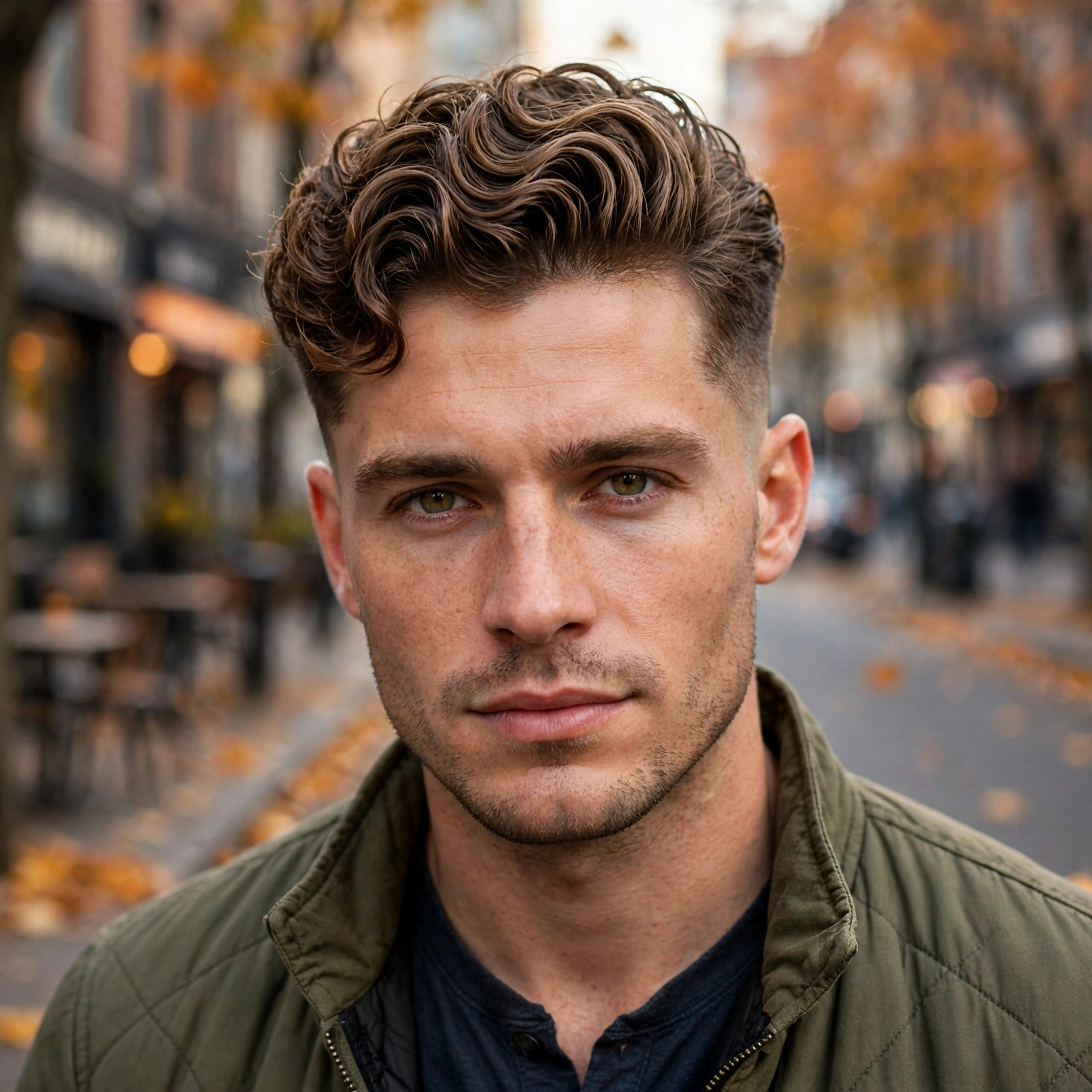
8. Wavy Faux Hawk
Controlled rebellion. The center strip is left longer and textured, styled upward with the wave providing natural lift, while the sides are faded clean. The wave does half the styling work here — it genuinely wants to go up anyway — which makes this far more wearable than a faux hawk has any right to be. Edgy enough for weekends and creative workplaces, clean enough (thanks to the fade) that it doesn’t read as a costume.
How to get it: Tell your barber: “Faux hawk for wave — keep the center long and textured, mid fade on the sides, wearable not spiky.” At home, blow-dry the center strip upward with your fingers, then work a small amount of matte paste or fiber through, pushing everything toward the center and up. The wave’s natural lift does the rest.
Best for: Round faces especially (the height is flattering); thick wavy hair (2A–2C) that has natural lift; guys who want edge without a full mohawk commitment.
Maintenance: Medium. Eight to ten minutes of styling; the fade needs refreshing every 3–4 weeks or the contrast softens and the whole thing goes shaggy.
Pro tip: Less product than you think — a faux hawk built on wave should feel touchable, not crunchy. Start with half the paste you’d expect, add more only if pieces fall. And style it the same day as your wash; this cut lives on fresh-hair grip, and day-three hair goes flat no matter what you do to it.
%
%
9. Tousled Curtain Cut
The 90s revival, wave-perfected. A center part with 3–5 inches falling to each side, the wave giving each curtain natural body and movement that straight hair simply can’t fake. This is peak 2026 energy — it’s everywhere in men’s textured hair trends right now — and wavy hair is objectively the best hair type for it. The curtains frame the face symmetrically, soften strong features, and grow out better than almost any cut on this list.
How to get it: Tell your barber: “Curtains — center part, 3 to 5 inches, textured for wave. Keep the sides long enough to tuck.” At home, part it down the middle on damp hair, mist with sea salt spray, and let it air-dry, pushing each side slightly forward as it dries so it frames the face instead of falling flat.
Best for: Oval and square faces especially; loose to medium wave (2A–2B) — this cut was made for it. Current length: 3+ inches on top, longer on the sides than a fade.
Maintenance: Low. Five minutes, no heat needed. Trims every 6–8 weeks to keep the shape; it grows out gracefully into a longer flow, so there’s no crisis if you stretch it.
Pro tip: The center part has to be trained — if you’ve parted on the side for years, your hair will fight the middle for a week or two. Part it wet, every day, for ten days straight, and the pattern resets. And resist the urge to thin the curtains out; the wave’s fullness is the whole look. Hanz de Fuko Quicksand is the cult product for this style for a reason — it adds gritty volume that makes curtains sit perfectly without looking product-y.
%

%
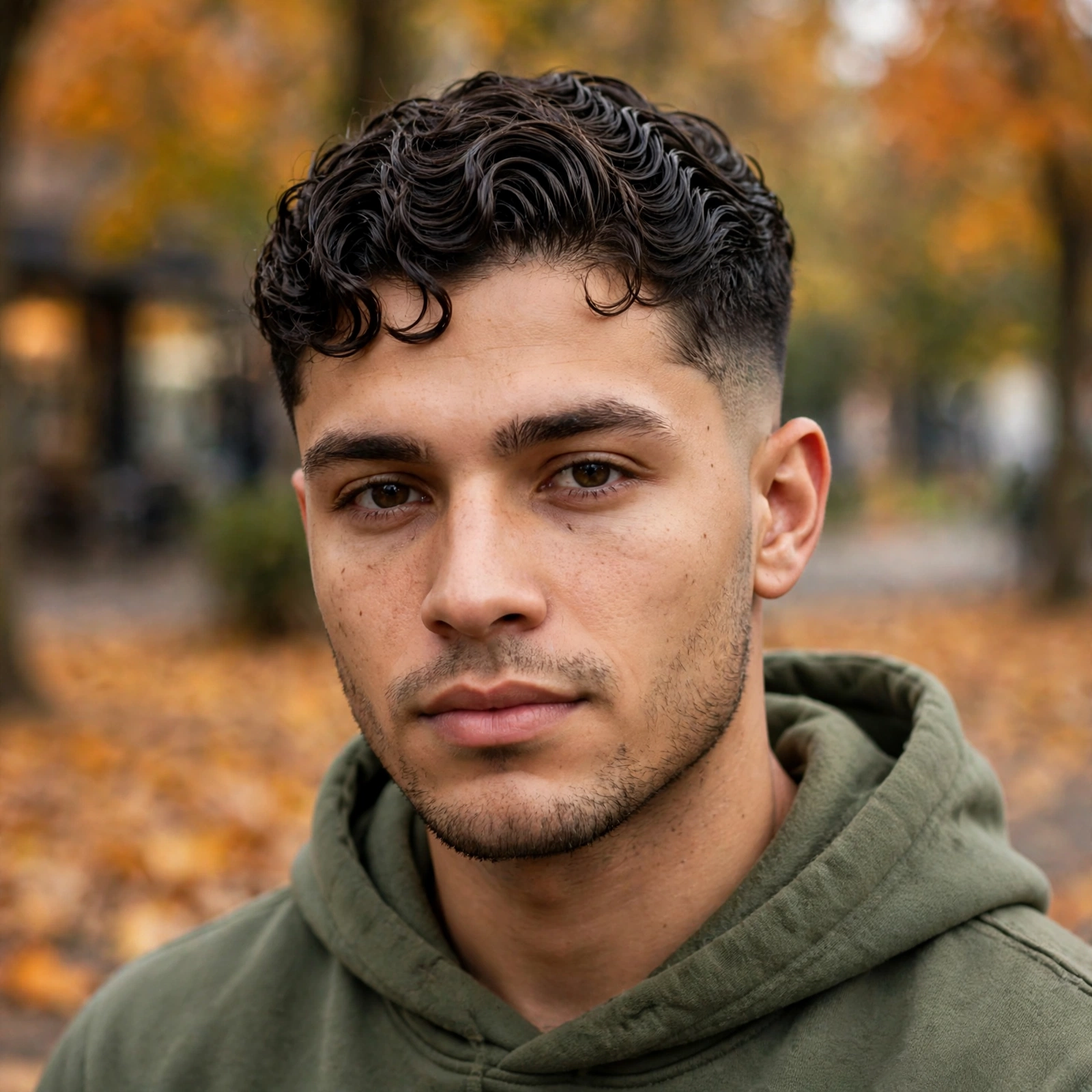
10. Defined Wavy Curls with Fade
For stronger wave bordering on curl. The top stays at 2–4 inches and gets defined with curl cream into separated, glossy waves, with a clean fade underneath for sharp contrast. This is the neatest way to wear strong wave: all the texture, none of the puff. It’s also the answer for guys whose wave has always gone frizzy and undefined — definition is a technique, not a hair type, and this cut proves it.
How to get it: Tell your barber: “Define the waves on top — layers for the pattern, not against it — and fade the sides clean.” At home, apply curl cream to soaking damp hair (not towel-dried — wetter is better for definition), scrunch upward in sections, then hands off until completely dry. Diffuse on low heat if you’re impatient; air-dry if you’re not.
Best for: Strong wave to loose curl (2B–2C); all face shapes; medium to thick hair with real density. This is the cut for guys who’ve been told their hair is “too curly” for short styles — it isn’t.
Maintenance: Medium. Ten minutes on wash days (the scrunch-and-dry routine), near-zero on refresh days. Fade trims every 4 weeks to keep the contrast sharp.
Pro tip: The “soaking damp” detail is the whole game — applying cream to towel-dried hair gives you frizz, applying it to dripping hair gives you definition. Our editors tested this side by side and the difference was dramatic. And once it’s dry, break the cast (that slightly crunchy feeling) by scrunching gently with dry hands — never a brush, never a comb.
%
%
11. Windswept Medium Layers
Artful disarray. Medium length (4–6 inches) with choppy layers throughout, styled to look windblown — which, on wavy hair, mostly means letting it be. This is the “I woke up like this” cut of fall 2026, and it suits creative types, casual dressers, and anyone whose style runs more interesting than polished. The deliberate undone-ness is the point: every layer is placed so the mess looks intentional.
How to get it: Tell your barber: “Choppy layers throughout, windswept texture, natural finish — point cut everything, no blunt lines.” At home, sea salt spray on damp hair is genuinely the only product you need: mist, scrunch, tousle, air-dry. On lazy days, even the spray is optional.
Best for: Oval, heart, and square faces; medium to thick wavy hair (2A–2B) — very fine hair can’t hold the piece-y separation. Current length: 4+ inches on top.
Maintenance: Low. Three to five minutes. Trims every 6–8 weeks to keep the layers from growing into a shapeless mop — the line between “windswept” and “neglected” is a fresh layer cut.
Pro tip: This cut photographs differently from every angle, so check the back in a second mirror before you leave — the layers that look perfect from the front sometimes do strange things behind the ears. A quick finger-comb fixes it in seconds. And sleep on it slightly damp once: you’ll wake up to the best version of this style you’ve ever had.
%

%
12. Wavy Slick-Back
Wave, but make it sleek. The top (4–5 inches) is combed back with cream for a smooth-but-textured finish — the wave gives it dimension and movement that straight hair can’t match. Tapered or faded sides keep it current. Sophisticated and mature, this is the wavy-haired man’s power move for formal fall events: weddings, holiday parties, big presentations. Without wave this cut can read dated; with wave, it’s modern.
How to get it: Tell your barber: “Slicked back, keep the wave texture — I want flow, not flat. Tapered sides.” At home, apply a medium-hold cream to damp hair, comb straight back with your fingers (a fine comb kills the wave; fingers preserve it), and let it set as it air-dries. For extra hold on important days, a light mist of flexible hairspray once dry.
Best for: Oval, square, and longer faces; medium wave (2A–2B) with medium to thick hair. Current length: 4+ inches on top — shorter and it won’t stay back.
Maintenance: Medium. Eight to ten minutes, and it needs a refresh if you take a beanie on and off. Trims every 5–6 weeks.
Pro tip: Cream, never gel — gel turns this into a 1980s throwback within an hour. You want a product with hold but zero crunch, applied to damp hair so the wave sets in a controlled pattern. And here’s the insider move: slick it back slightly damp, then don’t touch it until it’s 100% dry. Touching it mid-dry breaks the set and you get frizz instead of flow.
%

%
Fall Hairstyles for Men with Wavy Hair: FAQs
How do I stop my wavy hair from frizzing in dry fall air?
Fall’s low humidity actually reduces frizz compared to summer — see our guide to summer hairstyles for wavy hair for the high-humidity playbook — but the dryness can make waves wiry and flyaway. The fix is moisture discipline: switch to a hydrating shampoo, condition every wash, and add a weekly mask from October onward. On styling days, apply your product to damp (not dry) hair — dry application is the number one frizz trigger our testers found. And the simplest rule of all: once your waves start drying, stop touching them. Every touch breaks wave clumps apart and invites frizz.
Should I enhance my natural wave or try to control it?
Enhance it — every time. Fighting wave means heat-styling it straight daily (damage, time, and it never lasts in real weather) or cutting it so short the texture disappears. Enhancing means sea salt spray or curl cream on damp hair, a scrunch, and air-drying: three minutes for a result that looks intentional. For a deeper dive into the technique, Healthline’s overview of enhancing wavy hair is a solid primer. The cuts on this list are all built on that philosophy. The only exception is formal styling like the wavy slick-back (#12), where you direct the wave rather than flattening it — control with direction, not against the pattern.
What do I do about cowlicks with wavy hair?
Cowlicks are just wave patterns with strong opinions, and the strategy is redirection, not war. First, tell your barber where they are — a good cut works around them by leaving slightly more length at the cowlick so its weight holds it down. Second, always style the cowlick area while damp, pressing it flat in the direction you want with a little extra product. Third, consider that some cuts on this list (the textured crop #1, the quiff #4) actually use the cowlick’s lift as a feature. If a cowlick has tormented you for years, ask your barber specifically: “How do we cut around this?” — it’s a solvable problem, not a life sentence.
I’m growing out my wavy hair — how do I survive the awkward phase?
The awkward phase (roughly months 3–6) is real, and wavy hair makes it weirder — it goes wide before it goes long. Three survival tools: first, keep the sides trimmed while the top grows — a clean neckline and tapered sides make even in-between lengths look deliberate. Second, lean on styles that disguise unevenness: the tousled curtain cut (#9) and windswept layers (#11) are essentially designed for this. Third, embrace the beanie — fall grow-out season and hat season are the same season for a reason. Get a “dusting” trim every 8–10 weeks to keep ends healthy without losing length, and remember: the weight that eventually pulls waves into a flow only arrives if you don’t quit.
Which of these styles actually survive beanie and hat season?
Shorter sides win hat season: the wavy textured crop (#1), wavy faux hawk (#8), and defined curls with fade (#10) all come out of a beanie looking basically intact. Medium and long styles survive too, but with a strategy — the bro flow (#3) and shoulder-length waves (#7) bounce back if you shake them out and finger-comb after removing the hat. Two universal tricks: choose beanies with a smooth (satin or silk) lining to prevent frizz and breakage, and part or sweep your hair where the hat’s edge will sit before putting it on. Avoid the quiff (#4) and slick-back (#12) on heavy beanie days — structured height and hats are natural enemies.
The Bottom Line
The best fall hairstyles for men with wavy hair aren’t the ones that fight your texture — they’re the ones built around it, cut by someone who understands wave, and styled with a light hand. Pick one cut from this list that matches your wave intensity and your mornings, give it an honest two-week trial, and let this be the autumn your hair finally feels easy instead of adversarial. Happy fall — and happy hair days ahead. And if you want the dermatologist’s view on keeping waves healthy, the AAD’s hair-care guidance is a reliable reference.