10 Rugged Fall Hairstyles for Men (Beard-Friendly)
The best rugged fall hairstyles for men in 2026 are the textured crop with stubble blend, the messy quiff with a full beard, and the short waves with a beard fade — here’s why. There’s something about the first cold snap of autumn that makes a clean summer cut feel unfinished. The flannel comes out, the boots come out, and your hair should have some presence to match: texture you can see, weight you can feel, and a beard that looks deliberate rather than accidental.
Most guys treat fall as a waiting room between summer fades and winter hats. That’s a waste. Autumn is the one season where masculine fall hairstyles get every advantage — cooler air means less sweat flattening your style by noon, beards itch less and grow more comfortably, and heavy fabrics like wool, denim, and flannel practically demand hair with some grit to balance them.
The lumberjack hair trends of 2026 have grown up. The costume version — the full mountain-man beard with zero shaping — is out. What’s in is crafted ruggedness: choppy texture on top, fades and tapers that flow into the beard instead of stopping dead at the sideburn, and facial hair that’s full but defined. Hair and beard are one composition now, and the barbers doing the best work in 2026 treat them that way — blending, not separating.
And let’s kill the biggest myth right now: rugged does not mean unkempt. True rugged style is high-effort disguised as no-effort. The texture is cut in on purpose, the beard is shaped on purpose, the edges are cleaned up on purpose — it only looks like you woke up that way because someone made sure you would. The difference between rugged and sloppy is about ten minutes a morning and a barber who knows what “blend it into the beard” means.
What makes this guide different: every style below comes with the complete picture. Not just what it looks like, but exactly what to tell your barber (guard numbers, scissor work, texture techniques), how to style it at home, who it actually suits, honest maintenance expectations, and a pro tip our editors picked up from barbers who do these cuts daily.
Below are the 10 best rugged men’s haircuts 2026 has to offer — every one beard-friendly, every one built for fall.
Table of Contents
- Textured Crop with Stubble Blend
- Messy Quiff with Full Beard
- Short Waves with Beard Fade
- Buzz Cut with Heavy Stubble
- Slicked-Back with Short Boxed Beard
- Bro Flow with Rugged Beard
- French Crop with Chinstrap Blend
- Curly Top with Beard Taper
- Side Part with Corporate Beard
- Faux Hawk with Stubble
Editor’s Top 5 Rugged Picks
Short on time? These five beard and hair combos have the highest style-to-effort ratio on the list — one for every beard situation, from heavy stubble to full growth.
1. Textured Crop with Stubble Blend
The everyday workhorse of rugged fall hair: a choppy crop with faded sides that melt straight into heavy stubble — one continuous shape from crown to jaw. It works in every setting, suits nearly every face, and asks almost nothing of your mornings. That seamless hair-to-beard blend is what separates a 2026 cut from a 2019 one.
2. Messy Quiff with Full Beard
The classic rugged silhouette — volume on top, weight on the jaw, perfectly balanced. The quiff’s height elongates the face while the full beard adds the masculinity: the most recognizably rugged shape in men’s hair. It takes a real beard and ten real minutes, but the payoff is the strongest presence on this list.
3. Short Waves with Beard Fade
Natural texture meets barber precision. If your hair has any wave at all, this cut does half the styling for you — the wave is the ruggedness, the beard fade is the craftsmanship. Maximum effect, minimum effort, and the most 2026 detail on this list.
4. Buzz Cut with Heavy Stubble
Minimalism with muscle. Nothing on this list is simpler — a uniform buzz, a week of stubble, sharp edges — and nothing reads more disciplined. It’s the best answer for thinning hair and the lowest-maintenance pairing here: proof that rugged is about intention, not length.
5. Slicked-Back with Short Boxed Beard
Rugged, refined to its essence. Sleek, controlled hair on top against a short, geometric beard — all clean lines and quiet confidence. This is the one for formal settings, big meetings, and evenings out: every ounce of the masculine energy, completely polished.
What Makes a Fall Haircut Rugged (and Beard-Friendly)?
Ruggedness is built from three things: texture, weight, and intention. Texture means visible, touchable hair — choppy point-cut ends, piece-y separation, natural wave — never anything plastered flat or helmet-smooth. The cutting techniques behind it are specific: point cutting (snipping into the ends vertically) to remove bulk and create separation, and texturizing shears through the interior to thin without shortening.
Weight means the cut has presence. Rugged cuts keep real length on top — enough to move, catch light, and show texture — while the sides are tapered or faded rather than skinned into nothingness. A high-and-tight with a #0 fade has discipline, but it doesn’t have ruggedness; rugged needs something to grab onto. Even the shortest cut on this list, the buzz, gets its ruggedness from the stubble pairing rather than the hair alone.
Intention is the invisible ingredient — and it’s entirely about the transition zones. The three places where haircuts fail the rugged test are the sideburns, the temples, and the neckline. A fade that stops dead above a full beard creates a harsh shelf that screams “two separate haircuts.” A fade that graduates into the sideburn, or a taper that flows down into the beard’s cheek line, creates one continuous composition. The six words that transform any of these cuts: “blend the beard into the cut.” Say them at the start of the appointment, not the end — it changes how the barber approaches the sides.
Beard shape matters as much as the haircut, and the 2026 standard is natural but defined: full enough to have presence, shaped enough to show intent. Two lines make or break it. The neckline should sit about two fingers above the Adam’s apple — shave everything below it. The cheek line should be cleaned up to a natural curve (don’t carve it artificially low; follow where your growth naturally thins). Keep the mustache trimmed so it doesn’t hang over the lip. A rugged beard is a maintained beard that doesn’t look fussy.
Fall is rugged’s home turf practically too: cooler air means less sweat, so beards itch less and styles hold longer. The trade-off is dry air pulling moisture from hair and beard. Add beard oil — three to four drops daily, combed through — and switch to a richer conditioner or weekly mask. The guys whose rugged looks fall apart in November aren’t styling wrong; they’re moisturizing wrong.
How to Choose the Right Rugged Fall Haircut
Start with your beard reality, not your beard fantasy. Heavy, full growth supports the boldest beard and hair combos — messy quiffs, slicked-backs, bro flows. Patchy or slow growth suits shorter beards and heavy stubble paired with simpler cuts like crops and buzzes. There’s no shame in stubble; a well-kept heavy stubble with the right cut looks more rugged than a wispy full beard ever will. Work with what grows out of your face, not what grows out of someone else’s Instagram.
Face shape guides the hair-beard balance more than most guys realize. Round faces need height on top (quiffs, faux hawks, curly tops) and a beard with some length at the chin to elongate the jaw — avoid cuts that add width at the sides. Square faces are already angular: soften with texture on top and skip the overly boxy beards that turn your head into a rectangle. Oval faces can wear anything — pick based on hair type instead. Longer faces should keep beards shorter and add width with the haircut rather than stacking more length below the chin.
Be brutally honest about the maintenance contract: rugged looks are not low-maintenance looks. A full routine is roughly ten minutes each morning plus a barber visit every three to four weeks, with beard edging every few days. If that sounds like too much, choose simpler pairings — buzz plus stubble, crop plus short boxed beard. An honest low-maintenance cut beats an aspirational one every time; a neglected quiff doesn’t look rugged, it looks tired.
Factor in your hair type before falling in love with a photo. Thick, coarse hair holds texture and volume beautifully — quiffs, faux hawks, and bro flows were made for it. Wavy hair is the cheat code — lean into cuts that show it off rather than fighting it flat. Curly hair needs length on top — cropped too short, curls read messy rather than intentional. Fine or thinning hair should stay shorter on top with texture (crops, buzzes); length only emphasizes what’s missing. And straight hair can wear anything here, but it needs product to fake the texture that wavy and curly hair gets for free.
Finally, know your audience and plan the grow-out. Rugged plays beautifully in most modern workplaces, creative fields, and social settings — but some conservative environments still read heavy beards as unprofessional. The fix is calibration, not abandonment: the same textured crop reads completely different with a tight corporate beard versus a full woodsman. Adjust the beard to the room; keep the haircut.
10 Rugged Fall Hairstyles for Men (Beard-Friendly)
1. Textured Crop with Stubble Blend
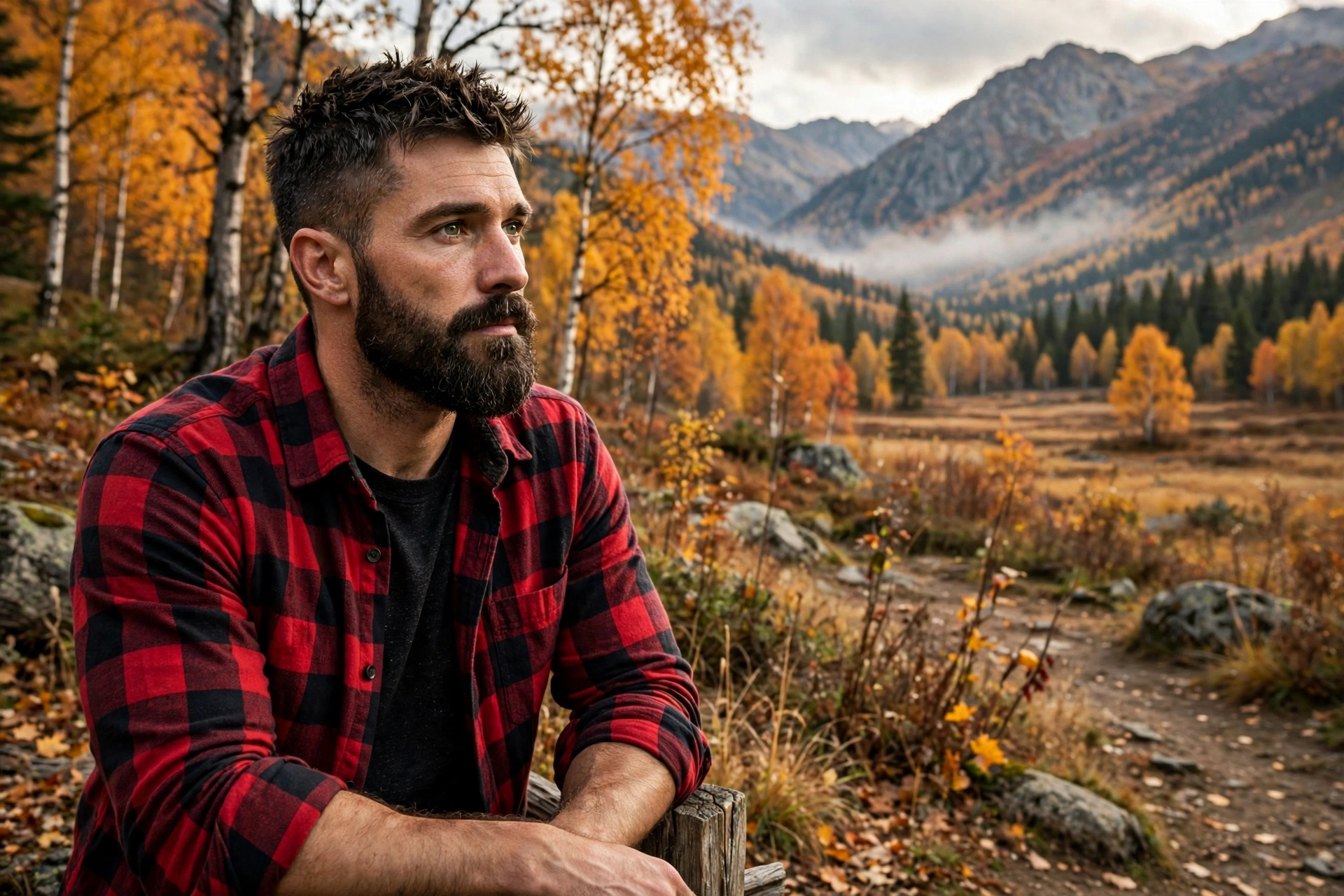
The everyday rugged standard — and the single most versatile cut on this list. A choppy, textured crop (one to two inches) on top with faded sides that melt directly into heavy stubble, no line between hair and beard anywhere. The vibe is quietly confident — office days, weekends, first dates, gym-to-dinner. Our editors tested this as the “one cut for a whole season” pick, and it survived everything from client meetings to camping trips without a restyle.
How to get it: Tell your barber: “Textured crop, about an inch and a half on top, point-cut for separation — fade the sides down into the stubble, no line between hair and beard.” Sides go #3 or #4 into the stubble zone; the sideburn blend is the critical part. Keep stubble at 4–5mm with clean neckline and cheek lines. At home: work a pea-sized amount of matte clay through dry hair, pushing it forward and breaking it up with your fingertips — no comb.
Best for: All face shapes (the forward texture flatters universally); straight to wavy hair; fine to thick densities — and it’s one of the best options for thinning crowns, since the texture disguises sparse spots. Ideal if your current length is short to medium.
Maintenance: Low. Three to five minutes each morning; trimmer pass every 3–4 days to hold stubble length. Barber every 3–4 weeks — once the fade-to-stubble blend grows out, the effect collapses.
Pro tip: Apply clay to completely dry hair — damp hair plus clay reads greasy by noon. For the most natural matte finish we’ve found, American Crew Fiber is the benchmark: strong hold, zero shine, and it restyles with just your hands.
%

%
2. Messy Quiff with Full Beard
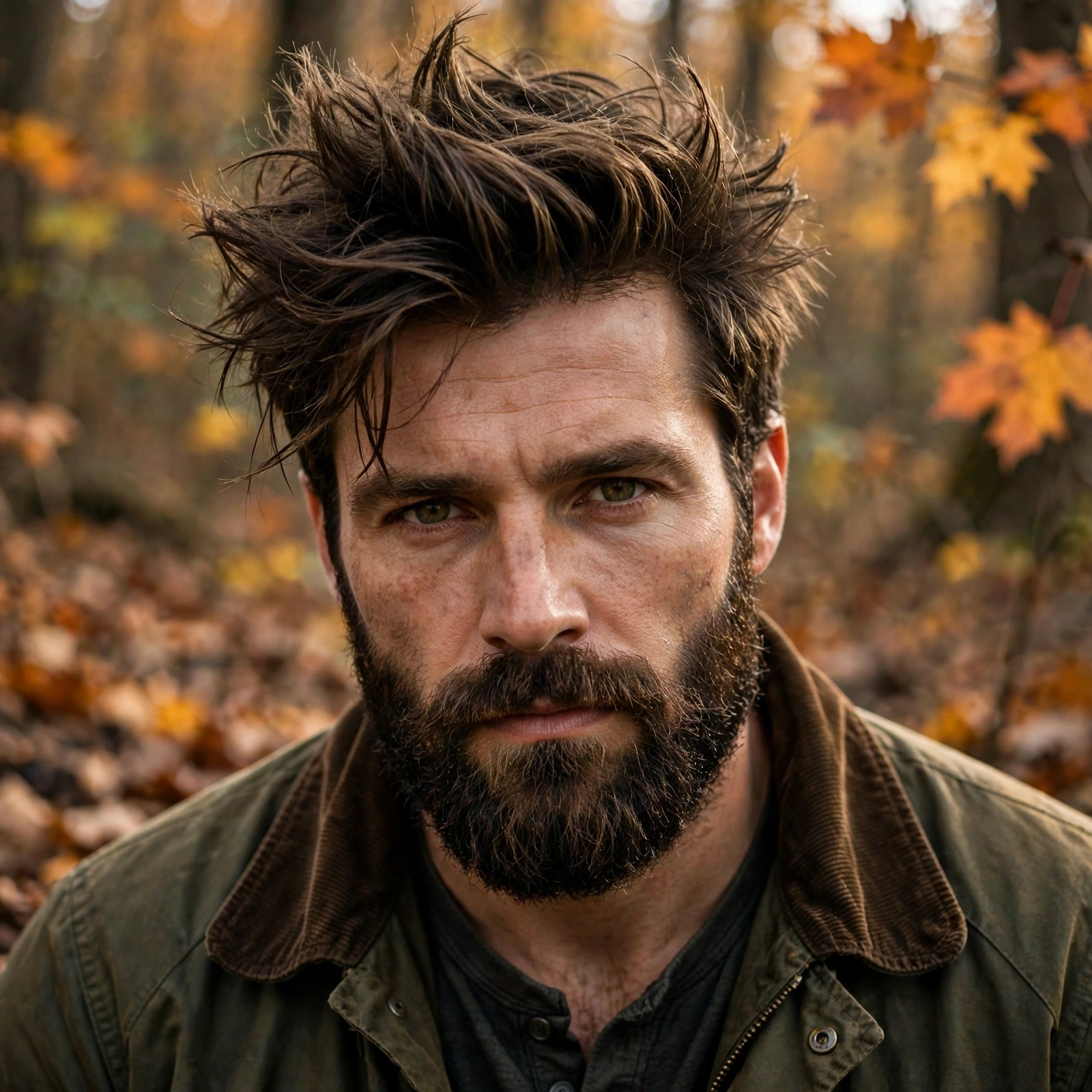
The classic rugged silhouette — volume on top, weight on the jaw, perfectly balanced. Two to three inches of textured height swept up and back, paired with a full, shaped beard that anchors the whole composition. This is the look people picture when they hear “rugged,” for good reason: the height elongates the face while the beard adds width and masculinity at the jaw, creating the most deliberately masculine shape in masculine fall hairstyles. Our editors found it’s the most complimented pairing on this list, by a wide margin.
How to get it: Tell your barber: “Messy quiff — two to three inches on top with heavy texture, tapered sides (not skin-tight), and shape the beard to match: full at the chin, cleaned up at cheeks and neck.” The beard needs a few weeks of growth to have weight; keep the mustache trimmed. At home: blow-dry upward and back for lift — air-drying gives flat, not quiff — then work matte clay roots to ends, pushing the front up and letting it fall messy.
Best for: Thick, coarse hair that holds height; strong, full beard growth; round and square faces benefit most (the height offsets width). Needs enough top length to work with — at least two inches to start.
Maintenance: Medium. Eight to ten minutes with the blow-dryer — skip the heat and the quiff won’t stand. Beard needs daily oil and edging every few days. Barber every 3–4 weeks.
Pro tip: Blow-dry the quiff in the opposite direction first, then sweep it back — counter-direction drying builds twice the root lift. For pre-styling volume, a blast of sea salt spray into damp hair before the dryer (Hanz de Fuko Quicksand doubles as volumizer and texturizer) gives the clay something to grip.
%
%
3. Short Waves with Beard Fade
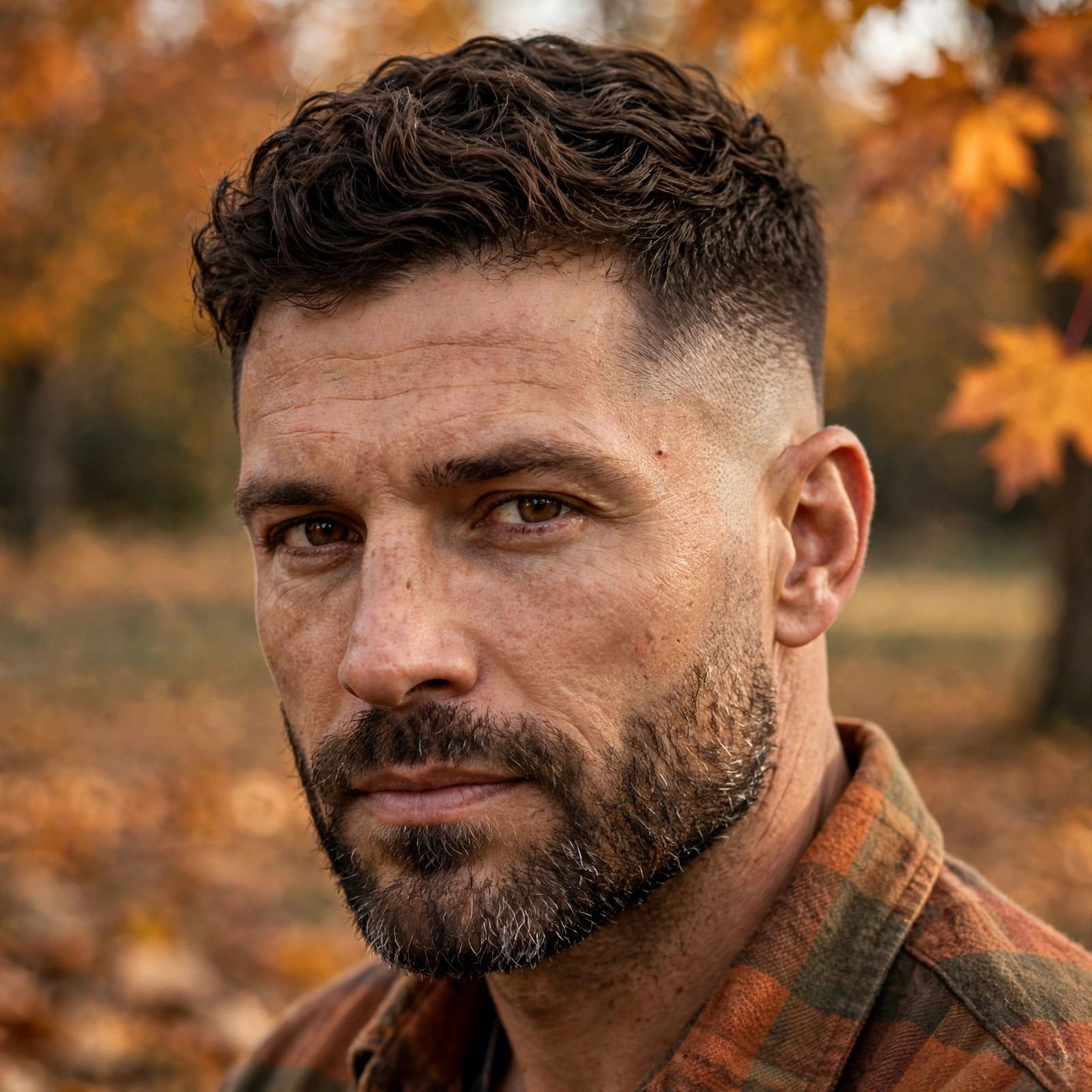
Texture, sculpted. Two to three inches of natural wave on top with faded sides, and the barber fades the sideburn area so the beard graduates seamlessly out of the haircut — one continuous, crafted shape from temple to jaw. It’s all over rugged men’s haircuts 2026 roundups because it solves the style equation elegantly: the wave supplies free ruggedness, the fade supplies the precision, and the combination looks expensive without looking fussy. We found this is the cut wavy-haired guys have been waiting for: it finally treats the wave as the feature, not a problem to straighten away.
How to get it: Tell your barber: “Wavy top at two to three inches, mid fade on the sides — and fade the beard in at the sideburn, all connected.” The beard fade is technical: ask whether he does them regularly before you sit down. At home: mist sea salt spray into damp hair, scrunch upward, air-dry or diffuse on low. Keep the beard medium length and oiled so the transition looks soft, not wiry.
Best for: Naturally wavy hair — this cut was made for it; square and oval faces; medium to thick densities. Straight-haired guys can approximate it with salt spray and scrunching, but the effect won’t match real wave.
Maintenance: Low to medium. Five minutes of scrunch-and-go; the beard needs daily oil and a weekly trimmer pass to hold the fade. Barber every 3–4 weeks.
Pro tip: Never brush wavy hair dry — it breaks the wave pattern into frizz; finger-comb only. If waves fall flat by afternoon, a light re-mist of salt spray and a quick scrunch revives them in thirty seconds. Oil the beard before bed rather than in the morning — overnight absorption keeps it softer through the fade zone all day.
%
%
4. Buzz Cut with Heavy Stubble
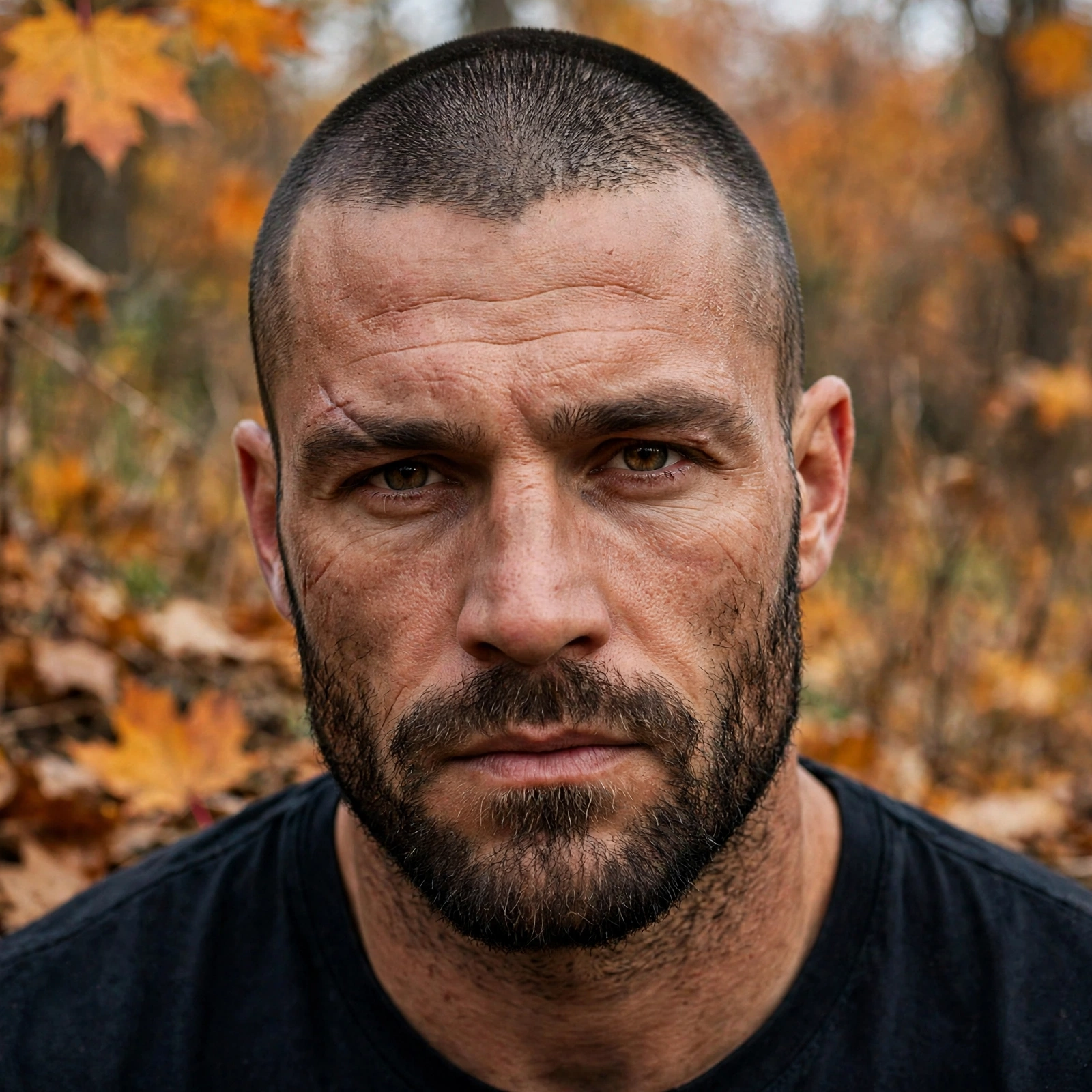
Brutal simplicity — and don’t mistake simple for easy to pull off. A uniform buzz (#2–#3) on top plus five to seven days of stubble, with the stubble’s edges kept razor-sharp. The entire style lives in the contrast: the severity and uniformity of the buzz against the raw texture of the stubble. It’s the most disciplined look on this list — military-adjacent, no-nonsense, quietly intimidating. Our editors timed it: total morning routine under two minutes, which makes it the undisputed efficiency pick. It also happens to be the most honest answer for thinning hair on this list.
How to get it: Tell your barber: “Buzz, uniform #2 (or #3 for more coverage), and clean up the stubble lines — sharp cheeks, sharp neckline.” The stubble is the actual haircut here: grow to 4–5mm, hold it with a trimmer, keep the edges crisp. You can buzz at home, but have the barber set the stubble lines first so you have a template.
Best for: Strong bone structure — oval, square, and diamond faces; the buzz exposes everything, so defined jawlines and cheekbones shine. Excellent for thinning or receding hair (it removes the contrast between thin and thick areas). Works with all hair textures since there’s barely any hair to texture.
Maintenance: Low. Zero hair styling; the stubble needs a trimmer pass every 3–4 days to hold uniform length, and edge cleanup every few days. Buzz it yourself every 2–3 weeks or see the barber monthly. Easiest full routine on this list.
Pro tip: The thing that ruins this look isn’t the hair — it’s the skin underneath. Exfoliate two to three times a week to prevent ingrown hairs and flakiness, and moisturize after every trim. Dry, flaky skin under stubble reads unkempt; smooth skin reads intentional.
%
%
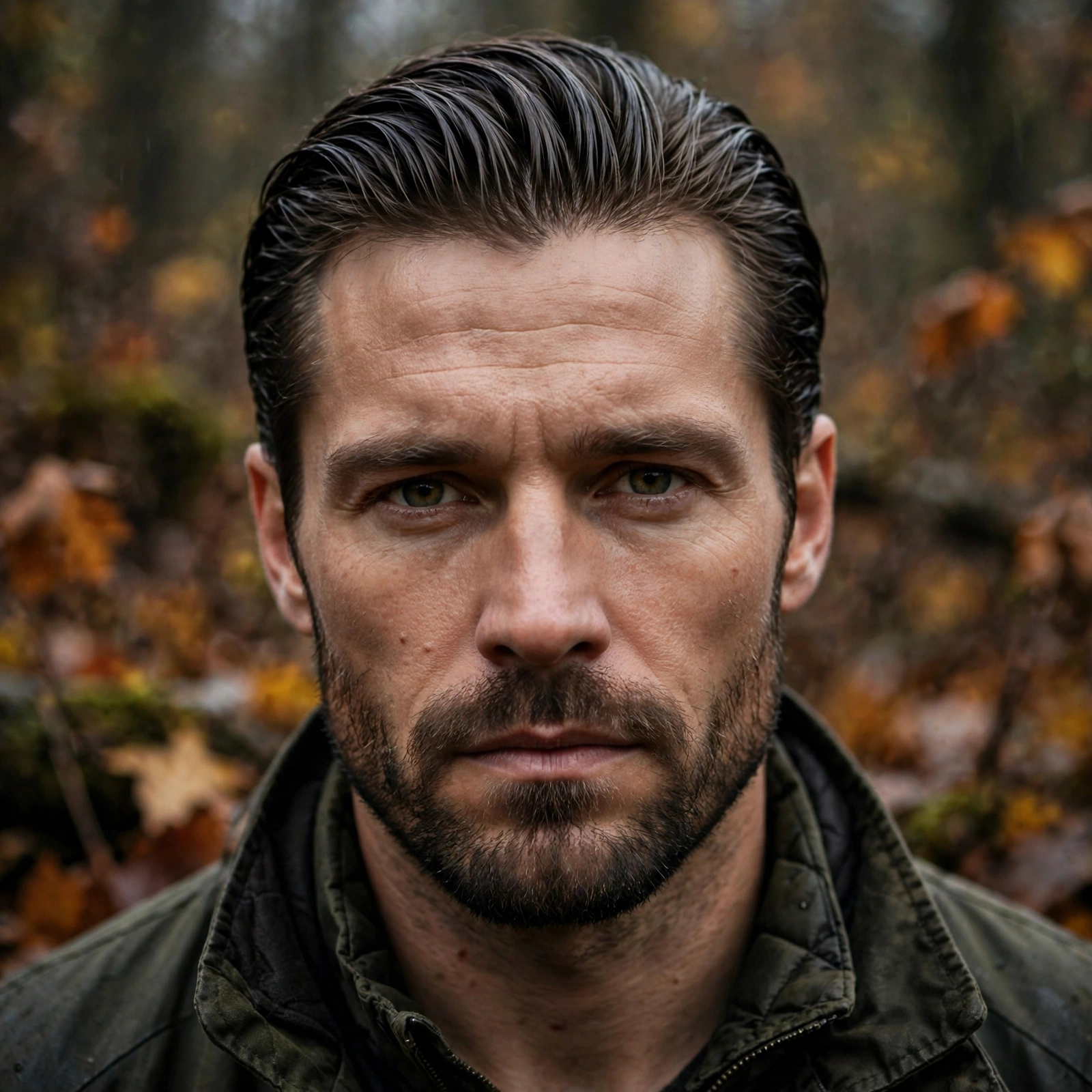
5. Slicked-Back with Short Boxed Beard
Refined rugged — contrast and control. Three to five inches on top swept straight back with medium hold, paired with a short, geometrically shaped beard: sharp cheek lines, defined jaw, modest uniform length. Where the other cuts on this list lean wild, this one leans powerful — it’s the beard and hair combo for formal settings, big meetings, weddings, and evenings out. In 2026 we’re seeing this everywhere in finance, law, and anywhere the dress code is sharp but the personality isn’t — proof that rugged and refined were never opposites.
How to get it: Tell your barber: “Slicked back, three to five inches on top with tapered sides — and box the beard: short, uniform, crisp cheek lines, defined jaw.” The top needs enough length to lie back without springing forward. At home: work pomade through towel-dried hair and comb straight back with a fine-tooth comb (fingers give messy; the comb gives sleek). For the beard: one uniform guard length, then edge cheeks and neckline with a detail trimmer.
Best for: Thick, straight to slightly wavy hair that lies back obediently; oval and oblong faces (the swept-back top adds the illusion of length control); guys who need a boardroom-safe rugged look. Curly hair can do it but needs more length and stronger hold.
Maintenance: Medium. Five to eight minutes each morning — the comb-back is quick once the length is right. The boxed beard is the demanding half: edging every 2–3 days to keep those lines crisp, since geometric beards show growth immediately. Barber every 3–4 weeks.
Pro tip: You want hold with a natural sheen — not wet-look gel (dated) and not full-matte clay (won’t hold the sweep). Baxter of California Clay Pomade sits right in that sweet spot: firm hold all day with a clean low-shine finish. Always slick it back while hair is slightly damp; pomade on bone-dry hair just sits on top and flakes.
%
%
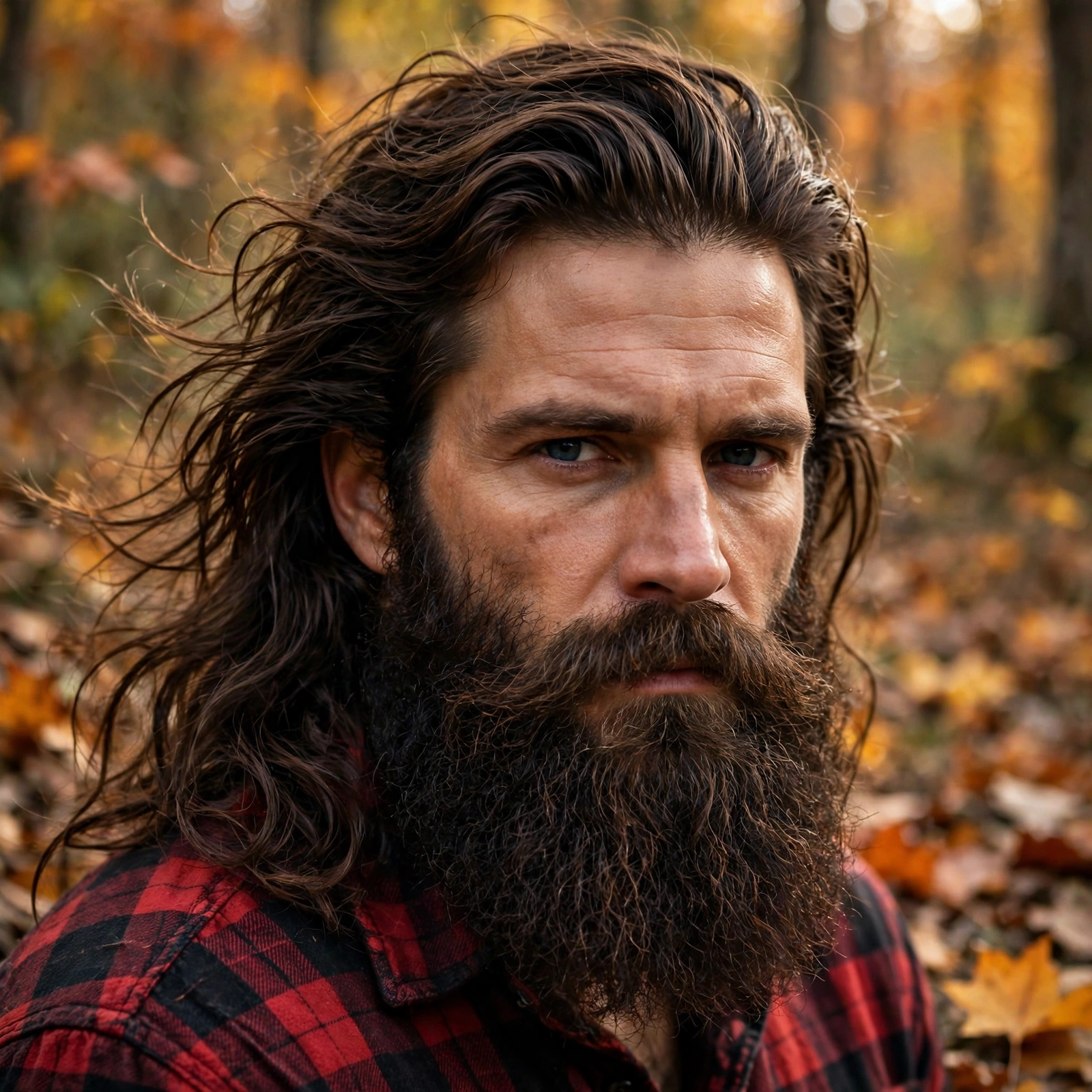
6. Bro Flow with Rugged Beard
Length meets lumberjack — the most romantic rugged look on this list. Five to seven inches of natural movement flowing back and to the sides, paired with a full, natural beard that’s shaped but never thinned. This is the modern evolution of classic lumberjack hair trends: all texture and presence, zero stiffness, the hair equivalent of a well-worn leather jacket. The vibe is adventurous and self-assured: road trips, fall hikes, live music, anywhere the dress code is “be yourself, but better.” Our editors found it’s the highest-compliment cut here among guys who can commit to the length — but that commitment is real.
How to get it: Tell your barber: “Bro flow — five to seven inches on top, long layers for movement, natural perimeter; shape the beard but don’t thin it.” The layers are essential: without them, long hair just hangs. Beard stays full with a clean neckline and soft cheek lines — shaped, not sculpted. At home: salt spray into damp hair, air-dry or rough-dry with fingers. Keep the beard oiled daily; long hair plus a dry beard slides from rugged to ragged fast.
Best for: Thick, wavy to straight hair with natural body; strong, full beard growth; oval, square, and oblong faces (the flow adds flattering width). Fine or very curly hair struggles here — fine hair goes limp at this length, and tight curls need a different shaping approach.
Maintenance: Medium. Five minutes of styling, but longer hair needs a weekly mask against dry fall air. The non-negotiable is the neckline — let it grow wild and the look slides from rugged to unkempt in two weeks. Barber every 6–8 weeks, neckline cleanups between.
Pro tip: The grow-out is the hard part. Months three through five are the awkward zone — too long to be short, too short to flow. Survive it with salt spray, matte paste at the roots, and strategic hat use. Tell your barber “ends only, keep the length” every visit — one overzealous trim resets months of progress.
%
%
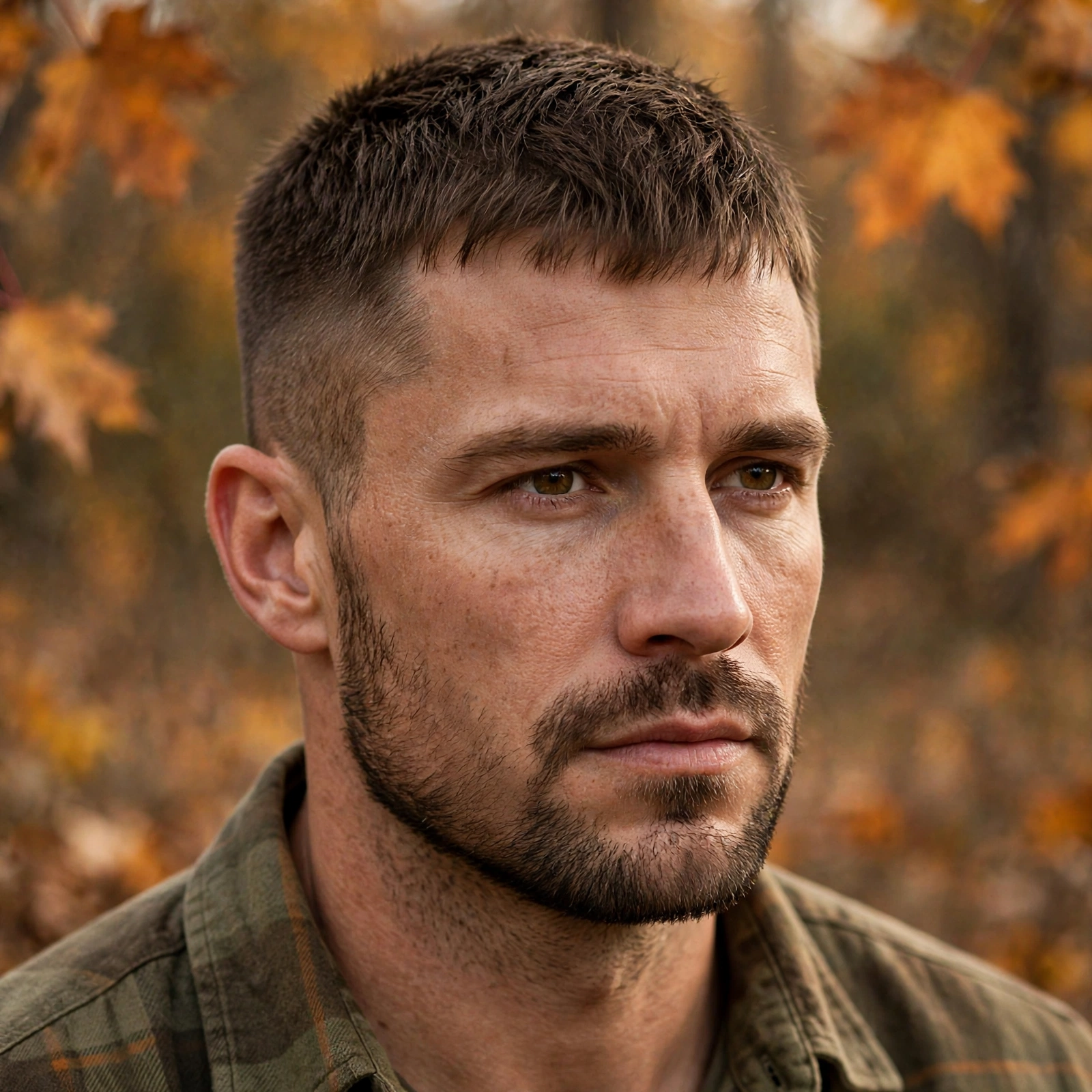
7. French Crop with Chinstrap Blend
Graphic and bold — the most architectural cut on this list. A blunt, textured fringe worn forward with faded sides, connected to a defined chinstrap-style beard that traces the jawline in one crisp line. The geometry is the entire point: every edge deliberate, every line clean, the fringe-to-beard connection creating a frame around the whole face. It’s not subtle and it’s not for every office — but it’s unforgettable, and in 2026 the French crop’s blunt fringe is one of the defining shapes in rugged men’s haircuts 2026. Our editors note this is the highest-impact, highest-commitment pairing here — it looks incredible when maintained and falls apart fast when it isn’t.
How to get it: Tell your barber: “French crop — blunt textured fringe, faded sides — and a chinstrap beard blended at the sideburn.” The fringe hits just above the brows with choppy texture (not a bowl cut). Sides fade #1–#3 into the chinstrap tracing the jaw at uniform width. At home: matte paste through the top, pushed forward, fringe broken up with fingers. Edge the chinstrap every 2–3 days with a detail trimmer — top edge, then bottom — to keep lines crisp.
Best for: Straight to slightly wavy hair (the blunt fringe needs hair that lies forward); square and oval faces — the geometry complements strong jawlines; guys with dense, even beard growth along the jaw (patchy cheeks will undermine the chinstrap). Confident dressers only — this cut makes a statement.
Maintenance: Medium to high. Five minutes for the hair; the chinstrap demands edging every 2–3 days — geometric lines show even a day of growth. Barber every 3 weeks.
Pro tip: Invest in a dedicated detail trimmer — the chinstrap lives or dies on line precision, and a slim trimmer lets you edge the jaw curve cleanly. Edge the top line first, then the bottom, and trim the strap’s width conservatively: you can take more off, but you can’t put it back.
%
%
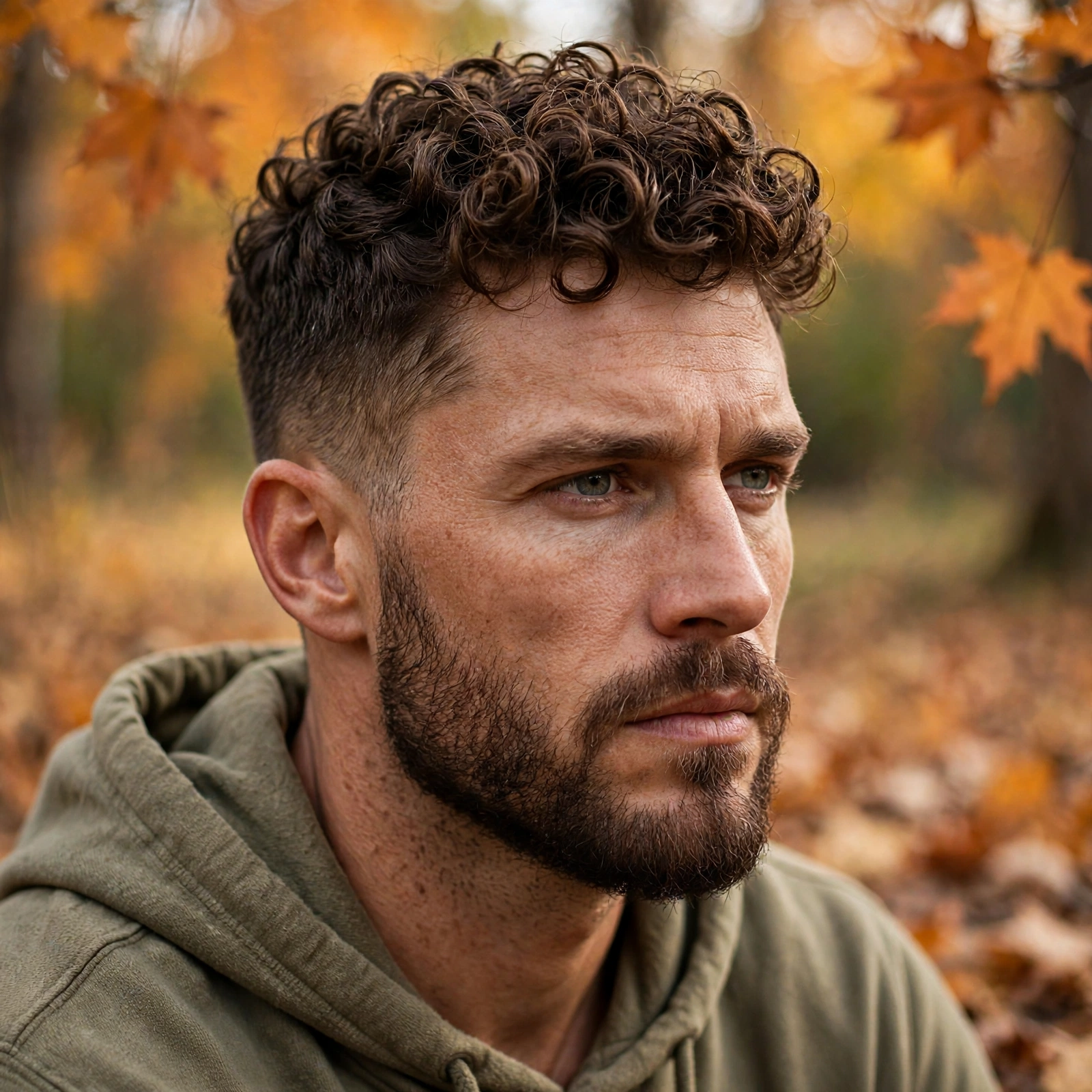
8. Curly Top with Beard Taper
Curls, contained and complemented. Two to four inches of defined curls on top with tapered sides that flow down into a medium beard — the taper keeps the silhouette narrow while the curls supply all the rugged texture for free. This is the cut curly-haired guys deserve: instead of fighting the curl pattern flat or cropping it into submission, it treats the curls as the feature and builds the architecture around them. It’s rising fast in 2026 as more guys embrace natural texture, and the taper-into-beard transition is what elevates it from casual to crafted. Our editors found the styling routine is genuinely the simplest of any textured cut here, because the curl pattern does what product does for everyone else.
How to get it: Tell your barber: “Curls on top — two to four inches, shape them, don’t thin into frizz — taper on the sides flowing into the beard.” Critical: cut curls dry or stretched to true length, since wet-cut curls spring up shorter than expected. At home: curl cream into damp hair, scrunch, air-dry or diffuse low. Keep the beard medium and oiled — dry frizz next to defined curls undermines the whole look.
Best for: Naturally curly to coily hair — the curlier, the better this works; round faces benefit from the height; all face shapes work since the taper keeps the sides controlled. Guys whose curls they’ve been hiding under short cuts — this is your permission slip.
Maintenance: Medium. Five minutes of scrunch-and-go; shampoo 2–3 times a week max — overwashing strips the oils curls need. Refresh non-wash days with a water mist and dab of cream. Barber every 4–6 weeks.
Pro tip: Sleep on a satin or silk pillowcase — cotton roughs up the curl cuticle overnight, which is why curls wake up frizzy. Our editors found the satin switch cuts morning restyling in half. And never brush curly hair dry: wide-tooth comb on wet, conditioned hair only. A dry brush turns defined curls into a halo of frizz in seconds.
%
%
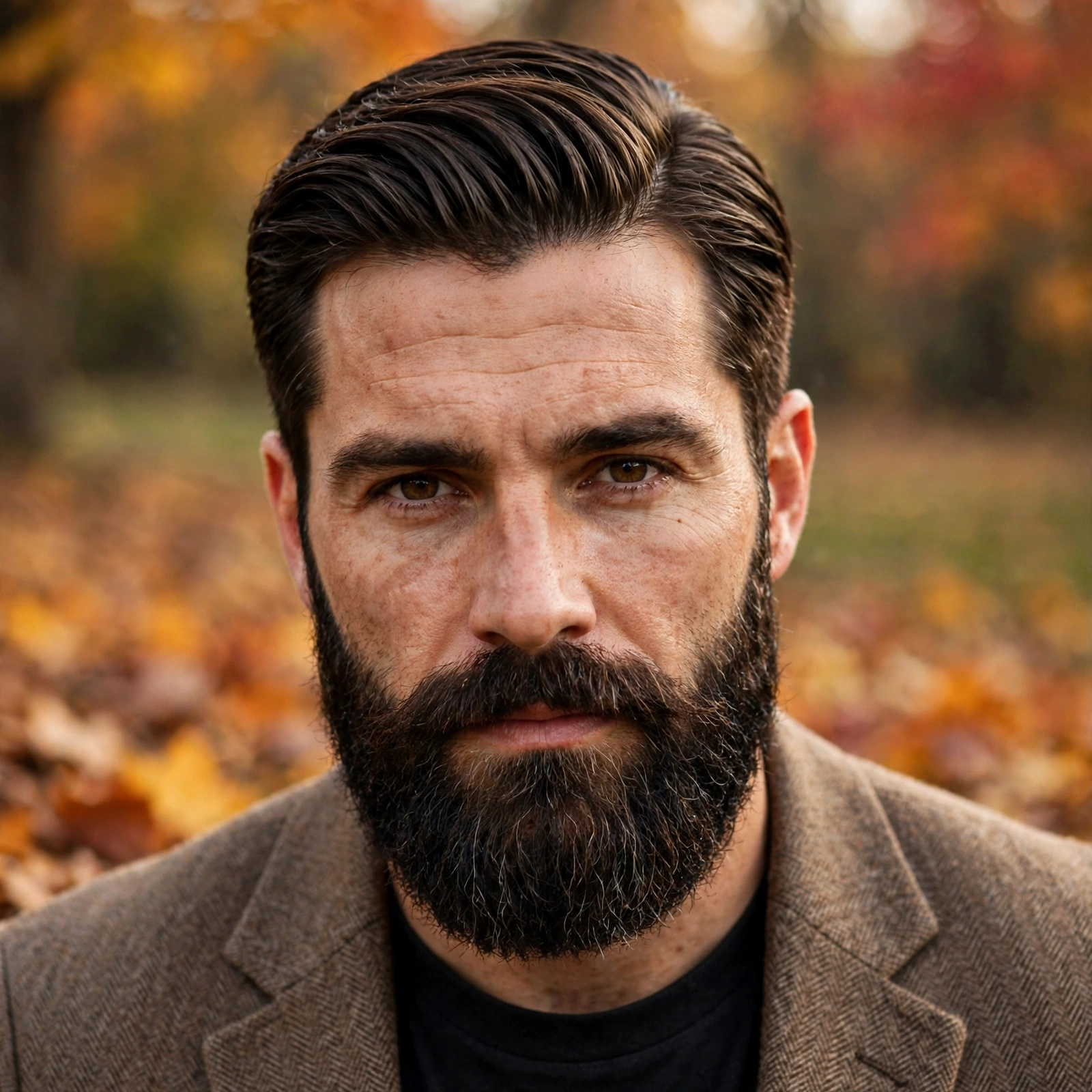
9. Side Part with Corporate Beard
Rugged goes to the office. A neat side part — two to three inches on top with clean tapered sides — paired with a short, immaculate corporate beard: full coverage, sharp lines, modest length. This is the most workplace-friendly beard and hair combo on the list, and it proves the central thesis that rugged and professional aren’t opposites — they’re a calibration. The haircut shows discipline; the beard shows personality; together they read as a man who’s serious but not sterile. Our editors found it’s also the most “promotable” look here — the one that photographs well for the company headshot and still looks great at the bar after.
How to get it: Tell your barber: “Classic side part — two to three inches on top, tapered sides, defined part — and a corporate beard: short, full coverage, everything sharp.” Have the part cut in, not just combed in, so it holds. Beard stays one short uniform guard length with crisp lines. At home: part damp hair, work light pomade through, comb to the side. Keep a pocket comb — a ten-second midday recomb keeps the part razor-sharp.
Best for: Straight to wavy hair that holds a part; all face shapes (the side part is universally flattering); conservative or client-facing workplaces; guys with full but not extreme beard growth — you need coverage, not length.
Maintenance: Medium. Five minutes each morning; edge the beard lines every 2–3 days — a corporate beard shows growth immediately. Barber every 3–4 weeks, no stretching appointments.
Pro tip: The difference between a side part that lasts and one that collapses by lunch is placement relative to your natural crown growth. Ask your barber to find your hair’s natural parting point — fighting the growth pattern means fighting your hair all day. Part with the grain and the style practically holds itself.
%
%
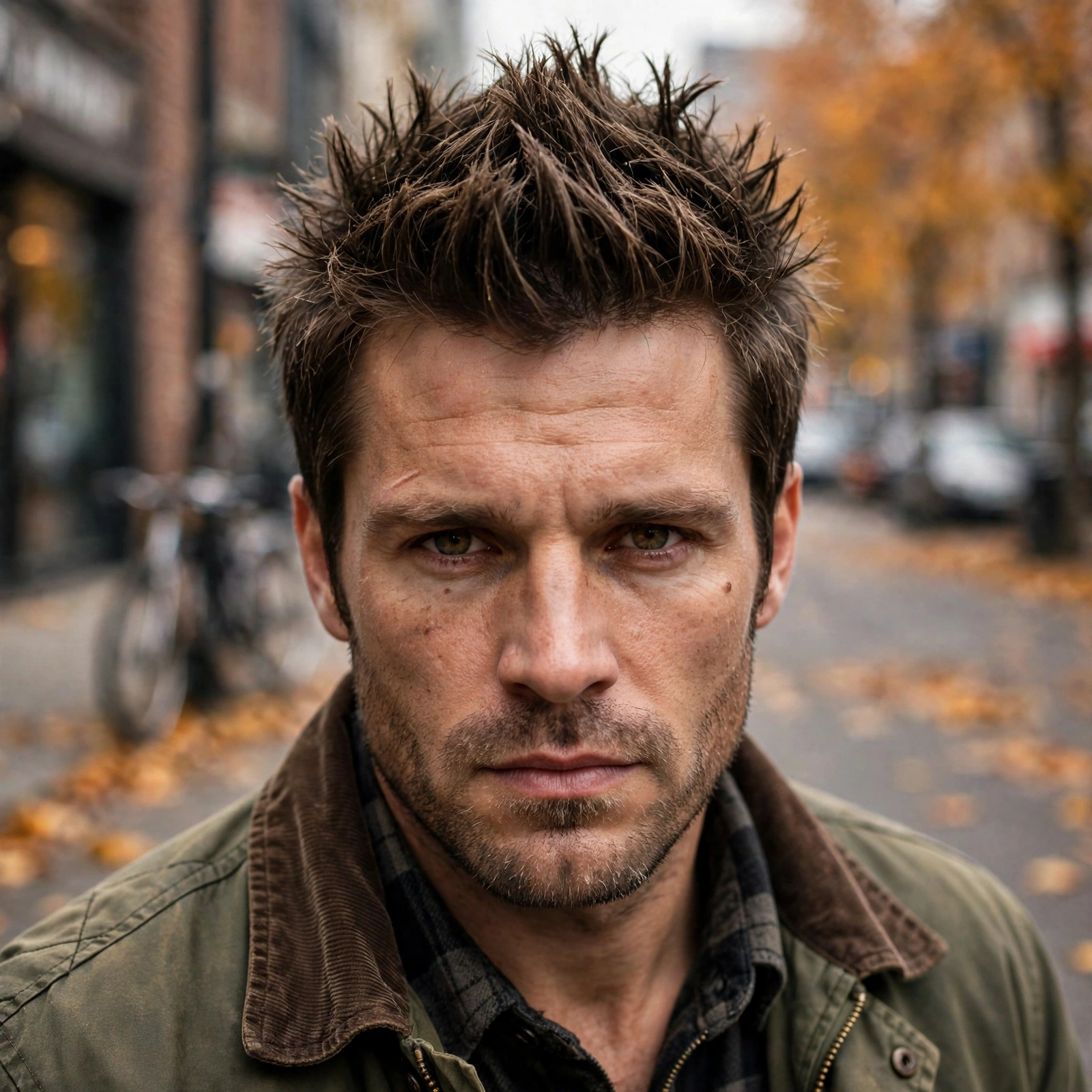
10. Faux Hawk with Stubble
Controlled wildness — the edgiest pairing on this list. A textured center strip styled upward with faded sides, paired with heavy stubble rather than a full beard. That stubble choice is deliberate and important: a full beard would push this into shaggy territory, while the stubble keeps it lean, angular, and aggressive. It’s all lines and attitude — the center strip draws the eye up, the fade sharpens the sides, the stubble textures the jaw. In 2026 the faux hawk has settled into its mature form: less punk-costume, more precision-cut, worn by guys who’ve outgrown the mohawk but kept the edge. Our editors found it’s the biggest personality-per-minute cut here: it announces itself before you say a word.
How to get it: Tell your barber: “Faux hawk — textured length through the center, mid fade on the sides — heavy stubble, not a full beard.” Center strip runs two to three inches with heavy texture; sides fade #1–#2 into the strip. Stubble at 4–5mm with sharp edges. At home: strong matte clay through dry hair, center strip pushed up and slightly forward, sections pinched for definition. Keep the sides flat — puffed-out sides collapse the silhouette.
Best for: Thick, straight to wavy hair that stands up willingly; oval and square faces (the upward strip elongates); confident dressers — this cut doesn’t do subtle. Fine or very curly hair struggles to hold the strip’s structure.
Maintenance: Medium. Eight to ten minutes each morning — no wash-and-go version exists. Stubble trimmed every 3–4 days; barber every 3–4 weeks.
Pro tip: Style the strip in small sections — pinch and push each one-inch section upward individually for real separation instead of one solid fin. And the detail most guys miss: warm a tiny amount of clay between your palms and apply to the roots first. That’s what gives the strip stand-up power; product on the ends alone just makes it floppy.
%
%
Rugged Fall Hairstyles for Men: FAQs
How long should my beard be to pair with these haircuts?
Match the beard’s visual weight to the haircut’s volume. Big, voluminous tops (messy quiff, bro flow, faux hawk) need a beard with real presence — full growth or heavy stubble. Shorter, tighter cuts (textured crop, buzz, French crop) pair best with heavy stubble or short boxed beards; 4–5mm is the sweet spot. The medium cuts (short waves, curly top, side part) are flexible either way. When in doubt, remember the transition matters more than the length — a well-blended short beard beats a disconnected long one every time.
I’m growing my hair out for a longer style — how do I survive the awkward phase?
The awkward phase is real — roughly 6–10 weeks where the top is too long to behave but too short to flow. Three survival tactics: texture product (salt spray and matte paste make in-between lengths look intentional), strategic hat use on bad days (a beanie over growing hair is legitimate in fall), and the big one — tell your barber “ends only, keep the length” at every visit. Don’t let him “clean up the sides” into a reset; the sides need to grow too. Push through — the other side is worth it.
What’s the actual difference between rugged and just messy?
About ten minutes and three details. Rugged is messy with intention: texture cut in on purpose (not just grown out), clean lines at the beard’s neck and cheeks, and product giving the hair deliberate separation. Messy is all three skipped. The diagnostic: look at the edges. Clean neckline, defined cheek line, intentional texture — that’s rugged. Overgrown neckline, beard down the throat, shapeless hair — that’s unkempt. Nobody can tell whether you spent ten minutes or zero on the interior, but everyone sees the edges.
Which of these styles actually survive beanie season?
Shorter textured tops win hat season: the textured crop (#1), buzz (#4), and French crop (#7) slide under a beanie and come out looking the same — texture benefits from compression. For the quiff or faux hawk, wear the beanie slightly back so it doesn’t crush the front lift, then finger-style after removal. The bro flow (#6) is trickiest — choose a looser knit and flip your head upside down and shake once when the hat comes off. Universal rules: the hat goes on over dry, styled hair (damp hair plus beanie equals disaster), and keep a travel-size matte paste in your pocket for the post-hat revival. Beards are completely hat-proof.
How do I keep a rugged style looking intentional instead of unkempt as it grows out?
Grow-out is where rugged styles go to die, so you need a maintenance rhythm, not just a haircut. Between visits: edge the beard’s cheek lines and neckline every few days (a $30 detail trimmer pays for itself in a month), keep beard oil daily so growth looks conditioned, not wiry, and don’t skip texture product as hair gets longer — long hair without product looks accidental. Book the next appointment before you leave the shop. And learn the warning signs: fade going soft, neckline creeping, texture ignoring product — that’s the appointment talking. Listen to it.
The Bottom Line
The best rugged fall hairstyles for men aren’t the wildest ones — they’re the ones where the texture looks deliberate, the beard looks shaped, and the two connect like they were designed together. Pick the cut that matches your beard reality and your actual mornings, and give it a genuine month. This is the season your hair was made for — wear it like it.