10 Professional Fall Haircuts for Men (Office-Ready)
Your haircut is part of your professional uniform — before you say a word in a meeting, it has already been noticed. If you’re looking for professional fall haircuts for men that hold up through real workdays, here is the direct answer: the best professional fall haircuts for men in 2026 are the classic taper, the side part with low fade, and the Ivy League — sharp at 8 AM, still sharp at 6 PM, and safe for every office from finance to tech. This isn’t about chasing trends for trend’s sake. It is about cuts that look deliberate every single day, without a twenty-minute morning production.
Fall is the best season for office hair, full stop. Summer’s humidity is gone, so styles stop wilting by lunch and one product actually lasts the whole day. And the dress code sharpens up with the weather — a clean cut under a sharp coat is one of the most put-together looks a man can wear.
The defining theme of professional men’s hair trends fall 2026 is control without stiffness. The fades are lower and softer than the aggressive skin fades of a few years ago. The finishes are matte, not glossy. The top lengths are a touch longer, which means the hair moves naturally instead of sitting like a helmet. In short, the modern office cut looks less “fresh off the clippers” and more quietly expensive — like a good suit rather than a loud one.
That shift is good news no matter where you work. Whether you are hunting for business haircuts for men 2026 that survive a conservative dress code or you just want something that reads competent on a video call, the through-line is the same: neat edges, intentional shape, and nothing fighting for attention. A professional cut doesn’t need to be boring — it needs to be consistent. The best office hair is the kind colleagues stop noticing because it always looks right.
What makes this guide different from every other listicle: every cut below comes with the full working picture. Not just what it looks like, but exactly what to tell your barber (the actual script, including guard numbers and scissor work), how to style it at home, who it flatters most, honest maintenance expectations (morning minutes plus barber frequency), and a pro tip our editors picked up that you won’t find in a caption. No fluff — just the ten sharpest office hairstyles for men this fall, decoded.
Below, we’ve rounded up the ten most wearable professional cuts of the season. Find the one that matches your office, your face, and your mornings — then book the chair with confidence.
Table of Contents
- Classic Taper
- Side Part with Low Fade
- Ivy League
- Neat Comb-Over
- Textured Crop (Conservative Length)
- Slicked-Back with Taper
- Short Quiff, Controlled
- Buzz Cut with Tapered Neckline
- Side-Swept Crew Cut
- Classic Scissor Cut
Editor’s Top 5 Professional Picks for Fall 2026
Short on time? These are the five cuts our editors keep recommending this season — the highest polish-to-effort ratio on the entire list, and the safest bets for any professional setting.
1. Classic Taper
The professional’s default for a reason. It suits every face shape, every hair type, and every office on the planet — and it grows out better than any fade, which means fewer barber visits. If you only ever get one haircut, make it this one.
2. Side Part with Low Fade
Boardroom polish with a modern edge. The side part says tradition; the low fade says you’re current. This is the 2026 update to the classic executive cut, and it flatters oval and square faces beautifully.
3. Ivy League
The safest interview haircut in existence. About an inch on top, tapered sides, neat by construction — it needs virtually no styling and reads competent everywhere. For men who want hair to be a solved problem, this is the answer.
4. Neat Comb-Over
Deliberate and distinguished — the modern textured sweep, not a cover-up. With a mid fade and matte clay, it gives men with thinning crowns honest, confident coverage that reads professional, not desperate.
5. Textured Crop (Conservative Length)
The creative-office sweet spot. Short choppy texture on top reads contemporary while staying completely workplace-appropriate. It’s the most fashion-forward cut on this list that still passes the boardroom test.
What Makes a Fall Haircut Office-Ready?
Office-ready hair follows three rules: neatness, restraint, and consistency — and fall is the season where all three get easier. Neatness means clean edges: a defined neckline, tidy sideburns, no stray growth creeping over the ears. Here is the part most men miss — the perimeter matters more than the cut itself. Even the most fashion-forward crop looks professional when the neckline and sideburns are sharp, and even the most classic taper looks sloppy when they aren’t. We found that cleaning just the neckline at the three-week mark (your barber will often do it free between cuts) buys you an extra week of sharpness.
Restraint is about the cut’s statement level, and it is the rule that actually differs by workplace. In conservative fields — finance, law, government, client-facing consulting — the classics win: side parts, tapers, neat comb-overs, Ivy Leagues. In tech, media, design, and startups, you have room for texture, higher fades, and modern crops. The practical move when you are unsure: look at what the people two levels above you wear on their heads. That is the real dress code, not the handbook.
Consistency means the cut performs every day without heroics. Office hair cannot depend on a twenty-minute routine or perfect humidity — it has to survive the commute, the office air conditioning, and the 4 PM slump. Choose cuts that look acceptable air-dried and need one product at most. Here is the honest test: if your cut only looks good for the first three days after the barber, it is not an office cut, it is a photoshoot cut. Tapers and scissor cuts pass this test easily; skin fades, which show grow-out almost immediately, do not.
Then there is the finish rule, which is the fastest way to read a cut as professional or not: matte beats shiny in daylight. A light pomade sheen can work in the evening, but under office fluorescents, high gloss reads more nightclub than boardroom. Fall 2026’s trend toward matte clays and natural-finish creams actually does you a favor here — the products that make these cuts work are the same ones that photograph well and stay understated in meetings.
Finally, plan around the grow-out, not just the fresh cut. Every haircut has two lives: week one, and weeks three through six. Before you commit to a style, ask yourself what it looks like at week four — because that is when you will be wearing it most. Cuts with soft transitions (tapers, scissor blends) age gracefully; cuts with hard lines (skin fades, blocked necklines) demand discipline every two to three weeks. The best professional haircut is the one you will actually maintain on a tired Tuesday in week five, not just on photo day in week one.
How to Choose the Right Fall Haircut for the Office
Start with your industry’s code, then filter by what grows out of your head. Face shape guides the specifics: square faces suit side parts and crops that add a bit of top volume to balance the jaw; round faces need height — a controlled quiff or textured top elongates; oval faces have the most freedom and can wear almost anything on this list; longer faces should keep the sides slightly fuller and avoid excessive height on top, which stretches things further.
Be honest about your hair type, because the wrong cut for your texture is a daily fight you will lose. Thick, straight hair holds structure beautifully (slicked-back, quiff) but can look bulky in crops unless the barber thins it properly. Fine hair needs shorter sides and texture on top to fake density — the comb-over and textured crop are built for this. Wavy hair is the easiest of all: it adds free texture to tapers, Ivy Leagues, and scissor cuts with almost no product.
Now audit your mornings ruthlessly. If you leave at 7 AM with no time to spare, your list is short: Ivy League, buzz with taper, neat crew cut — towel-dry, dab of product, done. If you have ten minutes, side parts, comb-overs, and slicked-back styles reward the effort handsomely. The best office cut is the one you will actually execute on a morning when you overslept — so choose the cut for your worst morning, not your best one.
Think about the long game: the barber cadence is part of the cut’s true cost. A skin fade every two weeks is roughly twenty-six appointments a year; a taper every five to six weeks is about nine. If you know you are a “stretch the appointment” person, choose cuts that grow out gracefully (taper, scissor cut, Ivy League) rather than cuts that punish you for skipping (high fades, blocked necklines). A grown-out sharp cut always beats a neglected edgy one, and your colleagues will notice the consistency more than the style.
Last, factor in the season itself. Fall means beanies and hats, which flatten volume and create the dreaded hat line. Lower-lying styles (taper, comb-over, crew cut) survive hats far better than tall quiffs and slicked-back volume. Pack a travel comb for post-hat rescue.
10 Professional Fall Haircuts for Men (Office-Ready for 2026)
1. Classic Taper
The undisputed professional standard. Hair graduates subtly shorter down the sides and back — no harsh lines, just clean progression — with 1–3 inches left on top. It is trending again for fall 2026 because the office mood has shifted toward quiet luxury: understated, expensive-looking, zero flash. The vibe is the reliable senior colleague — the man whose hair you never think about because it is always right. Boardrooms, client dinners, interviews, wedding guest duty — this cut has no wrong occasion, and that is exactly its superpower.
How to get it: Tell your barber: “Classic taper, scissor cut, neat — gradual blend on the sides, about two inches on top.” Ask for the sides tapered with scissors (not clippers) for the softest transition, a natural tapered neckline rather than a blocked one, and sideburns cleaned to mid-ear. At home, towel-dry, work a pea-sized amount of cream through from roots to ends, and comb through once — no blow-dryer needed. The whole routine is three minutes.
Best for: Every face shape (oval, round, square, oblong — the taper adapts to all); all hair types and textures, from fine to thick; straight to wavy hair especially. If you are unsure what suits you, this is the default answer.
Maintenance: Low. Three minutes each morning, no heat. Barber visits every 5–6 weeks — the taper grows out more gracefully than any fade, so you can stretch appointments without looking shaggy.
Pro tip: Emulsify your product until it disappears. Rub a pea-sized amount of something like American Crew Fiber between your palms until you can barely see it, then apply — this is the difference between natural hold and a greasy-looking scalp. And always ask for the tapered (not blocked) neckline; a blocked neckline grows into a hard shelf in two weeks, while a taper dissolves cleanly.
%

%
2. Side Part with Low Fade
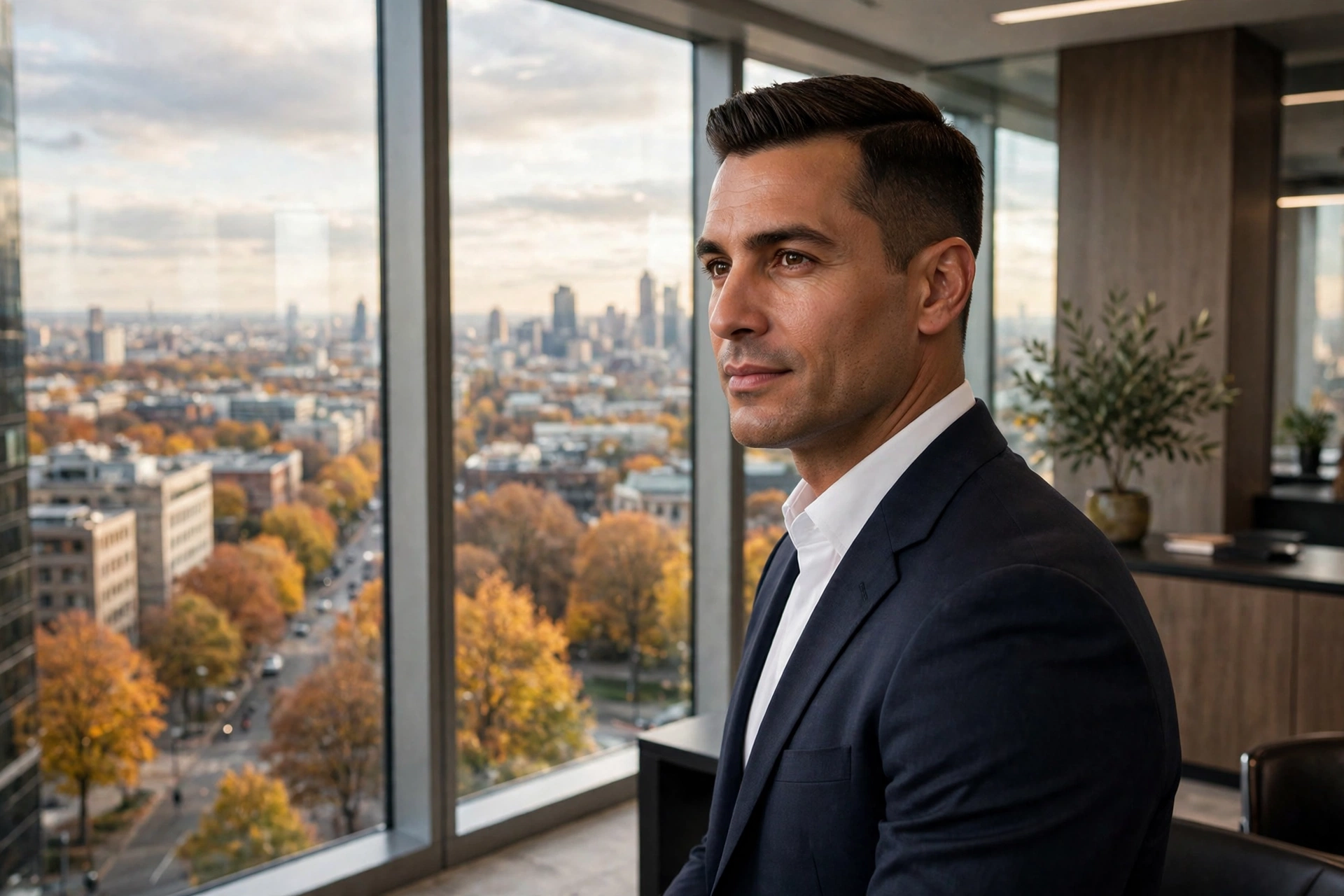
Tradition, sharpened. The side part brings timeless polish; the low fade — starting just above the ear and staying conservative — adds a contemporary edge without going overboard. It photographs like the old power cuts while feeling current. The vibe is the sharp young partner: confident, current, and completely at home in a suit. It moves from the boardroom to the client dinner to the after-work drink without a single adjustment, and it has enough personality to keep you from looking interchangeable.
How to get it: Tell your barber: “Side part, low fade, professional — find my natural part first.” Have the barber locate where your hair naturally splits before cutting (forcing a part where the hair doesn’t want to go is a daily war). Ask for a low fade blended up to about a #2, with 2–3 inches on top and the part cut slightly shorter on the heavy side so it lies flat. At home: blow-dry the top in the part’s direction for two minutes — this trains the hair and does half the styling work — then work a dime-sized amount of light pomade through and comb into place.
Best for: Oval, square, and oblong faces; straight to wavy textures; fine to medium hair (the short sides make fine hair look denser by contrast). Men with a natural side part get this cut nearly for free.
Maintenance: Medium. Seven to ten minutes in the morning, mostly the quick blow-dry. Barber visits every 3–4 weeks — the fade’s grow-out line is the limiting factor, so don’t stretch this one.
Pro tip: Train the part for two weeks and it becomes permanent-ish. Comb it the same way every morning (a little water helps), and the hair learns — after that, it falls into place with almost no effort. For the finish, a matte option like Suavecito Matte Pomade gives that executive satin look without the wet shine that reads after-hours.
%

%
3. Ivy League
The low-effort professional: about an inch on top, tapered sides, swept to the side or pushed forward — neat by construction rather than by styling. It is the safest interview haircut in existence, and for fall 2026 it is having a quiet resurgence as men trade high-maintenance trends for cuts that simply work. The vibe is the capable new hire who has everything under control — including his mornings, which take about ninety seconds.
How to get it: Tell your barber: “Ivy League, about an inch on top, tapered sides.” The top needs to be just long enough to side-sweep or push forward (roughly an inch to an inch and a half), the sides tapered down to a #2 or #3, and the front kept slightly longer so it doesn’t look like a buzz from the front. At home: towel-dry, tiny amount of cream, push with your fingers in the direction you want. That is genuinely the entire routine — no comb required, though one pass with a comb sharpens it up for big days.
Best for: All face shapes — this is the universal donor of haircuts; straight to wavy hair; fine to medium density (short all over means no thin spots to hide). Ideal for job interviews, first weeks, and conservative offices.
Maintenance: Low. Under two minutes each morning, no heat, minimal product. Barber visits every 3–4 weeks — the cut’s whole point is its precise shape, so keep the schedule tight.
Pro tip: Use less product than you think, and make it matte. A fingertip of Baxter of California Clay Pomade gives the top just enough control without the “done” look that cream-heavy styling creates — the Ivy League should look like you barely touched it. If your hair is wavy, let the natural texture do the work and skip the comb on casual days.
%

%
4. Neat Comb-Over
Distinguished, not desperate. The modern comb-over is a deliberate textured sweep — 2–3 inches on top with a mid fade and real texture cut into it — which is a completely different animal from the sad, flat comb-overs of decades past. It is on this list because it solves a real problem honestly: it gives men with thinning crowns coverage that looks intentional and confident rather than hidden. The vibe is the experienced executive: self-assured, unhurried, and completely comfortable in his own skin.
How to get it: Tell your barber: “Textured comb-over, mid fade — keep length on top for the sweep.” Ask for 2–3 inches on top with point-cut texture (this creates the piece-y separation that makes thin hair look thicker), a mid fade on the sides for contrast, and the top layered enough to sweep without lying flat. At home: apply a volumizing pre-styler to damp hair, blow-dry up and across in the sweep direction to build root lift (two minutes), then work matte clay through and sweep with your fingers. Never comb it flat against the scalp — lift is what makes it modern.
Best for: Men with thinning crowns or receding hairlines who want honest coverage; round and square faces; straight to wavy textures; fine to medium density. Also great for anyone whose hairline is retreating but not gone.
Maintenance: Medium. Eight to twelve minutes in the morning — the blow-dry step is non-negotiable for the lift. Barber visits every 3–4 weeks to keep the fade crisp.
Pro tip: The pre-styler matters more than the finisher here. A volumizing product like Hanz de Fuko Quicksand on damp hair gives fine hair the grip and body that clay alone can’t — then the clay just locks in what the blow-dry built. And the hard rule: if the top can’t cover the crown with lift, go shorter (see #8) rather than longer. Confidence always beats coverage.
%

%
5. Textured Crop (Conservative Length)
Modern but meeting-ready. The top is short and choppy — 1–1.5 inches of point-cut texture — with a clean, straight fringe line and sides kept neat via a mid fade or taper. It is the creative-office sweet spot of fall 2026: contemporary enough to show you have taste, restrained enough that no HR department will ever notice. The vibe is the sharp creative lead: modern, intentional, and completely comfortable in a blazer. Tech, media, design, startups — and honestly, most offices that aren’t pinstripe-strict.
How to get it: Tell your barber: “Textured crop, keep it office-appropriate — mid fade, clean fringe line.” The key details: the top point-cut for texture (not razor-shattered, which goes too edgy), the fringe kept straight across and just above the brows (not jagged or asymmetric), and the fade no higher than mid. At home: work a small amount of matte paste through dry or nearly-dry hair, pinch and push the top forward and slightly up to define the texture. Two minutes, no tools.
Best for: Straight to wavy hair (the texture shows best); oval and heart-shaped faces; younger professionals and creative-leaning offices; men with thick hair who want it controlled but not severe.
Maintenance: Low to medium. About four minutes each morning. Barber visits every 4 weeks — the fringe line is the tell, so keep it trimmed before it hits the brows.
Pro tip: The fringe line is the entire difference between “creative professional” and “weekend.” Ask your barber to soften the fringe, not shatter it — one rowdy, jagged edge pushes the whole cut from boardroom-adjacent to off-duty. When styling, keep the fringe forward and flat rather than spiked up; height on a crop reads casual fast.
%

%
6. Slicked-Back with Taper
Quiet authority. The top — 3–4 inches — is swept straight back with medium-hold product for a smooth, controlled finish, while the sides are tapered (scissor-tapered, not faded to skin) for clean lines that keep it office-appropriate. This is the power cut of fall 2026, trending as the matte, natural version replaces the wet-look slick-backs of the past decade. The vibe is the composed decision-maker: confident, controlled, and clearly in charge of the details. Pair it with a blazer and you are the most put-together man in the room.
How to get it: Tell your barber: “Slicked back, tapered sides, professional finish — scissors on top, no skin fade.” Ask for 3–4 inches on top with enough layering to sweep back without bulk, sides tapered with scissors for a soft transition, and the back blended rather than squared off. At home: apply cream to damp hair, comb everything straight back while blow-drying back and slightly down (this sets the direction and kills the morning cowlick), then finish by running dry hands through once to break up any stiffness. Avoid high-gloss products — the 2026 version is matte-to-satin, never wet.
Best for: Thick, straight hair (the density holds the sweep); oval and square faces; men with the length to commit (this is a grow-out cut — don’t attempt it on two inches). Longer faces should keep the sweep lower to avoid adding height.
Maintenance: Medium. About eight minutes, including the blow-dry. Barber visits every 4–5 weeks — the scissor taper grows out softly, so this one is forgiving.
Pro tip: The product choice makes or breaks this cut. Reach for a light-hold cream like Reuzel Fiber Cream rather than a heavy pomade — you want control with movement, not a shell. And blow-dry it back at least roughly every morning; skip the dryer and the top collapses into a shapeless mop by noon, no matter how good the product is.
%

%
7. Short Quiff, Controlled
Energy, contained. A modest quiff — about two inches of textured lift at the front, tidy rather than towering — with tapered sides keeping everything professional. It is the cut for men who want a little personality in their professional image without raising a single eyebrow: the height adds presence and flatters the face, while the taper keeps the overall read firmly office. The vibe is the dynamic young manager: ambitious, polished, and not afraid of a little lift.
How to get it: Tell your barber: “Controlled quiff, not too high — about two inches up front, tapered sides.” Ask for 2–2.5 inches at the front graduating shorter toward the crown (this builds the lift naturally), sides tapered to a #2, and texture point-cut into the top so it doesn’t fall in one heavy sheet. At home: blow-dry the front up and back for ninety seconds — this is the step that creates the quiff; product alone won’t do it — then work matte clay through and push the front up and slightly back with your fingers. The sides get nothing; they should stay flat and clean.
Best for: Round faces (the height elongates beautifully); thick, straight to wavy hair that holds lift; confident professionals in creative-leaning or modern corporate offices. Fine hair can wear it with a volumizing pre-styler.
Maintenance: Medium. Seven to ten minutes, mostly the blow-dry. Barber visits every 4 weeks — once the front gets too long, the quiff flops instead of lifting.
Pro tip: The blow-dryer does eighty percent of the work here — the clay just locks in what the heat built. Dry the front upward against the direction it wants to fall, then set it back; that tension is what holds through the day. A matte clay like Uppercut Deluxe Matte Clay keeps the finish modern; anything shiny turns a controlled quiff into a 1950s costume.
%

%
8. Buzz Cut with Tapered Neckline
Minimalism as strategy. A uniform short cut — #2 to #3 all over — with a tapered (not blocked) neckline for a softer, more professional grow-out. Zero daily styling, zero decisions, and a read that is disciplined, confident, and increasingly common even in conservative offices. What makes this version office-ready rather than military is entirely in the details: the tapered neckline dissolves cleanly as it grows instead of forming a hard shelf, and the natural hairline is preserved rather than edged into geometric sharpness. The vibe is the no-nonsense operator: direct, disciplined, and done with fuss.
How to get it: Tell your barber: “Buzz, number 2 all over, tapered neckline — keep the hairline natural.” Specify the taper (scissor-blended) over a blocked neckline explicitly, and ask the barber not to carve the hairline into sharp corners — the natural edge reads professional, the carved one reads barracks. At home: nothing. Towel-dry and walk out. The one seasonal addition: fall’s dry air makes short cuts show scalp flakiness fast, so a light, fragrance-free moisturizer on the scalp two or three times a week keeps everything clean-looking.
Best for: Strong features and defined bone structure (short hair puts the face on display); receding hairlines — this is the most honest and confident answer to thinning; coarse or thick hair; active lifestyles and hard-hat or helmet work where longer styles get crushed.
Maintenance: Low daily, scheduled barbering. Zero morning styling — but book every 2–3 weeks, or learn to touch up the sides yourself with clippers between visits. The cut is cheap in time but not in frequency.
Pro tip: The tapered neckline is the whole difference — say it out loud at the chair, because many barbers default to blocking. A blocked neckline looks sharp for exactly ten days, then grows into a visible shelf that screams “overdue.” Also: in winter, switch to a moisturizing shampoo; flakes on a buzz cut are far more visible than on longer hair, and prevention takes ten seconds.
%

%
9. Side-Swept Crew Cut
The crew cut, grown up. Slightly longer than military — about an inch on top — swept to the side with tapered sides, it is the neat middle ground between a buzz and an Ivy League: structured but soft, short but not severe. A dab of cream gives it direction; without product it still looks tidy, which is the mark of a great office cut. The vibe is the dependable professional: neat, approachable, and never overthinking it. Completely office-safe in any industry, from trading floors to tech campuses.
How to get it: Tell your barber: “Longer crew, side-swept, tapered — about an inch on top.” Ask for the top left long enough to sweep (a true military crew is too short for this), the sides tapered to a #2 or #3, and the front edge kept soft rather than blunt. At home: towel-dry, fingertip of cream, sweep to your natural part with your fingers or one pass of a comb. Three minutes, no heat, and it survives hats and helmets better than almost any cut on this list.
Best for: Most face shapes — the sweep can be angled to flatter yours; fine to medium hair (short all over hides thin spots); men transitioning from military to civilian life; anyone who wants short hair that still has a little softness.
Maintenance: Low. About three minutes each morning, minimal product. Barber visits every 4 weeks to keep the shape before the top gets long enough to flop.
Pro tip: Find your natural sweep direction and never fight it — push damp hair around with your fingers once and see where it wants to go; that is your part, and the cut will style itself along it. For product, a natural-finish cream like Layrite Natural Matte Cream gives direction without stiffness; heavy waxes turn a crew cut into a helmet, which defeats the whole soft-structure point.
%

%
10. Classic Scissor Cut
The barber’s craft, no clippers on top. Everything cut with scissors for a soft, natural finish — 2–3 inches on top, blended sides, no harsh fade lines anywhere. It grows out more gracefully than any cut on this list, easily stretching six weeks between visits, because there are no lines to outgrow — just shape that softens. For fall 2026 it is the connoisseur’s choice: understated, versatile, and quietly luxurious, the haircut equivalent of a well-made unstructured blazer. The vibe is the seasoned professional who has nothing to prove: calm, credible, and effortlessly put-together.
How to get it: Tell your barber: “All-scissor cut, natural finish, professional — about two to three inches on top, blended sides.” Ask for the sides cut with scissors (not clippers) for the softest transition, subtle layering through the crown for movement, and the neckline tapered naturally. At home: apply cream to towel-dried hair and finger-style — literally push it into place with your hands for a natural fall. No comb, no dryer needed on most days; a quick blow-dry adds polish for big meetings.
Best for: Medium to thick straight or wavy hair (the natural finish shows texture best); oval and oblong faces; men who dislike frequent barber visits; anyone whose office rewards understatement over edge.
Maintenance: Low. About four minutes each morning, one product. Barber visits every 5–6 weeks — the softest grow-out of any professional cut here.
Pro tip: Vet the barber before you sit down. Ask: “Do you cut the sides with scissors or clippers?” — the answer tells you instantly whether they can actually do this cut. Many clipper-first barbers will say yes to anything; a true scissor cut needs a barber who reaches for shears by default. It is the one cut on this list where the barber’s skill matters more than the style’s name.
%

%
Professional Fall Haircuts for Men: FAQs
My office is strict — finance/law conservative. Which cuts are actually safe?
Stick to the classics: the classic taper (#1), the Ivy League (#3), and the classic scissor cut (#10) are bulletproof in any conservative environment. Keep fades low or scissor-tapered rather than skin, keep the finish matte, and keep the neckline natural rather than carved. The rule of thumb: if the cut would look out of place in a 1995 boardroom photo, it is too edgy for a strict office in 2026.
How do I stretch time between barber visits without looking shaggy?
Choose your cut for its week-four look, not its week-one look. Tapers and scissor cuts (#1, #10) age the most gracefully and comfortably go 5–6 weeks. The practical hack: at the three-week mark, have your barber clean up just the neckline and sideburns — many shops do this free or cheap between full cuts, and it buys you an extra week of sharpness.
I’m thinning on top — what actually works in a professional setting?
Shorter is kinder than longer, and honesty beats camouflage every time. The neat comb-over (#4) done right — textured, matte, with lift — gives genuine coverage that reads confident. The buzz with tapered neckline (#8) is the most honest answer and increasingly respected in professional settings; it reads disciplined, not defeated. What fails: growing the top long to drape over thin spots, which everyone sees through, and glossy products, which make scalps shine through.
How do I survive hat and beanie season without hat hair?
Lower-lying cuts win hat season: tapers, comb-overs, crew cuts (#1, #4, #9) slide under a beanie and recover with a shake. Tall styles like the quiff (#7) and slicked-back volume (#6) will get crushed — on heavy hat days, either embrace the flattening or switch to a lower style that week. Three practical tricks: choose a beanie that fits snug but not tight (compression is what kills volume), run your fingers through your hair — never a brush — when the hat comes off, and keep a travel comb plus a tiny tin of matte paste in your bag for the post-commute reset.
I have a job interview — what should my hair look like on the day?
Get the cut three to five days before the interview, never the day before — a fresh cut needs a few days to settle into its natural look, and day-one sharpness can read stiff on camera and in person. Choose the most conservative cut on this list that still suits you: the Ivy League (#3) is the safest interview haircut in existence, followed by the classic taper (#1). On the day itself: clean neckline, matte finish, nothing new — no experimental product, no unfamiliar styling.
The Bottom Line
The right professional fall haircuts for men don’t demand your mornings — they quietly handle them. Pick the cut that matches your office code, your face, and your real routine; keep the edges clean and the finish matte; and let this be the season your hair becomes one less thing to think about. Sharp, consistent, done.