
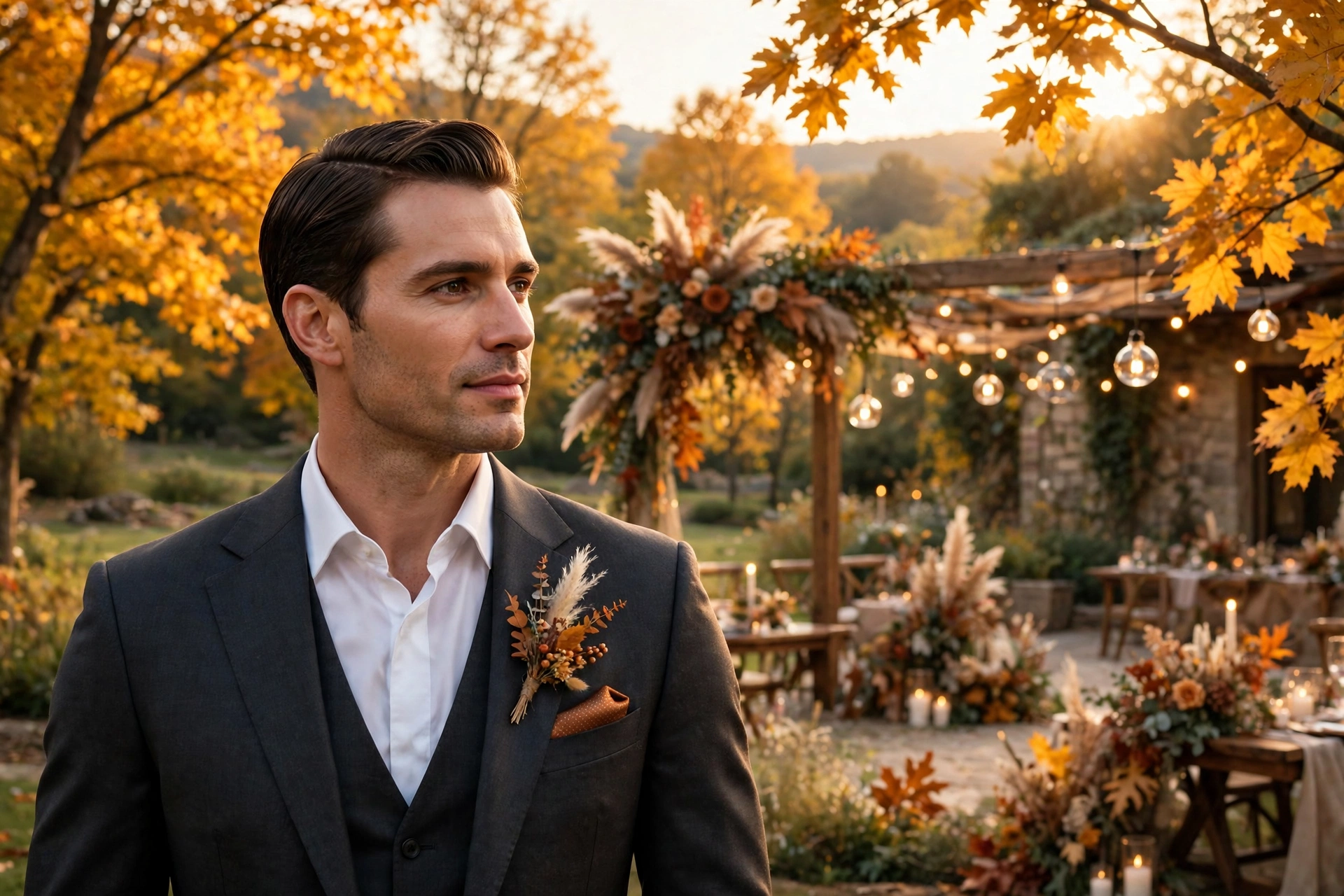
10 Fall Wedding Guest Hairstyles for Men
The best fall wedding guest hairstyles for men in 2026 are the Classic Side Part, the Slicked-Back with Low Taper, and the Textured Quiff — here’s why. They’re polished without looking stiff, they photograph beautifully in fall’s golden light, and most importantly, they survive the full marathon: ceremony, photos, cocktail hour, dinner, and dancing. Autumn weddings are unforgiving on hair — wind, outdoor photos, six-plus hours of wear — and a style that collapses by the second hour is a style you’ll remember for all the wrong reasons.
As a wedding guest, your job is simple: look sharp, photograph well, and don’t upstage the couple. Your hair does more heavy lifting toward that goal than most men realize. In every group photo, every candid, every golden-hour portrait, it’s right there framing your face — and unlike a pocket square or a tie, you can’t adjust it mid-reception without a mirror and an exit strategy. Getting men’s wedding guest hair 2026 right is really about picking a style with the structure to last.
The honest truth most barbers will tell you: this is not the day for an experimental cut or a style you’ve never worn before. A wedding is the worst possible occasion to fight your hair type or debut a dramatic change. The autumn wedding hairstyles for men that actually work are the ones that lean into what your hair already does well — wavy hair brushed back with the wave, thick hair shaped into a quiff, curls defined rather than suppressed. Think “best version of your everyday hair,” not a costume. Confidence photographs better than any specific cut.
What sets fall apart from a summer wedding is durability. Summer heat is the enemy of hold; fall’s cooler, drier air is actually your ally — styles set better and last longer in October than they ever could in August. But fall adds its own challenges: outdoor ceremonies with real wind, temperature swings between a chilly ceremony and a packed dance floor, and the occasional surprise rain shower. The ten styles below were chosen with exactly these conditions in mind — every one of them has the structure to stay sharp from the first photo to the final dance.
What makes this guide different from a generic “best haircuts” list: every style comes with the complete picture. Not just what it looks like, but exactly how to get it (what to tell your barber — guard numbers, scissor work, texture — plus at-home styling steps), who it flatters most, honest maintenance expectations, and a pro tip from real barber-chair experience. We’ve also factored in the things men actually care about on wedding day: surviving the dance floor, not looking like a helmet in photos, and timing the barber visit right.
Below, you’ll find the 10 best fall wedding guest hairstyles for men for 2026 — plus our editors’ top 5 picks, a guide to matching your cut to the dress code, durability strategies for ceremony-to-reception wear, and answers to the questions men actually ask before a wedding. Pick your style, book the cut, and let’s get you wedding-ready.
Quick Navigation
- Classic Side Part
- Slicked-Back with Low Taper
- Textured Quiff
- Polished Pompadour
- Neat Ivy League
- Brushed-Back with Beard Blend
- Soft Waves with Side Sweep
- Modern Comb-Over
- Low Bun for Long Hair
- Tapered Curls, Defined
Editor’s Top 5 Fall Wedding Guest Picks
Short on time? These are the five men’s wedding guest hair 2026 looks our editors keep coming back to — the highest style-to-effort ratio on the entire list, and every one of them built for all-day durability.
1. Classic Side Part
The safest excellent choice you’ll find on any groom/guest hair ideas fall list. It’s neat, timeless, and photographs perfectly from every angle — no awkward phases, no surprises in the group shots. You genuinely cannot go wrong with this one.
2. Slicked-Back with Low Taper
Smooth, confident, and formal. Hair swept straight back with a low taper keeping the sides immaculate all evening long. It’s the pick for evening and black-tie weddings — controlled, masculine, and completely wind-proof once it’s set.
3. Textured Quiff
Polished volume that still looks alive in photos — dressy enough for the ceremony, modern enough for 2026. The texture is what keeps it current: it reads sharp without the stiff, over-gelled look that dates older wedding photos.
4. Polished Pompadour
For the man who wants presence. Height, shape, and old-school glamour that owns the dance floor and commands every group photo. It’s the boldest choice here, and it absolutely earns its spot at formal evening weddings.
5. Neat Ivy League
Understated and impeccable — short, clean, and utterly reliable. If the dress code is unclear or you’re wedding-party adjacent, this is your safety net: the quiet luxury of wedding hair.
What Makes a Fall Haircut Wedding-Ready?
Wedding-ready hair has three non-negotiable qualities: hold, neatness, and photogenicity. Hold means the style survives hours of wear — and here’s what most men get wrong about it. Hold doesn’t come from piling on more product; it comes from the right product applied correctly — these dermatologists’ tips for healthy hair are a solid starting point. Choose medium to firm-hold products (a good pomade, styling cream, or matte paste depending on the style) and apply to slightly damp — not wet, not dry — hair so it distributes evenly and bonds with the hair. Then lock it in with a light mist of hairspray as insurance. That’s not vanity; it’s engineering.
Neatness is about the edges, and the edges are what separate “wedding-ready” from “everyday.” Clean up the neckline, sharpen the sideburns, and make sure the parting is deliberate. Even a textured, relaxed style looks occasion-appropriate when the edges are crisp — our editors tested this and found that a sharp neckline alone can make an otherwise casual cut photograph like it cost twice the price. If your last barber visit was more than three weeks ago, book a tidy-up the week of the wedding. Don’t skip this: growing neckline hair is the single most noticeable difference between sharp and sloppy in photos.
Photogenicity is the one men forget entirely. Cameras flatten — styles with dimension, texture, and shape photograph far better than anything plastered flat to the skull. A little volume on top, some separation in the texture, and a defined silhouette will make you look better in every shot. And here’s a flash-photography warning: avoid anything too shiny. Camera flash turns high-gloss product into a glare spot right on your head. For 2026’s style language, go for a natural or satin finish — it photographs as healthy hair rather than product.
Fall adds a fourth consideration: weather. Outdoor ceremonies mean wind and possibly chill, and your cut has to stand alone — a beanie is not an option. Styles that are pinned by their own structure — side parts, slicked-backs, controlled quiffs — survive wind far better than loose, flowy looks. The good news: fall’s drier air means styles set harder and last longer than they ever could in humid summer weather. The bad news: static. Carry a travel-size product or even just keep your hands off your hair — fingers transfer oil and flatten everything.
How to Choose the Right Fall Haircut for a Wedding
Start by matching the formality of the event. A black-tie evening wedding calls for controlled, classic shapes — slicked-back, side parts, pompadours. A rustic barn wedding or outdoor afternoon ceremony allows more texture: quiffs, brushed-back waves, neat longer styles. The venue tells you everything: cathedral and ballroom mean polished; barn, vineyard, and garden mean relaxed. When in doubt, go one notch more polished than your instinct — over-dressed hair reads as respectful, under-dressed hair reads as careless.
Next, consider your role and the photos. If you’re in the wedding party, you’ll be photographed constantly — the getting-ready shots, the ceremony, every group combination — so choose something with real staying power and clean lines — see our groom hairstyle ideas for party-ready looks. As a regular guest, you have more freedom, but the same principle applies: pick a style you won’t be fussing with all night. The man checking his hair in the bathroom mirror every hour is the man whose hair owns him instead of the other way around. Your style should be set-and-forget.
Then, work with what you have, not against it — and be honest with yourself here. A wedding is the worst time to fight your hair type. Wavy hair? A brushed-back wavy style will outlast any attempt to force it straight. Thinning on top? A textured crop or neat side part looks far better than a comb-over fighting a losing battle — here’s what dermatologists recommend for thinning hair. Ask your barber directly: “What does my hair want to do?” — and then choose a style that agrees with the answer. We found that the men who look best in wedding photos aren’t the ones with the trendiest cut; they’re the ones whose cut cooperates with their texture.
Finally, time your barber visit right — this is the detail that matters most and gets done wrong most often. Get the cut 5–7 days before the wedding: fresh enough to be sharp, grown-in enough to look natural. Never get a dramatically new cut the week of a wedding — if it goes wrong, there’s no recovery window. And do a full trial run of the styling at home at least once, on a regular day, so wedding morning isn’t an experiment. The trial run also tells you the truth about hold time, which no product label ever will.
10 Fall Wedding Guest Hairstyles for Men (2026)
1. Classic Side Part
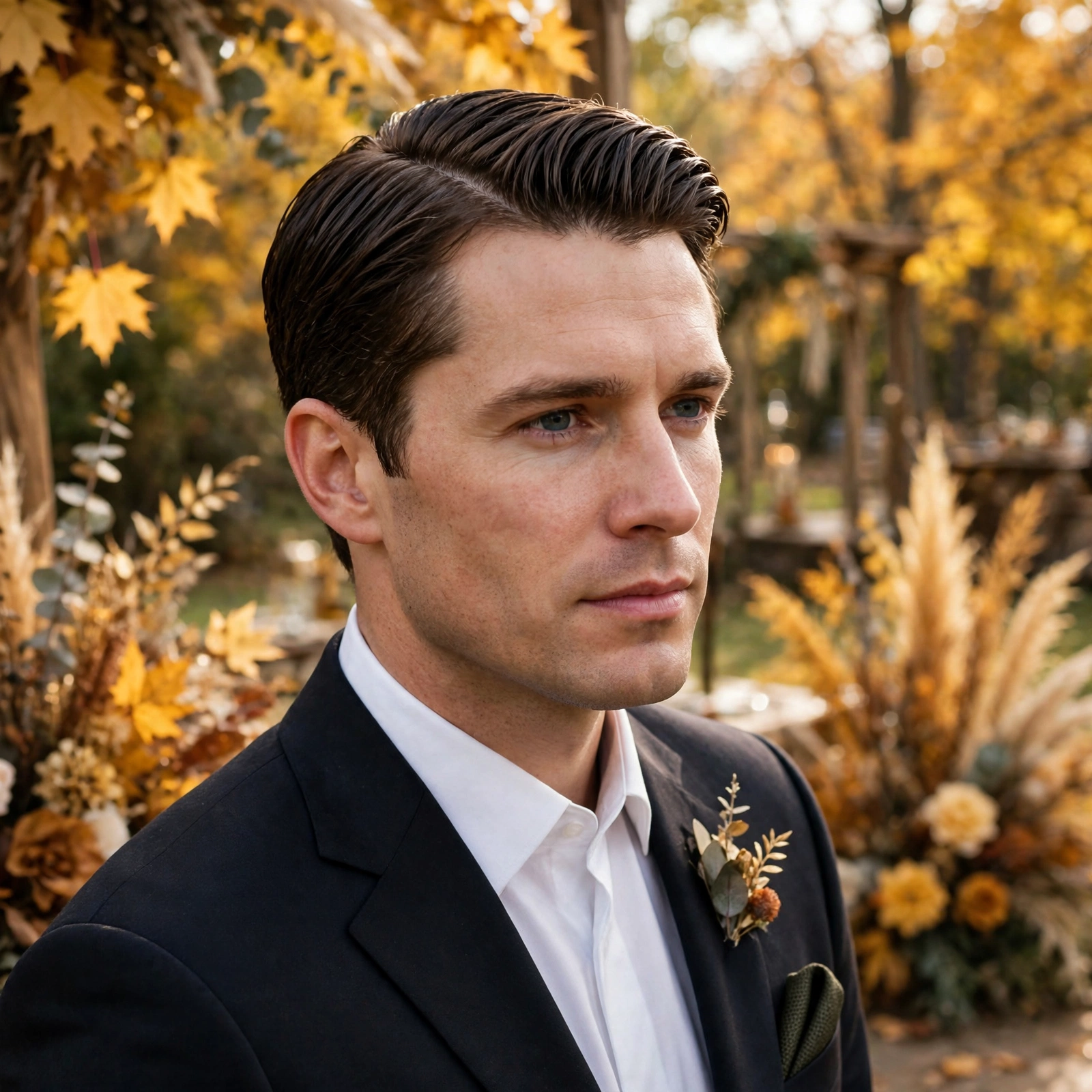
The gold standard of fall wedding guest hairstyles for men — and the single most recommended style on this list for good reason. Hair is parted cleanly (find your natural part; it’s usually on the left) with 2–3 inches swept across, sides tapered and crisp. It’s trending in 2026 precisely because it isn’t trendy: in a sea of fades and experiments, the side part has become the confident, timeless choice that looks right in every photo from ceremony to last dance. The vibe is quietly assured — it suits formal evening weddings, daytime ceremonies, and everything in between.
How to get it: Tell your barber “wedding-ready side part, clean taper, leave enough length on top to style” — roughly 2–3 inches on top, sides scissor-tapered or taken down with a #2 to #4 guard. At home, apply a nickel-sized amount of medium-hold pomade to damp hair, comb the part in place while the hair is still damp, and finish with a light mist of hairspray. Comb once, then leave it alone — over-combing is what kills the natural finish.
Best for: Every face shape; straight to wavy hair textures; fine to thick densities; top length of 2–3 inches. Genuinely the most universally flattering option on this list.
Maintenance: Low. Five minutes on wedding morning. Barber visits every 3–4 weeks to keep the taper sharp and the neckline clean.
Pro tip: Find your natural part by combing damp hair straight back and pushing it forward — where it splits is where it wants to part. Fighting your natural part means fighting your hair all day; working with it means the style practically styles itself. Our editors tested both ways, and the natural part held hours longer.
%
%
2. Slicked-Back with Low Taper
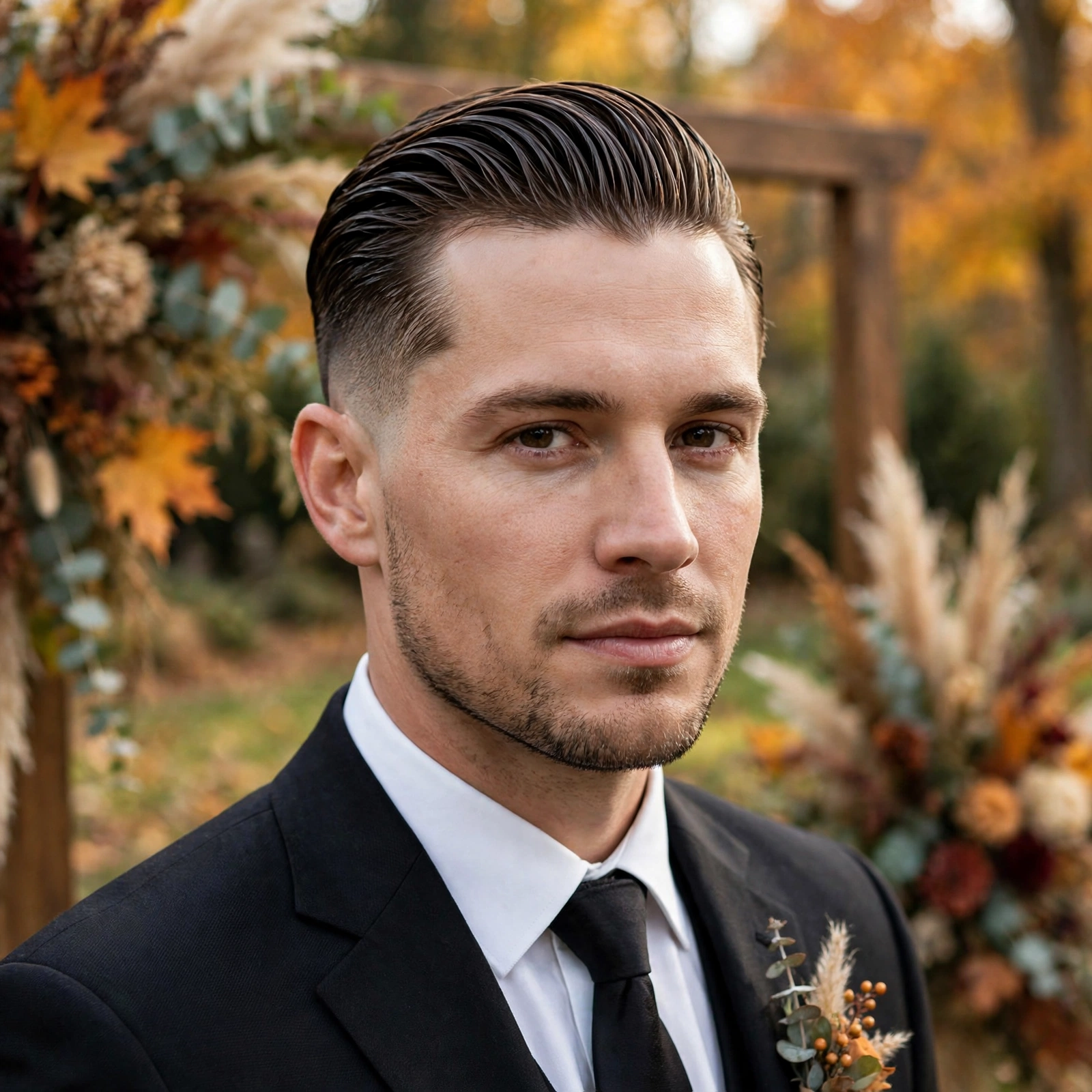
Smooth-operator energy, dialed to 2026. The top (3–5 inches) is combed straight back with medium-hold pomade for a sleek, controlled finish, while a low taper keeps the sides and neckline immaculate. It’s having a real moment in autumn wedding hairstyles for men because it nails the current sweet spot: formal and masculine without the aggressive edge of a high fade or the stiffness of old-school slick styles. The vibe is evening-formal — black-tie weddings, cathedral ceremonies, and anywhere the dress code says “sharp.”
How to get it: Tell your barber “slicked back on top, low taper on the sides, clean edges” — keep 3–5 inches of length up top, taper low around the ears and neckline. At home, work pomade through towel-dried hair, comb straight back with a fine-tooth comb for the first pass, then smooth with your fingers for a slightly less rigid finish. Set with hairspray. The low taper is the key detail: it’s formal without the aggression of a high fade, and it grows out more gracefully.
Best for: Thick, straight to wavy hair (it needs density to look full swept back); oval and square faces; medium to long top lengths. Men with very fine hair should steer toward the side part instead.
Maintenance: Low to medium. Ten minutes with the comb on event day. Barber visits every 3–4 weeks to maintain the taper.
Pro tip: Skip the high-gloss pomade for the wedding itself — flash photography turns shine into glare. Use a medium-hold pomade with a natural or satin finish, like Baxter of California Clay Pomade, which gives you the control without the wet look. Your future self in the wedding photos will thank you.
%
%
3. Textured Quiff
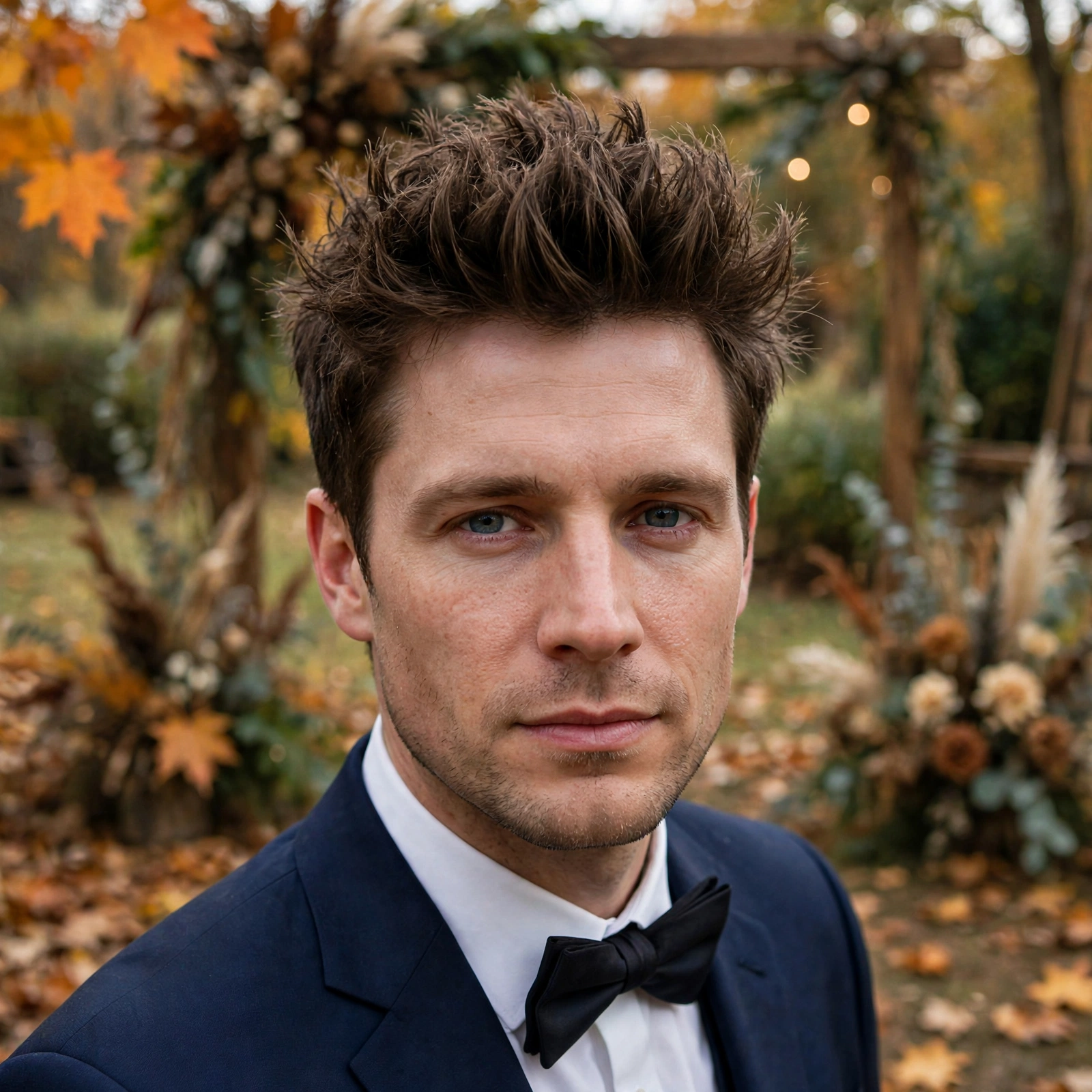
The modern guest’s choice and arguably the most 2026 style on this list. Volume is swept up and back with piece-y, separated texture, sides faded or tapered — polished but visibly alive. It’s trending because it bridges two worlds: dressy enough for the ceremony, cool enough for the after-party. The texture is the whole point — in 2026’s style language, a little controlled messiness reads as confident and current, while anything too perfect reads dated. The vibe is fashionable but not try-hard: it works at barn weddings, city lofts, and anywhere the dress code leans modern.
How to get it: Ask your barber for “textured quiff, mid fade, wedding-neat” — 3–4 inches on top with point-cut texture, sides faded from a #1 or #2 up. At home, blow-dry the top upward and back for lift (this step is non-negotiable — the dryer creates the volume, not the product), then work a matte paste or clay through with your fingers, twisting small sections to create separation. Finish with hairspray for insurance.
Best for: Thick, straight to wavy hair that can hold volume; round and square faces benefit most from the added height; top length of 3–4 inches minimum.
Maintenance: Medium. Fifteen minutes with a blow-dryer on event day. Fade touch-ups every 3–4 weeks.
Pro tip: American Crew Fiber is the classic here for a reason — it gives strong, pliable hold with a matte finish that photographs perfectly and survives hours of wear. Apply it to completely dry hair, not damp; fiber on damp hair goes gummy and loses its grip by dinner.
%
%
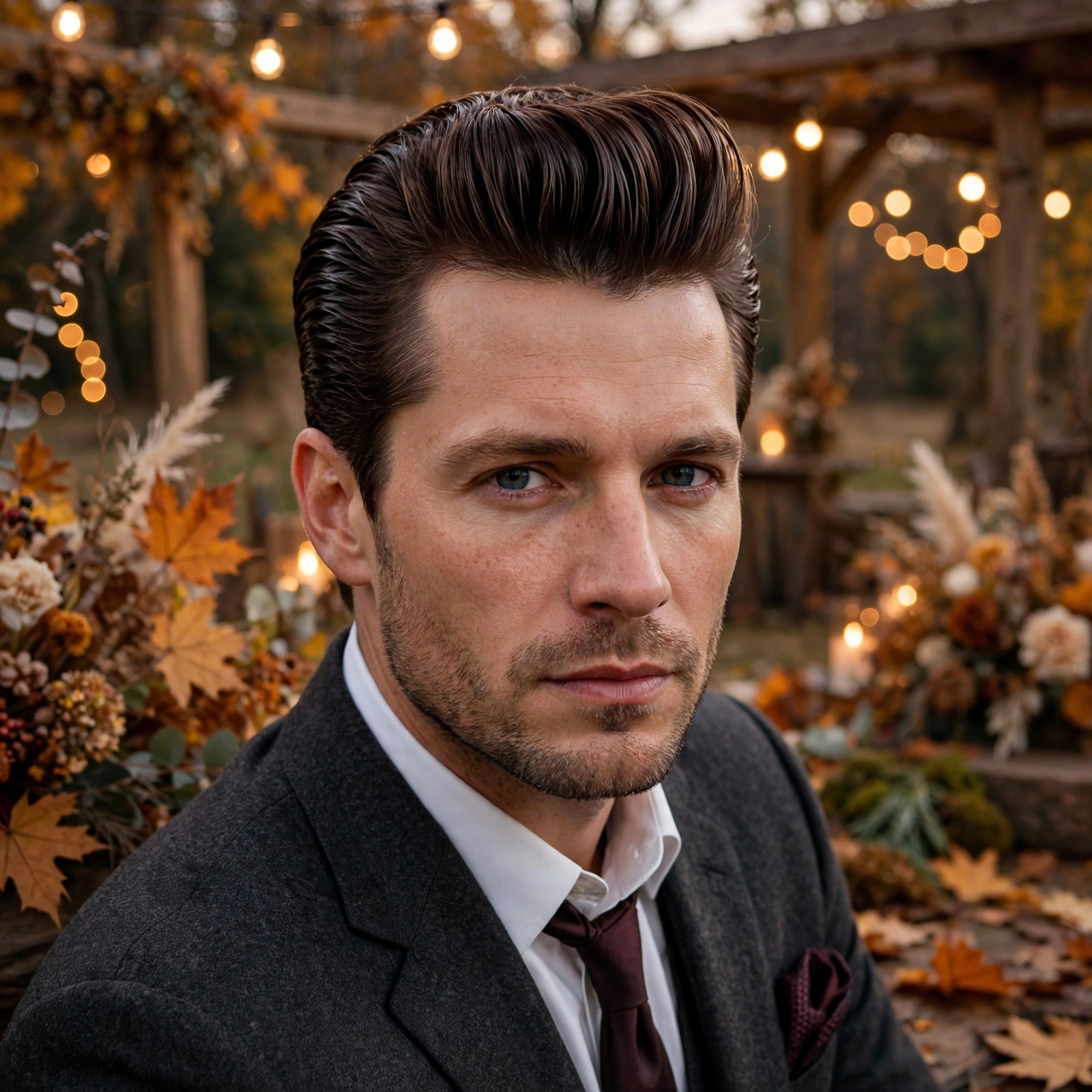
4. Polished Pompadour
For maximum presence. The front is styled high and back with 3–5 inches of height, sides tapered, everything smooth and deliberate — old-school glamour with modern polish. It’s the boldest choice among these fall wedding guest hairstyles for men, and it earns its place: nothing commands a group photo like real height and shape. It’s trending in 2026 as part of the broader return to classic barbering, but the modern version is softer and more wearable than the rockabilly originals. The vibe is unapologetically formal — evening weddings, ballrooms, and anywhere you want to own the room.
How to get it: Tell your barber “classic pomp, tapered sides, polished finish” — substantial length on top (4–5 inches in front), sides kept tight. At home, blow-dry the front up and back with a round brush or vent brush to build the height, then smooth a firm-hold pomade through and shape with a comb. This one genuinely needs a trial run before the wedding — the blow-dry technique takes practice, and wedding morning is not the time to learn it.
Best for: Thick, straight hair with natural volume; round and square faces (the height elongates and structures); men comfortable with a statement look.
Maintenance: Medium to high. Twenty minutes of blow-drying and shaping on event day. Barber visits every 3–4 weeks.
Pro tip: Build the pomp in two passes: first a volumizing pre-styler (mousse or sea salt spray) on damp hair before the blow-dry, then the firm pomade after. Most men skip the pre-styler and wonder why their pomp deflates by the cocktail hour — the foundation product is what holds the height, not the finisher.
%
%
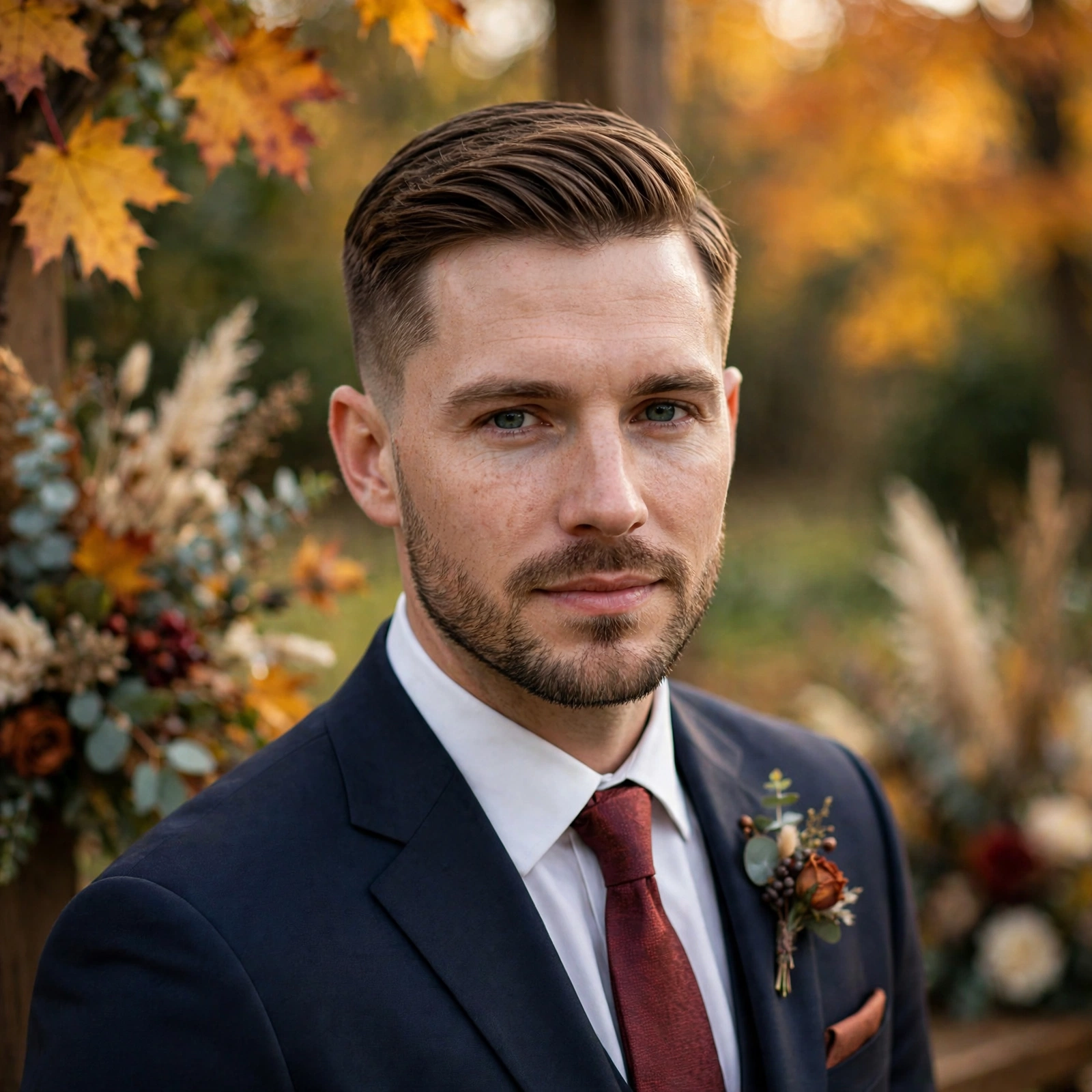
5. Neat Ivy League
Quiet perfection. About an inch on top, neatly in place, tapered sides — the cut that looks like you always look this good. It’s the underrated hero of men’s wedding guest hair 2026: no drama, no risk, no fussing in the bathroom mirror. It’s trending precisely as an anti-trend — as wedding hairstyles get more elaborate, the Ivy League’s restraint reads as genuine confidence. The vibe is understated and impeccable: think groomsmen-adjacent, unclear dress codes, daytime ceremonies, and any wedding where you want to look excellent without looking like you tried.
How to get it: Ask your barber for “Ivy League, neat, wedding-ready edges” — roughly an inch on top with enough length to part or sweep, tapered sides. At home, work a small amount of light styling cream through damp hair and comb or finger-style into place. That’s genuinely the entire routine. Have your barber clean up the neckline and sharpen the sideburns the week of.
Best for: All face shapes; all hair textures including thinning hair (short length minimizes the appearance of thinness); men who want the lowest-risk option.
Maintenance: Low. Three minutes on wedding morning. Trims every 3–4 weeks — short cuts lose their shape fastest, so don’t stretch this one.
Pro tip: The Ivy League lives or dies on the edges, not the top. A week-of tidy-up — neckline, sideburns, around the ears — does more for this cut than any product. Book the tidy-up, not just the cut, and tell your barber it’s for a wedding; they’ll know exactly what sharp means.
%
%
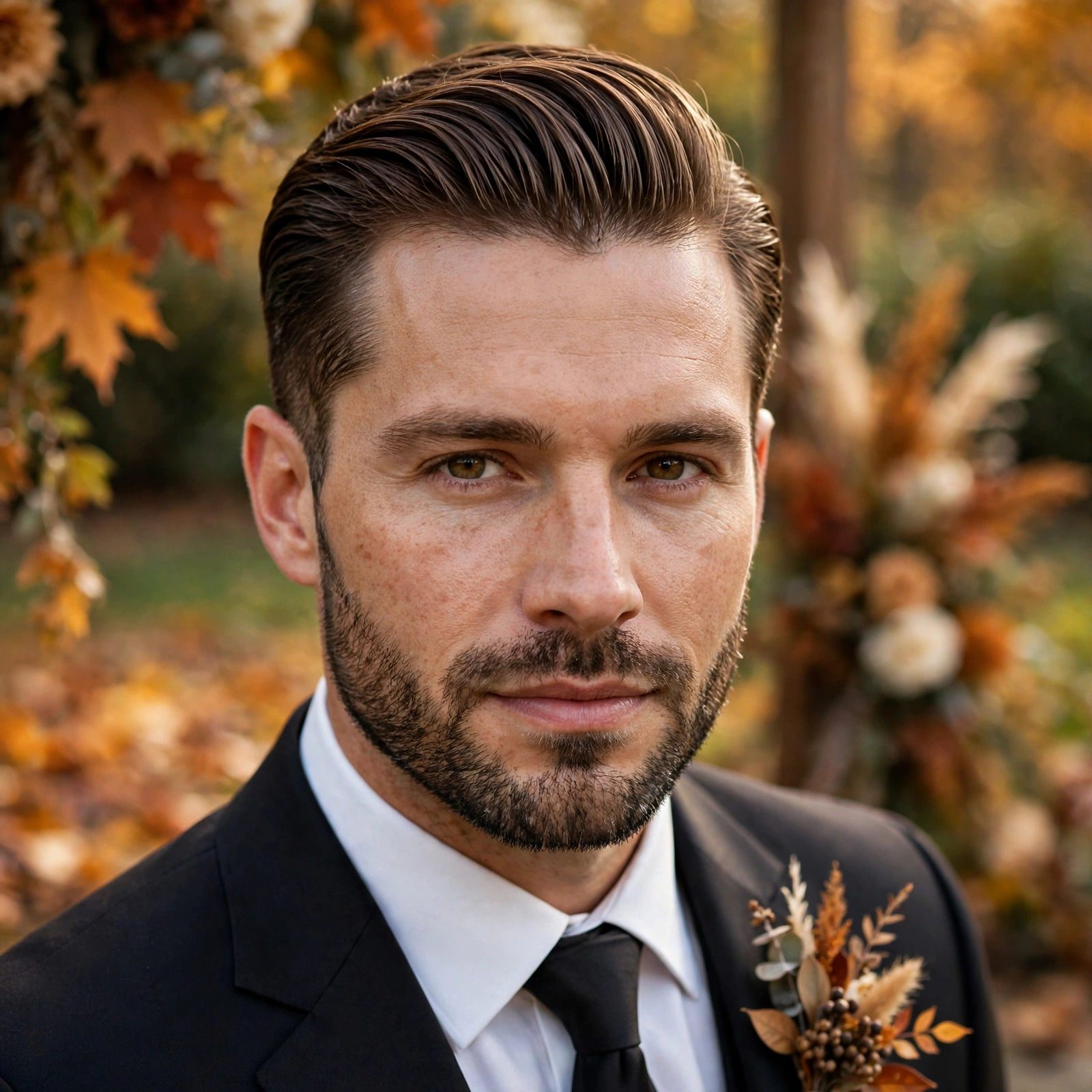
6. Brushed-Back with Beard Blend
For the bearded guest — and this is the detail most groom/guest hair ideas fall roundups get wrong. The hair (3–4 inches) is brushed back with natural texture, but the real work is the beard: shaped, lined up, and blended into the haircut so the whole head reads as one groomed unit. It’s trending in 2026 because the beard-plus-hair combination has matured — the goal is no longer “big beard, whatever hair,” but a cohesive, intentional silhouette. The vibe is rugged yet refined, which is exactly fall’s aesthetic: think vineyard weddings, outdoor ceremonies, and anywhere a suit meets a season.
How to get it: Tell your barber “brush it back on top, and blend the beard into the cut” — keep 3–4 inches up top with texture, sides tapered, and critically, have the sideburns faded or blended into the beard so there’s no disconnect. At home, blow-dry the top back for control, work a light cream or matte paste through, and brush into place. The beard needs its own appointment the week of: trimmed, neckline cleaned, cheeks lined up, and conditioned with beard oil so it photographs soft rather than wiry.
Best for: Men with established beards (at least a few weeks of growth to shape); wavy to straight hair; oval and oblong faces; medium top lengths.
Maintenance: Medium. Ten minutes on wedding morning (hair plus beard). Beard trims every 1–2 weeks; haircuts every 3–4 weeks.
Pro tip: The beard is only wedding-appropriate if it’s as groomed as the hair — an immaculate haircut above a neglected beard ruins the entire effect. Line up the cheek line and clean the neckline two days before the wedding (not the morning of, in case of irritation), and run beard oil through it the morning of for a soft, camera-friendly finish.
%
%
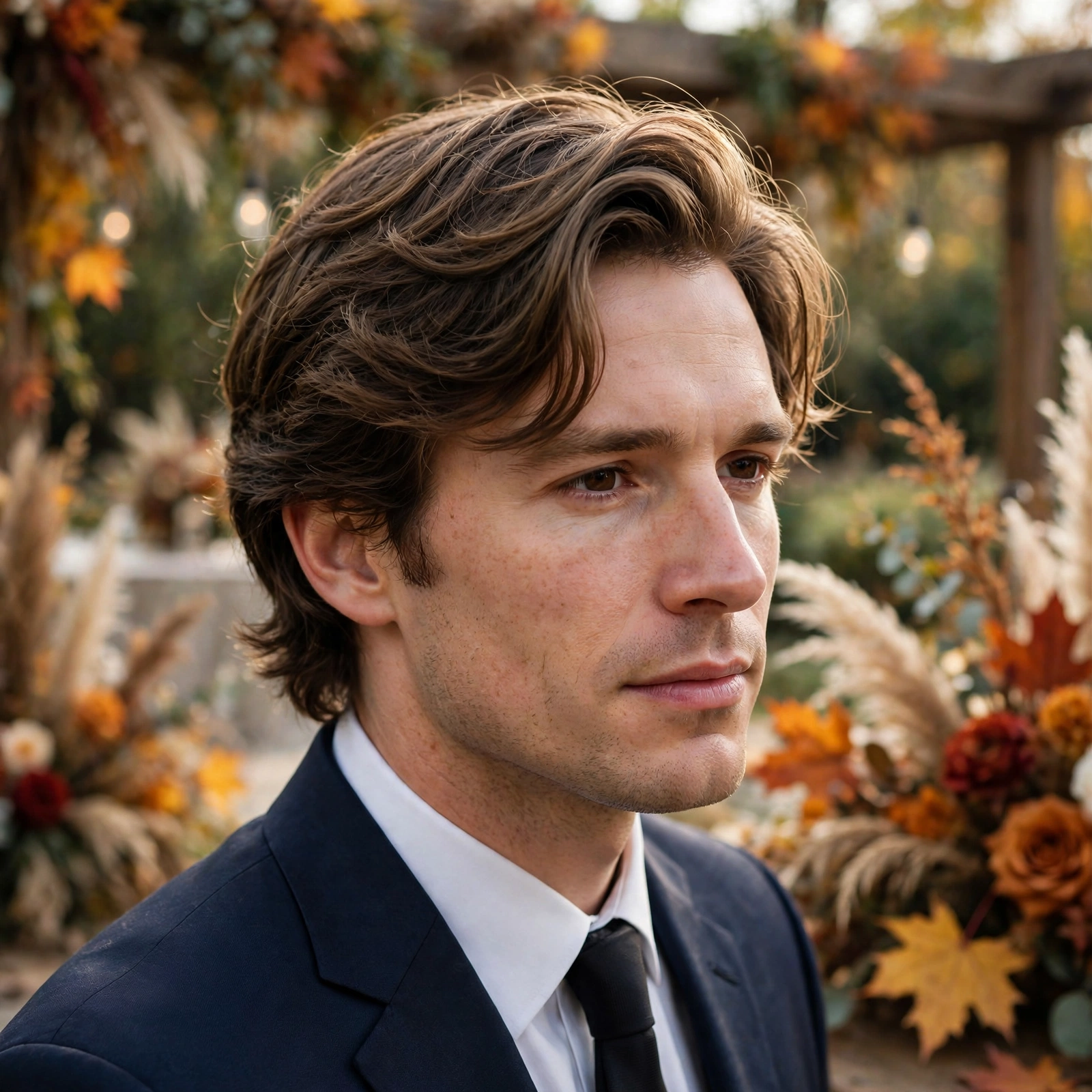
7. Soft Waves with Side Sweep
Romantic and effortless — the most natural-looking option in this entire guide. Natural waves are swept to one side with light cream, letting the texture be the feature rather than fighting it. It’s trending in autumn wedding hairstyles for men for 2026 because the broader style conversation has finally caught up with what wavy-haired men always knew: enhanced natural texture beats forced straightness every time, especially in photos. Fall’s golden light does magical things with real wave and movement. The vibe is soft and romantic — outdoor ceremonies, vineyard settings, and golden-hour portraits.
How to get it: Tell your barber “keep the waves, side sweep, clean up the sides” — 3–5 inches on top to let the wave form, sides tapered but not skin-tight. At home, apply a light curl-enhancing or anti-frizz cream to damp hair, then either air-dry or diffuse — never rough-dry with a towel, which creates frizz. Sweep to your natural side and leave it alone; touching waves once they’re dry breaks them apart.
Best for: Naturally wavy to wavy-curly hair (this style is built for it); oval, heart, and oblong faces; medium top lengths. Straight-haired men should choose a different style rather than trying to fake wave.
Maintenance: Low. Five minutes — the wave does the work. Trims every 6–8 weeks to keep the shape; wavy styles grow out more forgivingly than fades.
Pro tip: If the ceremony is outdoors, anti-frizz is your insurance policy — wind plus dry fall air is the frizz formula. Apply the cream to soaking-wet hair, not towel-dried; product on wetter hair distributes more evenly and locks in the wave pattern before frizz can start. We found this single change makes the biggest difference in how waves photograph.
%
%
8. Modern Comb-Over
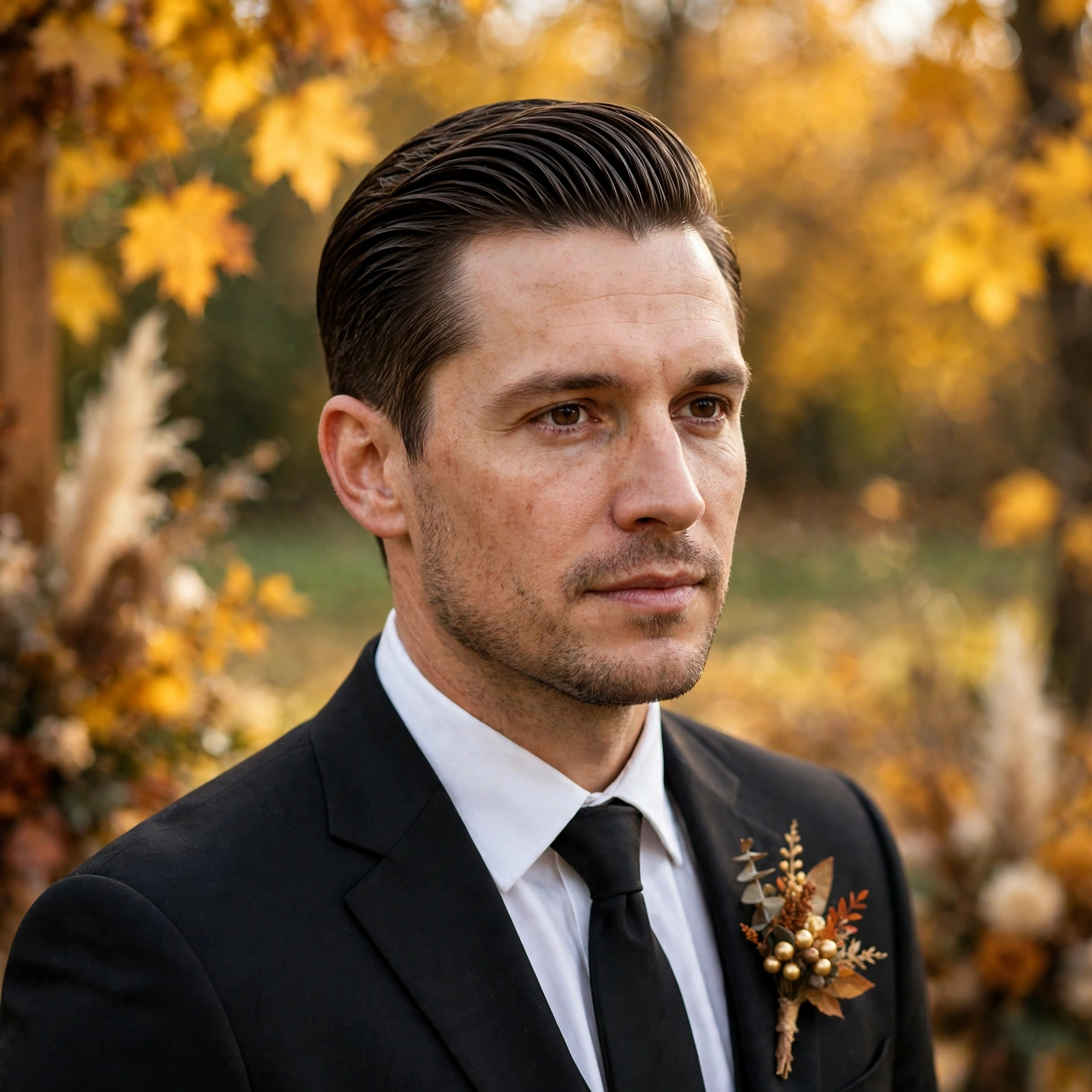
Not your grandfather’s comb-over — this is a deliberate, textured sweep across with faded sides, and it’s one of the sharpest options for men dealing with thinning hair. The top (2–3 inches) is styled across with real separation and movement, never plastered flat. It’s trending in 2026 because the stigma is finally dead: worn with intention and a clean fade, it’s simply a good haircut. The vibe is sharp and self-assured — it reads confident rather than concealing, which is the entire difference between this and the sad comb-overs of old.
How to get it: Tell your barber “textured comb-over, mid fade” — 2–3 inches on top with point-cut texture for separation, sides faded. At home, blow-dry the top across for volume (flat-dried hair is what makes this look dated), then work a matte clay through with your fingers, creating separation between sections. The matte finish is essential — shine plus a sweep across reads retro in the wrong way.
Best for: Men with thinning on top or a receding hairline (the texture and sweep provide honest coverage); straight to wavy hair; round and square faces; short to medium top lengths.
Maintenance: Low to medium. Ten minutes with the blow-dryer on event day. Fade touch-ups every 3–4 weeks.
Pro tip: Hanz de Fuko Quicksand is made for exactly this — it adds gritty volume and a dry matte finish that makes thinning hair look thicker and keeps the sweep separated all day. Work it through dry hair in small amounts; too much collapses the texture you’re trying to build.
%
%
9. Low Bun for Long Hair
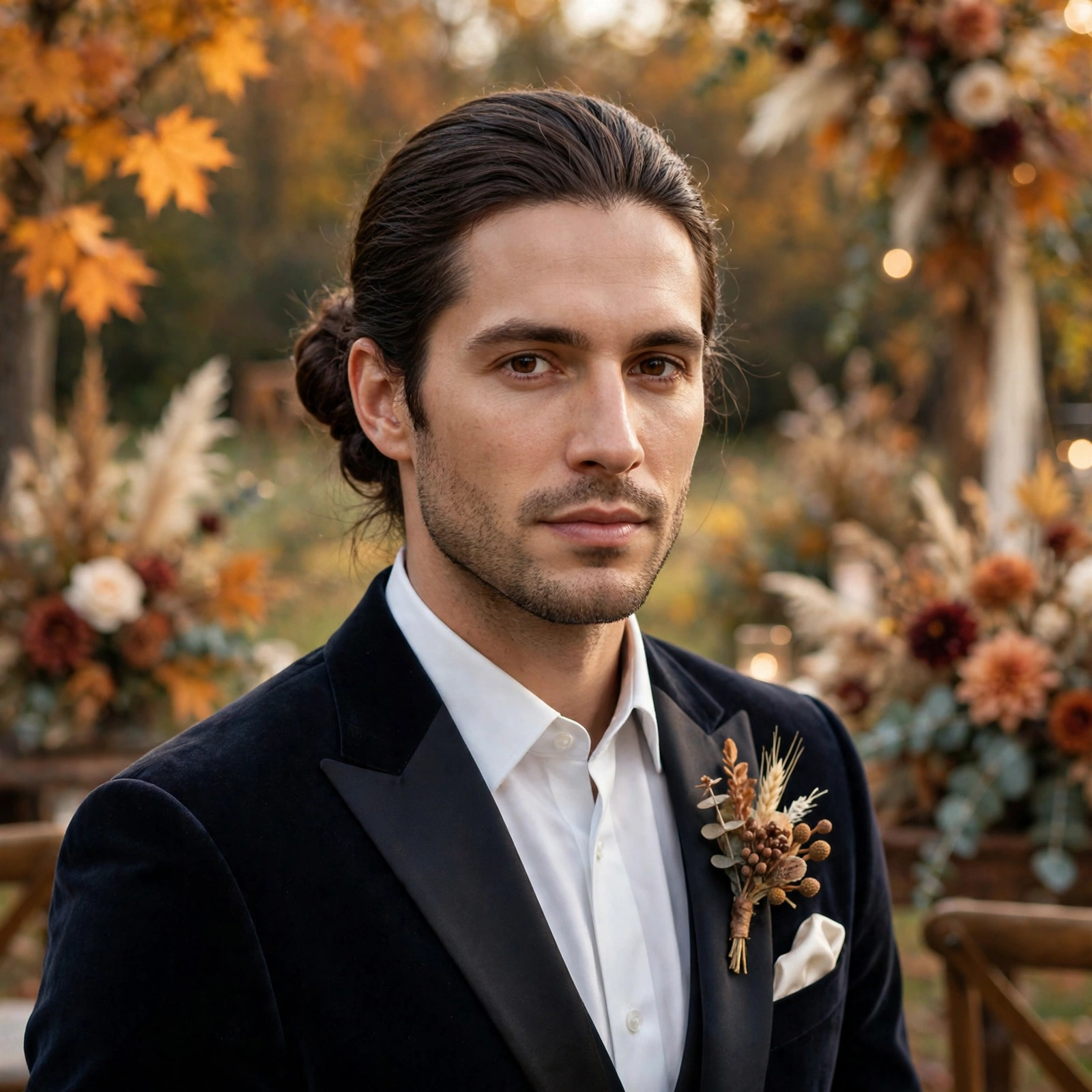
The long-haired gentleman’s answer to wedding dress codes. Hair is gathered into a neat, low bun at the nape — smooth, controlled, and secured with a subtle elastic. It’s trending in men’s wedding guest hair 2026 because long hair on men has fully arrived in formal settings, and the low bun is the style that makes it undeniably occasion-appropriate. Worn loose, long hair at a wedding can read casual or get in the way; gathered low and neat, it reads intentional and sharp. The vibe is modern and composed — pair it with a sharp suit and it looks like a choice, not an accident.
How to get it: Have your barber clean up the ends and shape the cut for wearing up the week before (layered ends escape the bun; a blunter perimeter holds better). At home, smooth a light serum through damp hair to control flyaways, gather at the nape — not the crown, placement is everything — twist into a bun, and secure with a dark elastic that matches your hair plus two pins crossed underneath. The bun should sit low and tight, never floppy.
Best for: Long hair (shoulder length and beyond); straight to wavy textures (very curly hair can work but needs more smoothing); oval and oblong faces; men comfortable with an understated statement.
Maintenance: Low. Five to ten minutes, no heat required. End trims every 8–10 weeks keep it looking deliberate rather than neglected.
Pro tip: Tame the halo of flyaways with a clean toothbrush spritzed with hairspray, brushed gently over the surface — it beats any edge-control product for a soft finish. And do a trial wear for a full evening before the wedding; a bun that loosens after three hours needs a different elastic or pin placement, and you want to discover that at home.
%
%
10. Tapered Curls, Defined
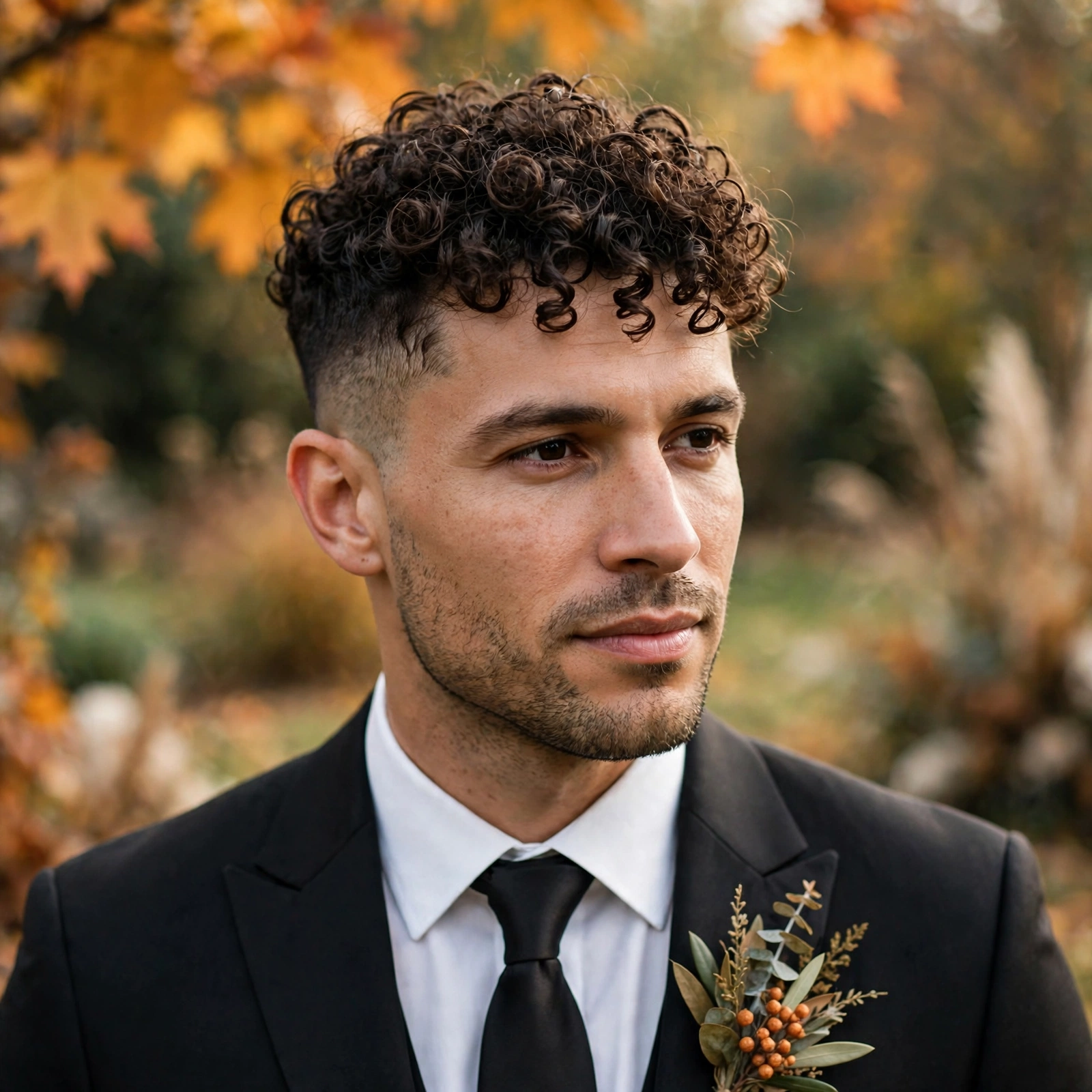
Let the curls shine — just give them structure. Curls are left long enough to form properly on top (2–4 inches) with tapered sides, defined with curl cream for separation and shine control. It’s the best wedding option for curly-haired men, full stop: it celebrates the texture instead of fighting it, while the taper keeps everything event-ready and sharp. It’s trending in 2026 as part of the wider embrace of natural texture, and curly hair has a secret advantage in wedding photos — it photographs with fantastic dimension that straight styles can’t match. The vibe is confident and natural — the man who knows his hair is the feature, not the problem.
How to get it: Tell your barber “defined curls on top, tapered sides, shape it for the occasion” — 2–4 inches on top (length is what lets curls form), sides tapered with clippers. At home, apply curl cream to soaking-wet hair, scrunch upward to encourage the curl pattern, and let it air-dry or diffuse — then don’t touch it once it’s dry. Touching dry curls creates frizz; the style is set-and-forget by design.
Best for: Naturally curly to coily hair; round, square, and heart-shaped faces (the tapered sides slim, the curls add flattering height); medium top lengths.
Maintenance: Low. Five minutes of product application on damp hair; the curls do the rest. Shape-up trims every 4–6 weeks to keep the taper clean.
Pro tip: The wedding-day rule for curls: style them the night before or morning-of on freshly washed, conditioned hair, and then hands off. Every touch after drying breaks the curl cast and invites frizz. If you need a midday refresh, mist lightly with water and scrunch — never re-apply dry product over dry curls.
%
%
Fall Wedding Guest Hair: FAQs
How do I make my hairstyle survive an outdoor fall wedding?
Wind is the enemy, so choose structure over flow: side parts, slicked-backs, and controlled quiffs survive gusts that destroy looser styles. Prep matters more than product quantity — apply your styling product to damp hair so it bonds properly, then lock everything with a light hairspray mist once the style is set. Our editors tested this and found the hairspray finish coat adds hours of hold in wind. Also, keep a pocket comb for a thirty-second touch-up before photos, and resist the urge to touch your hair between fixes — fingers transfer oil and flatten everything they touch.
Will my hair hold up through hours of dancing and sweat?
Yes, if you build the hold in layers rather than relying on one product. The formula that survives a dance floor: a pre-styler (mousse or sea salt spray) on damp hair for foundation, your main styling product for shape, and a hairspray finish for lockdown. Matte products like clay and fiber handle sweat better than wet-look pomades, which can go greasy as the night goes on. One more thing — dance-floor sweat hits the hairline first, so make sure your front sections are the most securely styled part of the whole cut. A quick bathroom check after dinner, before the dancing starts, catches problems early.
How should I time my barber visit before the wedding?
The sweet spot is 5–7 days before the wedding — fresh enough to be sharp, grown-in enough to look natural. Never get a dramatically new cut the week of; if it goes wrong, there’s no recovery window. If your wedding is on a Saturday, book the previous weekend. And separate the cut from the tidy-up if needed: the full cut 5–7 days out, then a quick neckline and sideburn cleanup 1–2 days before for maximum sharpness in photos. Tell your barber it’s for a wedding — they’ll take the edges more seriously.
What do I do if it rains on the wedding day?
Don’t panic — rain is manageable if you planned for it. Keep a travel-size hairspray and your styling product in the car or your jacket pocket; a quick restyle in the venue bathroom takes two minutes. Styles with real structure (side parts, slicked-backs) recover from light rain far better than texture-dependent styles — you can recomb a side part, but you can’t rebuild a quiff’s volume without a dryer. If the forecast looks genuinely wet, lean toward a more controlled style choice from the start. And whatever happens, remember: slightly imperfect hair in the photos beats a stressed expression in every single one.
How do I look good in wedding photos without looking overdone?
The camera rewards dimension and punishes extremes. Choose a style with some volume and texture rather than anything plastered flat — cameras flatten, so flat hair photographs lifeless. Avoid high-gloss products: flash turns shine into a glare spot, so go for natural or satin finishes. Keep your edges immaculate (neckline, sideburns, parting) because that’s what reads as “groomed” in a photo from ten feet away. And the simplest advice: pick the style you’d wear on your best normal day, just executed more carefully. “Best version of everyday” always photographs better than a costume.
The Bottom Line
The best fall wedding guest hairstyles for men aren’t the most dramatic ones — they’re the ones with the structure to last from the first photo to the final dance, matched to your hair type and the formality of the day. Pick your style from this list, book the cut 5–7 days out, do one trial run at home, and walk in knowing your hair is handled — or browse our complete guide to wedding guest hairstyles for men for even more ideas. Enjoy the wedding.