

12 Volume-Boosting Winter Hairstyles for Thin Hair
Winter is the hardest season for fine hair — and the one where volume matters most. The moment a beanie or wool hat goes on, whatever lift you built in the morning collapses into a flat, static-charged sheet by noon. Add dry heated air that saps moisture, scarves that flatten the nape, and static electricity that sends every fine strand flying, and thin hair can look half as thick as it did in September. The best winter hairstyles for thin hair in 2026 are the ones built to survive all of that: cuts with hidden internal layers, root-lift styling that holds under a hat, and strategic texture that fakes density all day long.
Here’s what stylists told us while testing these looks: volume in winter isn’t about more hair — it’s about architecture. Blunt perimeters make ends look thicker instead of wispy, shorter internal layers push the outer shell of hair outward, and root-focused styling (mousse only at the scalp, blow-drying upside down, dry shampoo on day two) creates the illusion of density where it counts most. The worst thing you can do to fine hair in winter is weigh it down with heavy oils and rich conditioners at the roots — conditioner belongs on the mid-lengths and ends only, always.
Static is the other great enemy. Fine hair has the least mass to resist an electrical charge, which is why your strands fly toward every dry wool surface by January. The fix is part routine, part styling: a humidifier at home, satin or silk hat linings, switching from plastic combs to a natural-bristle brush, and — our editors’ favorite discovery — a tiny amount of anti-static leave-in or dryer-sheet trick on the inside of your beanie. Details below in the full guide.
This isn’t a generic list of “cute winter styles.” Every one of the 12 looks below was chosen and tested for a single job: making thin hair look fuller in winter, from beanie mornings to party evenings. You’ll get the full picture for each — how to get it, who it flatters, honest maintenance, and a pro tip with a real product recommendation our editors actually use. No invented products, no vague promises.
Whether you’re dealing with naturally fine strands or noticing your hair looking thinner with age, cold weather doesn’t have to mean flat hair until spring. The hairstyles for thin hair in winter below prove that the right cut and a handful of volume tricks can keep your hair looking thick, bouncy, and intentional all season — hat hair included. Let’s get into it.
In this guide: jump straight to any style that catches your eye.
- 1. Alpine Root-Lift Blowout
- 2. Winter Velvet Shag
- 3. Snowbound Textured Lob
- 4. The Cashmere Crown
- 5. Frost-Kissed Curtain Blowout
- 6. Chalet Cozy Topknot
- 7. Icicle-Proof Bubble Braid
- 8. The Wool-Coat Wrap Pony
- 9. Fireside Finger Waves
- 10. Snowlight Bixie
- 11. The Nordic Twist
- 12. Après-Ski Loose Chignon
Editor’s Top 5 Volume-Boosting Picks
Short on time? These are the five thin hair volume looks our editors kept coming back to during testing — the ones with the biggest visual payoff for the least daily effort, and the ones that best survive winter’s hat-static-dry-air triple threat.
1. Alpine Root-Lift Blowout
The purest expression of the whole list: maximum root lift, softly flipped ends, and enough product-free bounce to survive a beanie. If you only master one styling routine this winter, make it this one — it’s the foundation underneath half the styles below.
2. Winter Velvet Shag
A shag with shorter hidden layers through the crown is the single most transformative cut for fine hair we tested. It turns limp, see-through lengths into a cloud of texture that looks twice as thick — and it’s practically wash-and-go on good hair days.
3. Snowbound Textured Lob
The collarbone-length lob with choppy, point-cut ends is the volume sweet spot for thin hair: long enough to feel feminine, short enough that gravity can’t flatten it. It grows out gracefully and survives hats better than any longer length.
4. Frost-Kissed Curtain Blowout
When you need winter glamour — holiday parties, date nights, photos — nothing fakes fullness like a sweeping curtain blowout with Velcro-roller-set front pieces. The face-framing movement reads as density even on the finest hair.
5. Après-Ski Loose Chignon
The genius hat-survivor: everything sits at the nape, below the beanie line, so taking your hat off reveals a soft, romantic updo instead of a disaster. Three minutes, day-two hair preferred, zero heat.
Why Winter Flattens Fine Hair (and How to Fight It)
Winter attacks thin hair on three fronts at once. First, hats and hoods physically compress the roots for hours, pressing any morning lift flat against the scalp — and fine hair, with fewer strands and less natural spring, stays flat once it’s been flattened. Second, cold outdoor air and heated indoor air strip moisture, leaving strands drier, lighter, and more static-prone — which is why your hair looks thinner in February than it did in October even though nothing about your head changed. Third, the heavy conditioners and rich masks everyone reaches for in winter coat the roots in weight, and on fine hair that weight translates directly to flatness.
The counterattack starts in the shower, not the styling drawer. Switch to a lightweight volumizing shampoo, apply conditioner only from the mid-lengths down (never on the scalp), and rinse with cool water — it seals the cuticle and adds shine that reads as health and fullness. If your hair is truly fine, consider washing every other day rather than daily; slightly grippy day-two roots hold volume better than squeaky-clean ones, as long as you use dry shampoo at the roots on non-wash mornings. Dermatologists’ healthy hair tips are worth a read if you’re rebuilding your winter routine from scratch.
Styling order matters more than styling effort. Always apply volumizing mousse to damp roots only — the ends don’t need it and will just get sticky — then blow-dry upside down for the first 80 percent, flipping right-side up only to smooth and finish. That inverted drying is the single highest-impact habit for fine hair volume in 2026 testing across every product we tried. Finish with the cool-shot button (heat shapes, cold sets), and mist a flexible-hold hairspray only at the crown, never all over — all-over spray glues fine strands together and actually makes hair look thinner.
Finally, winterize your accessories. Choose beanies with silk or satin linings — they prevent the friction that causes both breakage and static — and part your hair where the hat’s edge will sit before you put it on, which prevents the classic horizontal dent. Keep a travel-size anti-static spray in your coat pocket; one spritz over the crown when the hat comes off kills flyaways instantly. And here’s the hat-hair reset our editors swear by: flip your head upside down, massage the roots with your fingertips for ten seconds, and flip back up. Instant second morning.
Cuts, Color Tricks, and Styling for Maximum Fullness
For thin hair, the right cut does more work than any product. Blunt perimeters are your best friend — a clean, straight-across edge at the bottom makes ends look thick instead of wispy, which is why the lob and the bixie dominate this list. Below the blunt line, ask for invisible internal layers: shorter layers hidden underneath the top shell that push the outer hair outward, creating movement and body without removing any visible length. What to avoid: long one-length hair past the chest (gravity flattens it and the ends go see-through), razor-cut edges (they shred fine ends), and over-layering the top (it removes the very density you’re trying to keep).
Color can fake what genetics didn’t give you. Dimension is the key word: fine hair in a single flat color shows every strand gap, while two to three tones woven through it create shadows and highlights that read as depth and thickness. Ask your colorist for a root shadow slightly deeper than your lengths (it makes the crown look denser), plus fine babylights or lowlights through the mid-lengths. A demi-permanent gloss between appointments keeps the shine that makes hair look healthy — dull hair always looks thinner. The payoff is real: our thin hair hairstyles guide covers more cut-and-color pairings if you’re planning a salon visit.
On the styling side, think in layers of lift rather than one miracle product. The winning formula from our testing: mousse at damp roots, upside-down blow-dry, cool-shot set, dry shampoo on day two, and a backcombed “cushion” at the crown for updos (a small section teased underneath and smoothed over — invisible, but it doubles the apparent height). Each step adds maybe 10 percent more fullness; stacked, they transform the look. Velcro rollers at the crown while you do your makeup are the lazy version of all of this — set them on dry hair for fifteen minutes and you’ve got a mini blowout with zero heat damage.
One last rule, and it’s the most important: never condition the roots, never oil the roots, never serum the roots. Every heavy product belongs on the mid-lengths and ends, where fine hair needs moisture and protection. Roots get volume products only — mousse, root-lift spray, dry shampoo. The moment you break this rule on a hat day, nothing else in this guide can save you. For shorter-volume cuts specifically, our short hairstyles for thin hair roundup has even more blunt-perimeter inspiration.
12 Volume-Boosting Winter Hairstyles for Thin Hair
1. Alpine Root-Lift Blowout
The foundation of winter volume: a blowout engineered entirely around the roots, with hair lifted straight up off the scalp and ends flipped softly outward for that snow-day bounce. It’s the most versatile look on this list — office-appropriate, date-night-ready, and the styling base underneath several other styles here. What makes it winter-specific is the setting routine: Velcro rollers at the crown while it cools, a cool-shot finish, and a flexible spray only at the root — a combination our editors found holds lift for a full workday, even with a commute in between.
How to get it: Work a golf-ball of volumizing mousse through damp roots only, then blow-dry with a medium round brush, lifting each section straight up and over-directing it. Set the crown in two large Velcro rollers while you finish your makeup, remove, and blast the roots with the cool shot. Flip the ends outward with the brush as you go for that lifted, airy finish.
Best for: Shoulder-length to long fine hair; oval, round, and heart-shaped faces; anyone who wants one master technique that upgrades every other style on this list.
Maintenance: Medium. Ten to fifteen minutes on wash day, then two-minute root refreshes with dry shampoo on days two and three. No salon upkeep tied to the style itself.
Pro tip: Spray Color Wow Raise the Root Thicken & Lift Spray directly onto damp roots before your mousse — it’s the one product our editors found that keeps fine roots standing up under a beanie for hours. And never, ever apply mousse to the ends; it just makes fine hair sticky.
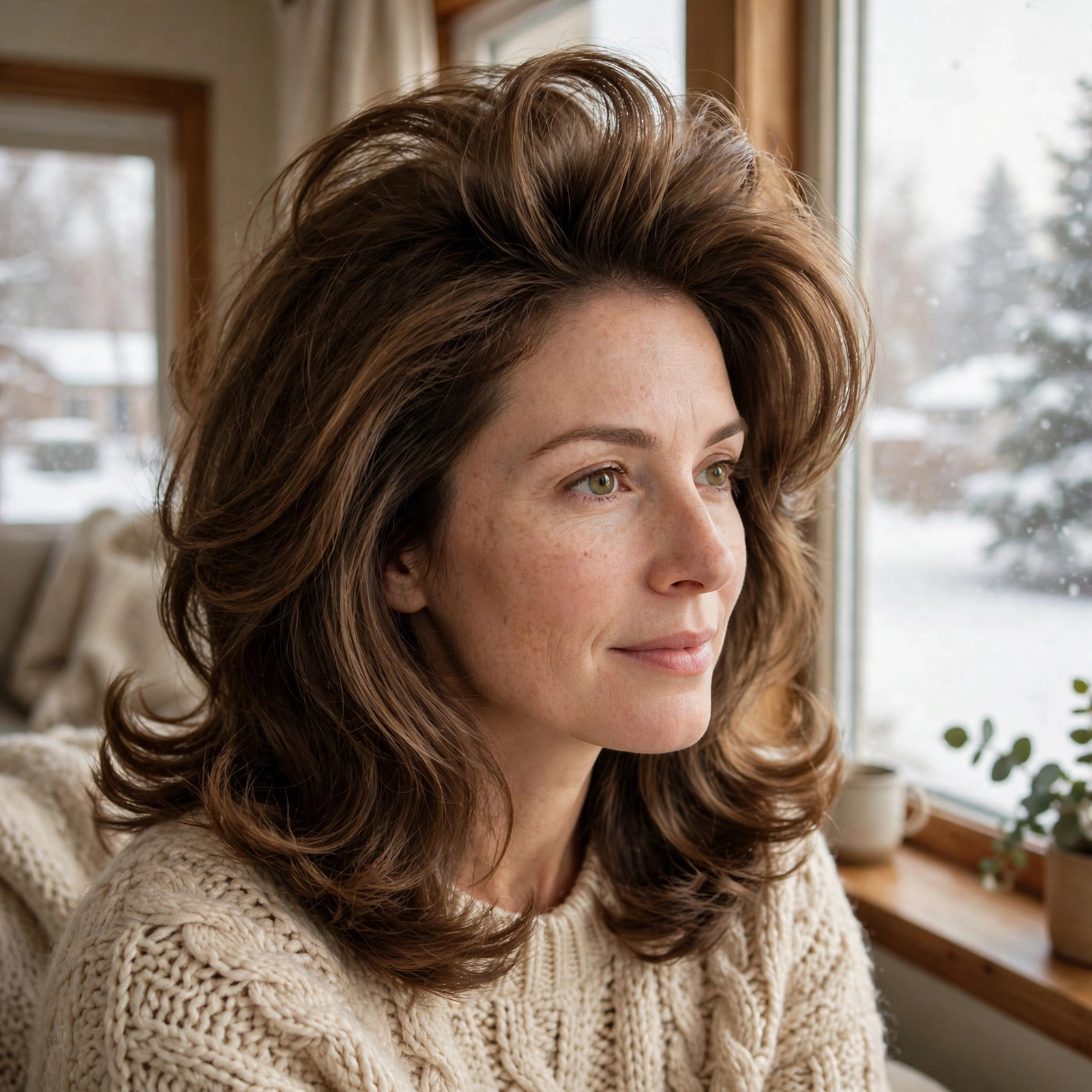
2. Winter Velvet Shag
A shag redesigned for fine hair: shorter hidden layers through the crown (invisible from the outside), a blunt-ish perimeter to keep ends looking thick, and soft face-framing pieces starting at the cheekbones. Where a classic shag can shred fine ends into nothing, this version keeps all the density on the surface and hides the volume machinery underneath. The result looks like a cloud of soft texture — the single biggest visual thickness upgrade of any cut on this list, and genuinely wash-and-go on wavy days.
How to get it: Ask your stylist for a medium-length shag with shorter internal crown layers, disconnected texture through the ends, and face-framing pieces — and specifically say you want the perimeter kept solid, not razored. At home, scrunch a lightweight texture spray into damp hair and air-dry or diffuse. That’s the whole routine.
Best for: Naturally wavy to straight fine hair; oval and heart-shaped faces; medium lengths. The cut was practically invented for hair that needs fake body.
Maintenance: Low. Wash-and-go most days, texture-spray refresh on the rest. Trims every 10–12 weeks — shags grow out beautifully.
Pro tip: Never brush it dry — finger-comb only, because a brush collapses the internal layers into one flat sheet. On flat mornings, flip your head upside down and scrunch the crown for ten seconds; the hidden layers spring right back.

3. Snowbound Textured Lob
The collarbone-grazing lob with choppy, point-cut ends is the volume sweet spot for thin hair in winter: long enough to pull back, short enough that gravity can’t drag it flat, and the textured ends create movement that reads as thickness. It’s also the best hat-surviving length — long hair gets crushed and tangled under a beanie, but a lob pops right back with a quick root massage. Our editors ranked it the most flattering winter length for fine hair across the widest range of face shapes, and it grows out gracefully enough to stretch salon visits.
How to get it: Ask for a collarbone-length cut with point-cut (not blunt, not razored) ends for lived-in texture, plus light face-framing. Style by rough-drying with mousse at the roots, then bending just the ends with a flat iron — alternate directions for piece-y separation — and flicking the front pieces outward with a round brush.
Best for: Fine to medium hair; oval, round, heart, and square faces; anyone growing out a bob or tired of long hair going limp by noon.
Maintenance: Low to medium. Five to ten minutes on styling mornings; air-dries acceptably on lazy days. Salon visits every 8–10 weeks.
Pro tip: Sleep on a silk pillowcase — it preserves the piece-y texture overnight, so day-two hair often looks better than day-one. And keep dry shampoo at the roots only; the textured ends need their grit.

4. The Cashmere Crown
A half-up style with a secret: a softly backcombed cushion at the crown, hidden under smoothed-over top hair, that gives the illusion of dramatically thicker hair from every angle. The bottom half stays down (soft waves or natural texture), so you get the fullness of an updo without losing the length. It’s the ultimate special-occasion trick for thin hair — wedding guest, holiday party, family photos — because cameras read crown height as hair density, and this delivers both.
How to get it: Section off the crown, backcomb the underside of that section lightly with a fine-tooth comb, smooth the top layer over it, and pin the sides back into a small half-up twist or knot at the back of the crown. Mist the crown only with flexible-hold spray. Curl the loose lengths loosely for contrast.
Best for: Medium to long fine hair; round and oval faces (the crown height elongates); special occasions and photos.
Maintenance: Low. About eight minutes, no heat required if your natural texture cooperates. The cushion lasts all day if you don’t touch it.
Pro tip: Backcomb only the underside — the top layer must stay smooth, or the trick is visible. A light mist of Kenra Professional Volume Mousse 12 on the crown section before backcombing makes the cushion hold twice as long on fine hair.

5. Frost-Kissed Curtain Blowout
Big, sweeping, face-framing volume with front pieces that curve around the cheeks like a curtain — the glamour pick of this list, and the one that fakes fullness most convincingly on truly fine hair. The face-framing movement creates shadows and dimension that read as density, while the roller-set front sections hold their sweep all evening. It’s our editors’ top recommendation for holiday party season: maximum impact, moderate effort, and it photographs like you have twice the hair you do.
How to get it: Ask your stylist for long face-framing layers starting at the cheekbones — they’re the architecture. At home, apply mousse to damp roots, blow-dry with a large round brush rolling sections away from the face, and set the front pieces in Velcro rollers while they cool. Finish with the cool shot and a light flexible spray.
Best for: Medium to long fine hair; oval, round, and heart-shaped faces; evenings, events, and photos where volume matters most.
Maintenance: Medium. Fifteen minutes for the blowout, lasting two to three days with dry shampoo at the roots and a silk pillowcase overnight.
Pro tip: Let the front rollers cool completely before removing — warm-removed rollers fall flat within the hour. While they set, do your makeup; the fifteen-minute wait is the whole secret.

6. Chalet Cozy Topknot
A high, deliberately soft topknot with real height at the crown — built on day-two texture and a backcombed base, so even fine hair makes a satisfyingly full bun. Unlike sleek topknots that expose thin density, this one is all about the pouf: tease the ponytail base, wrap loosely, pin, then gently pull the knot apart for width. It sits above the beanie line, so it’s a true hat-day hero — pop the beanie on and off without touching the style.
How to get it: Flip your head over, gather hair high (hands only — texture is the point), and secure into a ponytail. Backcomb the ponytail lightly, twist it loosely, wrap into a knot, and pin. Pull gently at the knot’s edges to widen it, and leave soft pieces around the face.
Best for: Medium to long fine hair; oval and round faces (the height elongates); weekends, cozy days, and every hat-day emergency.
Maintenance: Low. Three minutes, zero heat, and it actively prefers unwashed hair. No salon upkeep.
Pro tip: Place the knot slightly forward of the crown’s highest point — it photographs better and won’t press into your head when you lean back. A travel-size Batiste Dry Shampoo at the roots before gathering gives fine hair the grip it needs to hold the height.

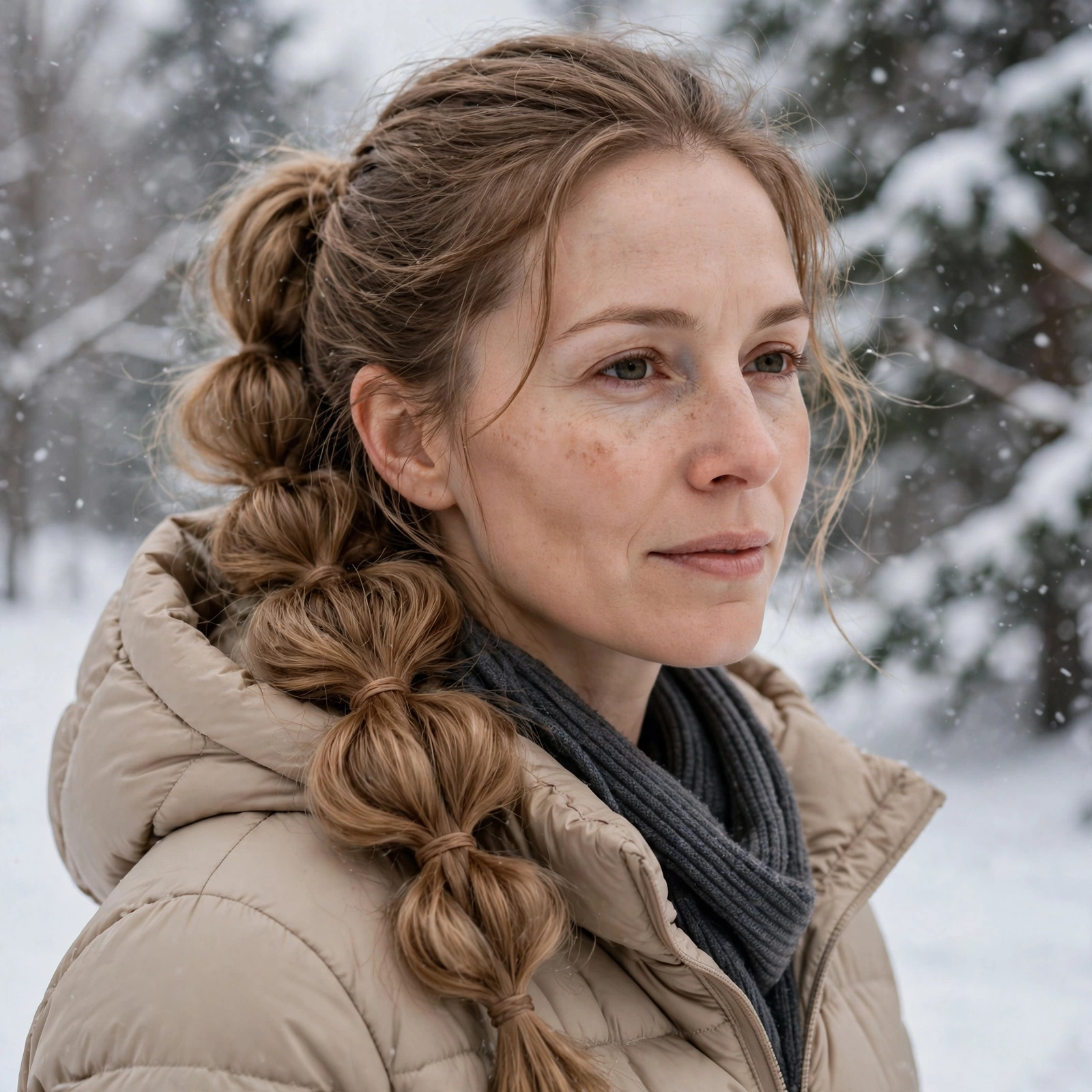
7. Icicle-Proof Bubble Braid
A bubble braid — ponytail sectioned with elastics and gently pulled apart — is one of the only braids that makes fine hair look thicker than it is. Each “bubble” gets pancaked outward, multiplying the apparent width of the hair, and the style sits low enough to survive under a hood or beanie. It’s also genuinely windproof: unlike loose styles that tangle in winter gusts, the bubble braid stays put from morning commute to evening, and it looks even better slightly loosened by the end of the day.
How to get it: Secure a low or mid ponytail, add small clear elastics every two inches down the tail, and gently tug each section outward to widen it into bubbles. Mist with texture spray before you start for grip, and pancake only the sides of each bubble — never the middle — so it doesn’t loosen apart.
Best for: Medium to long fine hair; all face shapes; windy days, travel, and outdoor winter plans.
Maintenance: Low. Five to eight minutes, no heat, no salon upkeep. Sleep in it for heatless waves the next morning.
Pro tip: Hide the elastics by wrapping a tiny strand of hair around each one and pinning underneath — it elevates the whole look from playground to polished. And start the bubbles a touch looser than you think; they’ll tighten as the day goes on.

8. The Wool-Coat Wrap Pony
A high ponytail with a wrapped base and a teased crown — the sleek ponytail’s volume-obsessed cousin. The height at the crown fakes density, the wrapped elastic looks polished against winter tailoring, and the whole thing sits high enough that coat collars and scarves don’t touch it. On fine hair, the trick is in the prep: backcomb the crown, smooth the top layer over, and use a texture spray on the tail so it doesn’t go stringy. The result is a ponytail that looks twice as thick as a plain one.
How to get it: Backcomb the crown lightly, smooth the top layer over, and gather hair into a high ponytail. Secure tightly, then wrap a strand of hair around the elastic and pin underneath. Tease the tail lightly and mist with flexible spray — or curl the tail loosely for extra width.
Best for: Medium to long fine hair; oval and heart-shaped faces; workdays, evenings, and tailored winter outfits.
Maintenance: Low to medium. About eight minutes. The crown teasing needs a brush-out and re-set if you wear it multiple days.
Pro tip: Tilt your head back slightly while securing the ponytail — it pulls the front hairline taut and smooth, which is what separates a polished pony from a messy one. Two stacked elastics hold fine-hair ponytails higher and longer than one.
9. Fireside Finger Waves
Soft, sculpted S-waves close to the head — vintage glamour, reimagined for fine hair. Because the waves lie flat against the head in a controlled pattern, there’s no flyaway-prone volume to collapse; instead, the shine and sculptural shape read as intentional luxury. It’s the lowest-maintenance “fancy” style here: set it once, and it holds through dinner, dancing, and a coat check. On fine hair, finger waves are genius — they turn a lack of volume into an aesthetic choice.
How to get it: On damp hair, apply a light styling gel or mousse, create a deep side part, and use a fine-tooth comb to sculpt alternating S-waves, clipping each wave as you go. Let air-dry or diffuse on low, remove clips, and smooth a single drop of light oil over the surface for shine.
Best for: Short to medium fine hair (bobs and lobs especially); oval and heart-shaped faces; holiday parties, weddings, and vintage-inspired evenings.
Maintenance: Medium. Twenty minutes to set, but it lasts two days — sleep with a silk scarf wrapped over it and revive with a light mist.
Pro tip: Let every wave dry completely before removing a single clip — impatience is the only reason finger waves fail. And keep the gel light; heavy product on fine hair turns sculpted waves into a helmet.

10. Snowlight Bixie
The bixie — a bob-pixie hybrid with tapered sides and textured length on top — is the boldest volume move a fine-haired woman can make. Short hair can’t be flattened by gravity, hats, or scarves, and the textured top swept forward or to the side creates the illusion of real density. It’s also the ultimate low-effort winter cut: two minutes with a pea-sized amount of styling cream and you’re done, and it looks perfect coming out from under every beanie you own.
How to get it: Ask your stylist for tapered (not shaved) sides with textured, piece-y length left on top — bring photos, because bixie variations are endless. At home, work styling cream through the top and sweep it to your preferred side with your fingers, lifting at the roots as you go.
Best for: Fine hair of any texture; oval, heart, and square faces; anyone ready to trade length for the freedom of a precision cut.
Maintenance: Low daily, higher salon frequency. Two minutes each morning — but book trims every 4–6 weeks, because short cuts lose their shape fast.
Pro tip: When it starts growing out, flip the sweep to the opposite side — the new part disguises the awkward phase for weeks. And a matte texture product beats a shiny one on fine hair; shine shows scalp, matte hides it.

11. The Nordic Twist
Two twisted sections drawn back from the temples, crossed and pinned at the crown over a lightly backcombed base — a romantic half-up with real engineered height. The twist detail distracts from thin density while the hidden cushion underneath delivers the volume, and the loose lengths fall soft around the shoulders. It handles winter wind better than fully-down styles (the front is secured) and takes the hat off gracefully, since the structure is pinned, not heat-set.
How to get it: Backcomb the crown lightly and smooth the top layer over. Take a two-inch section from each temple, twist each back toward the crown, cross them over each other, and pin where they meet in an X. Mist the crown with flexible spray and curl the loose lengths loosely.
Best for: Medium to long fine hair; round and oval faces (the crown lift elongates); date nights, dinners, and festive gatherings.
Maintenance: Low to medium. About ten minutes, no heat required if your texture cooperates. No salon upkeep tied to the style.
Pro tip: Crisscross two bobby pins in an X instead of using one — the hold is dramatically stronger on fine, slippery hair. And twist on day-two hair; freshly washed strands will slide right out of the pins.

12. Après-Ski Loose Chignon
A soft, slightly undone bun at the nape — the ultimate hat-surviving updo for thin hair. Everything sits below the beanie line, so the hat goes on and off without touching the style, and the loosened, pancaked shape makes even fine hair look substantial. Add a backcombed cushion inside the bun for real fullness, pull a few face-framing pieces out to soften it, and you’ve got a three-minute style that reads elegant at a holiday dinner and effortless on a ski-lodge weekend.
How to get it: Backcomb the crown lightly, gather hair into a low ponytail at the nape, twist loosely, wrap into a bun, and pin — leaving face-framing pieces out. Gently pull at the bun’s edges to loosen and widen it, then mist lightly with flexible spray. U-shaped hair pins hold better than bobby pins here.
Best for: Medium to long fine hair; all face shapes — adjust the face-framing pieces to flatter yours; hat days, evenings, and travel.
Maintenance: Low. Three minutes, zero heat, and it genuinely prefers day-two hair. No salon upkeep tied to the style.
Pro tip: Never attempt this on freshly washed, slippery hair — a mist of Ouai Texturizing Hair Spray first gives fine strands the grip they need. And choose a beanie with a silk lining; it slides over the bun without crushing it.

Winter Hairstyles for Thin Hair: FAQs
How do I fix hat hair on fine hair without restyling everything?
The fastest rescue takes under a minute: flip your head upside down, massage your roots with your fingertips for ten seconds, flip back up, and smooth the top layer with your palms. The inverted massage breaks up the compression and reactivates whatever root product you applied in the morning. For prevention, part your hair where the hat’s edge will sit before putting it on, choose silk-lined beanies, and apply dry shampoo to your roots before the hat goes on — it absorbs the moisture and oil that make hat hair stick. Low, nape-sitting styles like the Après-Ski Loose Chignon (#12) avoid the problem entirely by living below the hat line.
Why does my fine hair get so staticky in winter, and how do I stop it?
Static happens when dry winter air strips moisture from your hair, leaving strands with an electrical charge — and fine hair, with the least mass per strand, is the most affected. The fixes stack: run a humidifier at home, switch from plastic combs to a natural-bristle brush, wear silk or satin-lined hats, and keep a travel anti-static spray in your coat pocket. In the shower, don’t skip conditioner on your ends (dry hair charges faster), and avoid over-drying with high heat. A tiny amount of leave-in on the mid-lengths also helps — just keep it far from the roots, where it would flatten your volume.
How often should I wash thin hair in winter?
Every other day is the sweet spot for most fine hair in winter — daily washing strips the natural oils that give fine strands grip and body, while going longer than two to three days usually means limp, separated roots that no product can rescue. On non-wash days, dry shampoo at the roots is non-negotiable: it absorbs oil and adds the grit that makes fine hair hold volume. If your hair starts looking thinner rather than just flatter — more scalp visible at the part, a widening part line — that’s a different question from styling, and worth reading about the common causes of hair loss in women before your next dermatologist visit.
Are hair extensions or toppers a good idea for thin hair in winter?
They can be — winter is actually a forgiving season for extensions, since hats, scarves, and high collars hide attachment points and blend lines beautifully. Clip-in wefts and halo-style toppers add instant density for events without commitment, and they’re gentler than bonded methods. The cautions: fine hair is more vulnerable to traction damage, so keep clip-ins to occasional wear rather than daily, never sleep in them, and have a stylist color-match and blend them. If you’re experiencing active shedding or scalp issues, address the underlying cause first — the Cleveland Clinic’s guide to hair loss in women is a solid, no-hype starting point — before adding any weight to fragile strands.
What’s the best way to get root lift that actually lasts all day on fine hair?
Lasting root lift is a stack, not a single product. Start with a root-lift spray on damp roots, layer volumizing mousse over it, and blow-dry upside down until 80 percent dry — that inverted drying trains the roots to stand up. Finish with the cool-shot button (heat shapes, cold locks), and don’t touch your roots again until the hat comes off. The two things that kill lasting lift: heavy conditioner or oil migrating to the scalp, and re-touching your roots with your hands throughout the day (the oils from your fingers flatten fine hair fast). On day two, dry shampoo at the roots reactivates the lift without a full restyle. For more volume-first ideas across every length, our youthful hairstyles for women over 50 guide has plenty of root-lift-friendly cuts that work beautifully on thinning hair too.
The Bottom Line
The best winter hairstyles for thin hair aren’t about having more hair — they’re about architecture, routine, and a few well-chosen tricks that survive hats, static, and dry air. Pick one cut from this list that suits your length, master the root-lift styling stack (mousse at damp roots, upside-down drying, cool-shot set, dry shampoo on day two), and winterize your accessories with silk-lined beanies and an anti-static spray in your coat pocket. Give your chosen looks a genuine two-week trial — the same testing window our editors used — and let this be the winter your fine hair finally looks full. Happy winter, and happy hair days ahead.