
12 Fall Curly Hairstyles for Boys
If you’re hunting for fall curly hairstyles for boys that actually work on real kids — not just on models in a barbershop portfolio — you’re in the right place. There’s a particular kind of morning every October when you realize summer’s easy wash-and-go routine isn’t cutting it anymore: the air is crisp, his curls feel drier by the hour, and last week’s cute style is now a tangled halo. The best fall curly hairstyles for boys in 2026 are the curly top taper fade, the twist-out with a mid fade, sponge curls with a temple fade, and defined coily styles — and this guide breaks down exactly how to get, maintain, and style each one.
Here’s what stylists and barbers will tell you behind the chair: fall is secretly the best season for curls, and also the trickiest. Lower humidity means less frizz and more defined curl patterns — the ringlets and coils that went limp in August humidity now spring up with real shape. But cool, dry air is also moisture’s worst enemy, pulling water straight out of curl strands and leaving behind dryness, tangles, and shrinkage that can turn wash day into a wrestling match. The styles that win this season are the ones built for both sides of that equation: cuts that show off natural texture and routines that lock moisture in.
The curly boys’ hair trends for 2026 share one clear theme: celebration over control. Barbers are leaning into curl definition rather than cutting it away — tapered sides with full, textured tops, twists and coils worn proudly, and fades that frame the curl pattern instead of fighting it. The “grown-out and guessing” look is out; intentional shape is in. Even better, most of this season’s winning styles are genuinely low-effort for parents: school-morning routines of five minutes or less, protective styles that last for weeks, and cuts that still look sharp under a beanie.
But a great curly haircut is only half the battle, especially in autumn. Curls are naturally drier than straight hair because the scalp’s oils can’t travel down all those twists and turns — and fall’s dry air makes that worse. This guide covers the full picture, not just the cut: what to tell the barber (exact scripts, so nothing gets lost in translation), the at-home curl-defining routine that keeps the style alive, honest maintenance expectations for busy school weeks, and a pro trick for every style. Our editors tested the routines and wash-day strategies behind these picks, so the advice here has survived real mornings, real sports practices, and real kids who won’t sit still.
What makes this guide different from a photo roundup: every style below comes with the complete playbook — exactly how to get it (barber script plus the curl routine), who it suits best (curl pattern, age, face shape), honest maintenance expectations, and a pro tip you won’t find in a caption. No fluff — just the 12 best boys’ curly hairstyles for fall, decoded for parents.
Below, we’ve rounded up the 12 most wearable curly haircuts for boys for autumn 2026. Defined, practical, and genuinely cool — let’s find his fall hair.
In this guide: jump straight to any style that catches your eye.
- 1. Curly Top Taper Fade
- 2. Twist-Out with Mid Fade
- 3. Sponge Curls with Temple Fade
- 4. Defined Coily High-Top Fade
- 5. Two-Strand Twists with Low Fade
- 6. Curly Frohawk
- 7. Wash-and-Go Curly Crop
- 8. Finger Coils with Tapered Sides
- 9. Curly Fringe with Low Fade
- 10. Pineapple Puff with Undercut
- 11. Short Box Braids with Fade
- 12. Curly Side Part with Taper
Editor’s Top 5 Fall Curly Hairstyles for Boys
Short on time? These are the five curly boys’ haircuts our editors keep coming back to this season — the highest style-to-effort ratio on the entire list, tested on real school mornings.
1. Curly Top Taper Fade
The gold standard of the season, and our number one pick for a reason. It keeps all the curl celebration on top with neatly tapered sides that stay crisp for weeks, looks sharp under a beanie, and grows out gracefully between appointments. If he only gets one cut this fall, this is the one.
2. Twist-Out with Mid Fade
Maximum definition with minimum daily effort — the twist-out stretches shrinkage into bouncy, stretched curls that last for days, and the mid fade keeps the whole thing clean and modern. It’s the best answer to “his hair looks different every morning,” because it genuinely doesn’t.
3. Sponge Curls with Temple Fade
The fastest transformation on this list: a curl sponge turns short coils into perfectly defined texture in under five minutes. It’s a lifesaver for younger boys who won’t sit still for long routines, and the temple fade gives it that fresh-from-the-barber edge.
4. Curly Frohawk
For the kid with opinions about his hair — all the attitude of a mohawk, softened into curls, with faded sides keeping it school-appropriate. It photographs incredibly well, which matters a lot in holiday photo season.
5. Pineapple Puff with Undercut
The fun pick: a high, joyful puff of curls on top with clean undercut sides. It’s the quickest morning routine here, it keeps curls off the neck under scarves, and kids absolutely love the volume.
Fall Curl Care: Fighting Dryness When Temperatures Drop
Here’s the science in one sentence: curly hair is drier than straight hair because the scalp’s natural oils can’t slide down a spiral, and fall’s cold, low-humidity air pulls even more moisture out of the strand. That combination is why wash day feels harder in October than it did in July — more tangles, more shrinkage, more frizz at the ends. The fix isn’t more products; it’s the right moisture routine, done consistently. For the dermatologist-backed basics, these curly hair care tips from dermatologists are the best starting point we’ve found.
The routine our editors swear by for fall is the LOC method: Liquid (water), Oil, Cream. After washing, work leave-in through soaking-wet hair (water is the real moisturizer — everything else seals it in), follow with a light oil like jojoba to lock it in, then a curl cream for definition. On non-wash days, just mist with water and smooth a pea of leave-in over dry spots — our testing showed this three-minute refresh buys two to three extra days between washes.
Wash less, condition more. For most curly-haired boys, once or twice a week is plenty in fall — daily shampooing strips the oils curls desperately need. When you do wash, use a sulfate-free shampoo focused on the scalp (the lengths get clean enough from the rinse), and be generous with conditioner: detangle while the conditioner is still in, with a wide-tooth comb or just your fingers, starting from the ends and working up. That single habit — never detangling dry — prevents more breakage and tears than any product ever will.
Two fall-specific upgrades make an outsized difference. First, add a deep-conditioning session every week or two: a rich mask or even regular conditioner left on under a shower cap for 15–20 minutes while he plays or watches something. Second, swap the cotton pillowcase for satin (a satin pillowcase or a satin-lined bonnet). Cotton wicks moisture out of curls overnight and creates morning tangles; satin lets curls glide. It’s the cheapest, highest-impact change in this entire guide.
Finally, watch the heat and the hats. If you diffuse, use low heat and low speed with a heat protectant — high heat plus dry fall air is brutal on curls. And choose beanies with a satin or silk lining (or a thin satin cap underneath); wool rubbed directly on dry curls all school day breaks hair at the hairline.
Choosing by Curl Pattern: Wavy, Curly, Coily
Not all curls are the same, and the right cut depends on what grows out of his head — not the photo you saved. Hair typing runs Type 2 (wavy) to Type 3 (curly) to Type 4 (coily), with A/B/C marking loose to tight. Knowing roughly where he falls changes product choice and cut selection completely. This guide to caring for curly hair covers washing, detangling, and styling by hair type.
Wavy hair (Type 2A–2C) has the easiest fall of the three patterns — it’s the least prone to dryness, but also the most likely to fall flat. For wavy boys, choose cuts with texture and movement: the curly fringe, the side part with taper, and the wash-and-go crop all let waves do what they do naturally. Product-wise, less is more — a light curl cream or mousse on damp hair, and skip heavy butters and oils that weigh waves down into stringiness. Wavy hair can usually handle washing two to three times a week without drying out.
Curly hair (Type 3A–3C) is the classic ringlet zone: defined S-shaped curls with real volume. This pattern loves moisture but hates heaviness, so the LOC routine with lightweight products is the sweet spot — a watery leave-in, a light oil, a curl-defining cream. Nearly every style on this list was designed with Type 3 in mind, but the taper fade, twist-out, finger coils, and frohawk show it off best. Detangle only when wet with conditioner in, and hands off once it’s dry — touching Type 3 curls after they set is the fastest route to frizz.
Coily hair (Type 4A–4C) has the tightest pattern, the most shrinkage (up to 75% of its actual length can disappear into the coil), and the greatest need for moisture and gentle handling. Protective styles are this pattern’s superpower in fall: two-strand twists, box braids, and the twist-out all guard the ends from dry air while stretching shrinkage into visible length. Wash in sections to prevent tangling, deep-condition regularly, and moisturize twists and braids every few days so the style lasts. Never detangle coily hair dry — it’s the single most damaging thing you can do to this pattern.
One honest note: most boys don’t fall neatly into one box — mixed patterns are completely normal in kids. When in doubt, care for the tightest section and cut for the loosest: the routine that keeps 4C happy keeps 3B happy too, but a cut designed for loose waves won’t flatter tight coils. And patterns change as kids grow, so reassess once a season.
12 Fall Curly Hairstyles for Boys
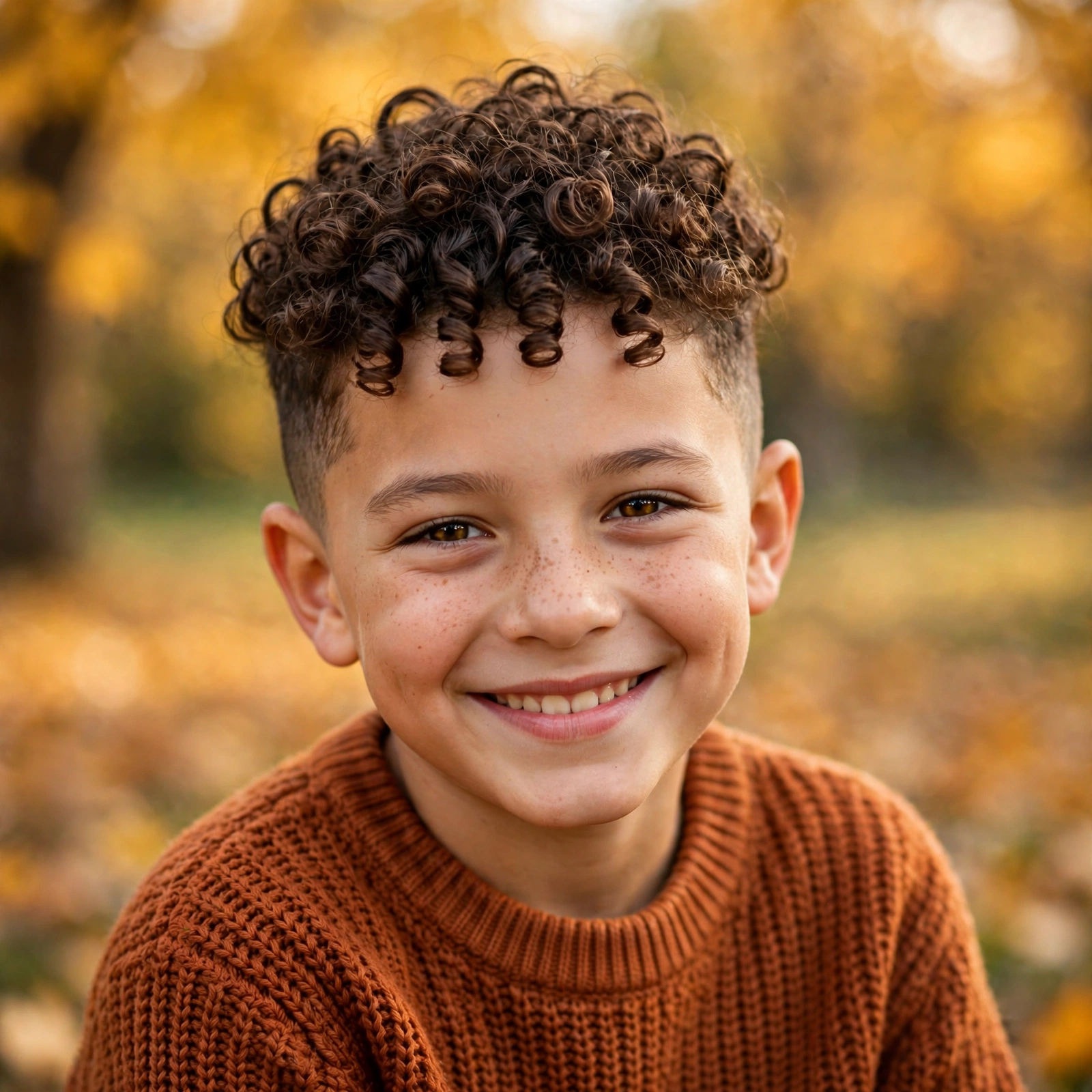
1. Curly Top Taper Fade
The undisputed champion of boys’ curly haircuts for fall 2026: full, defined curls on top with sides and nape tapered down gradually for a clean, sharp frame. It’s trending because it’s the perfect compromise — maximum curl celebration up top, zero mess around the ears and neckline, and it looks just as good under a beanie as it does in holiday photos. The vibe is confident everyday cool: school days, weekend sports, family dinners, and every “I need to look put-together in five minutes” morning.
How to get it: Tell the barber: “Taper the sides and back, keep the top long enough to show the curl pattern — about two to three inches — and shape the top with the curls, no thinning shears.” At home, the routine is a classic wash-and-go: leave-in conditioner on soaking-wet hair, a curl-defining cream scrunched in section by section, then air-dry or diffuse on low. Hands off once it starts drying.
Best for: Type 3A–3C curls and looser 4A coils; ages 5–14; all face shapes — the taper can be adjusted higher or lower to balance round or long faces.
Maintenance: Low. Five minutes on styling mornings; refresh with a water mist on non-wash days. Barber visits every 4–5 weeks to keep the taper crisp — the top grows out fine on its own.
Pro tip: On refresh days, don’t re-wet the whole head — mist just the frizzy spots with water, smooth a pea-sized amount of leave-in (our editors like Cantu’s Shea Butter Leave-In for this) over them, and scrunch. Targeted refresh beats a full re-wet every time.
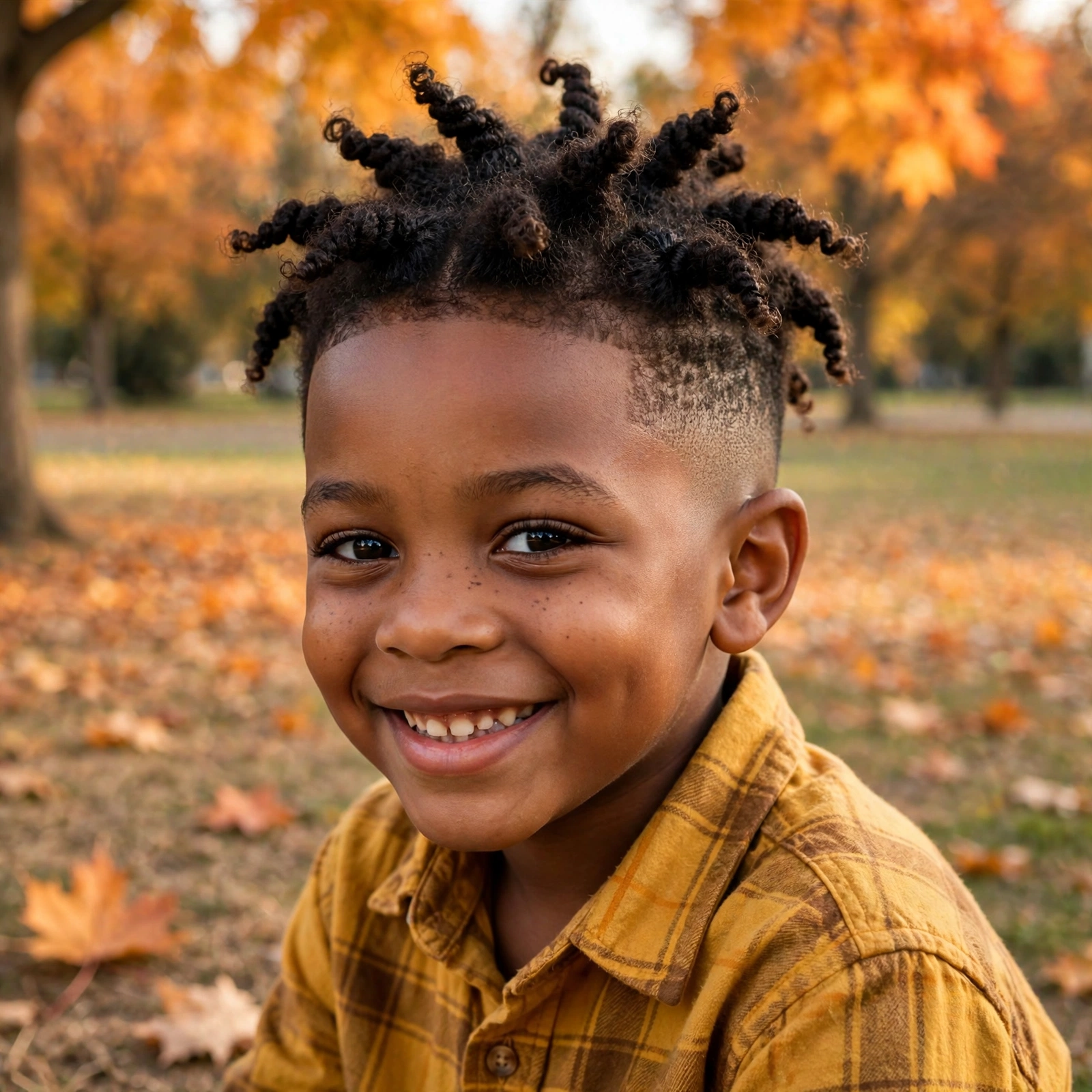
2. Twist-Out with Mid Fade
Two-strand twists worn overnight, unraveled in the morning into stretched, bouncy, beautifully defined curls — paired with a mid fade that keeps the silhouette clean and modern. It’s a hero of fall curly hairstyles for boys because it solves shrinkage: twists stretch the curl pattern overnight, so he wakes up with visible length and definition that lasts for days. The vibe is polished and intentional — picture day, holiday gatherings, and any week you want wash day to stretch into a five-day style.
How to get it: Tell the barber: “Mid fade on the sides and back, keep enough length on top for two-strand twists.” At home: on clean, conditioned, damp hair, apply leave-in and a light hold cream, then twist two-strand twists all over (smaller sections = more definition). Let them dry fully — overnight is best — then unravel gently, separate each twist once or twice, and pick at the roots for volume. Never unravel damp twists; they’ll frizz instantly.
Best for: Type 4A–4C coils especially, also works on tight 3C curls; ages 6–14; round and oval faces benefit most from the stretched height.
Maintenance: Medium. The twist session takes 30–45 minutes once or twice a week; mornings are five-minute refreshes. Protect it nightly with a satin bonnet or durag. Barber every 4–6 weeks for the fade.
Pro tip: Twist on damp — not dripping — hair, and add a drop of light oil to your palms before unraveling. Oiled fingers separate twists without creating frizz, which is the difference between a crisp twist-out and a fuzzy one.
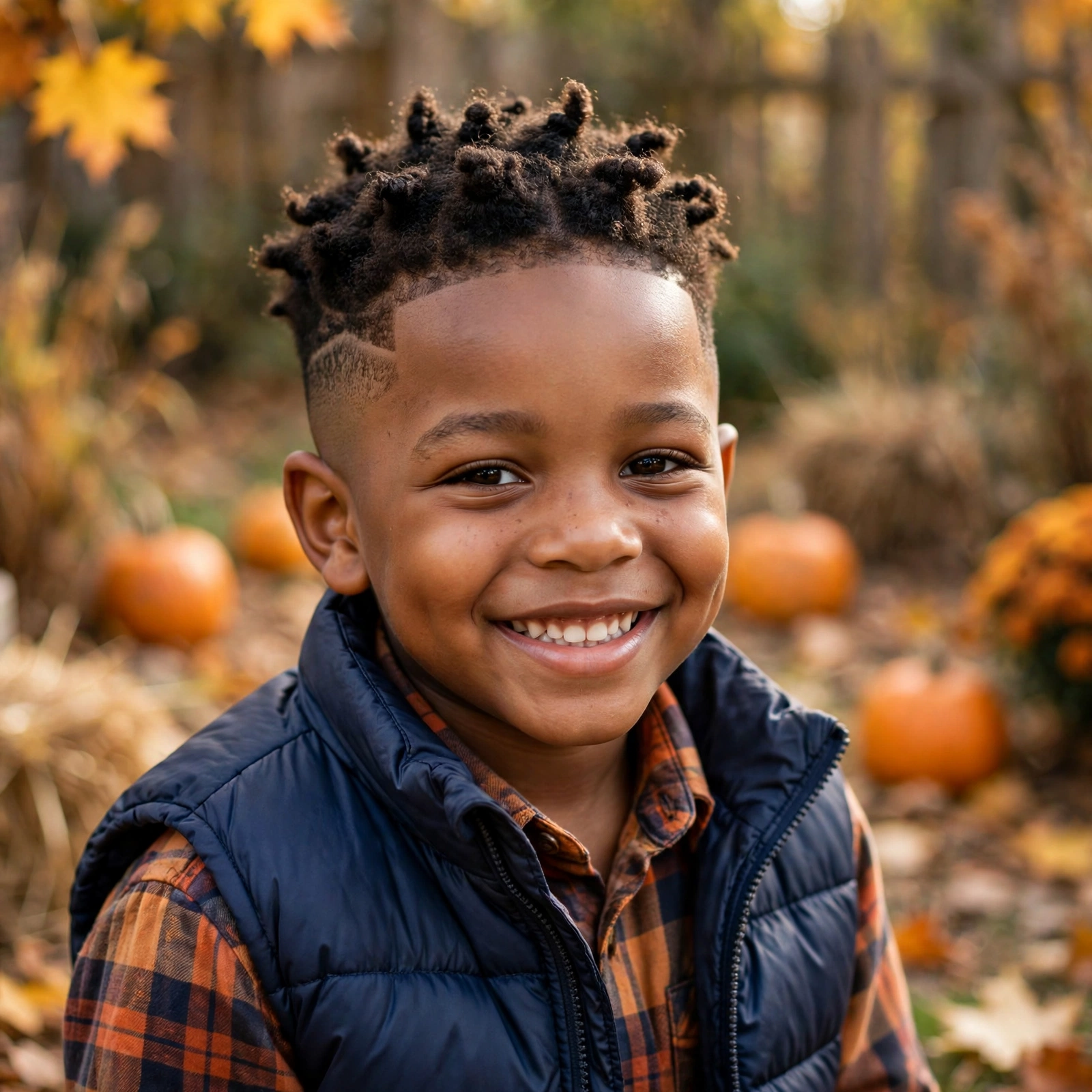
3. Sponge Curls with Temple Fade
The fastest transformation on this list: a curl sponge twisted over short coils creates perfectly defined, uniform texture in under five minutes — no long routines, no sitting still required. Paired with a sharp temple fade (tapered at the temples and sideburns), it looks fresh from every angle. It’s the ultimate easy curly hairstyle for boys this fall: playground-proof, sports-proof, and genuinely fun for kids who hate fussy hair routines. The vibe is playful and cool — recess, birthday parties, and everyday elementary-school swagger.
How to get it: Tell the barber: “Temple fade on the sides, keep the top about one to two inches so the sponge can grab it.” At home: dampen the hair (a spray bottle is fine), work a curl cream or twisting butter through it, then press the curl sponge flat against the head and move it in small circles — same direction, steady pressure — for three to five minutes. The coils form right under the sponge.
Best for: Type 4A–4C short coils; ages 4–10; perfect for squirmy kids who won’t tolerate long styling sessions, and for shorter hair that can’t hold twists yet.
Maintenance: Low. Five minutes each morning to re-sponge the flat spots; a water mist revives it between washes. Barber every 3–4 weeks — the temple fade is the part that needs upkeep.
Pro tip: The sponge only works on damp hair — too wet and the coils won’t form, too dry and you’ll get frizz instead of definition. Mist, don’t soak. And replace the sponge when the holes start flattening; a worn sponge is the number one reason this style “stops working.”
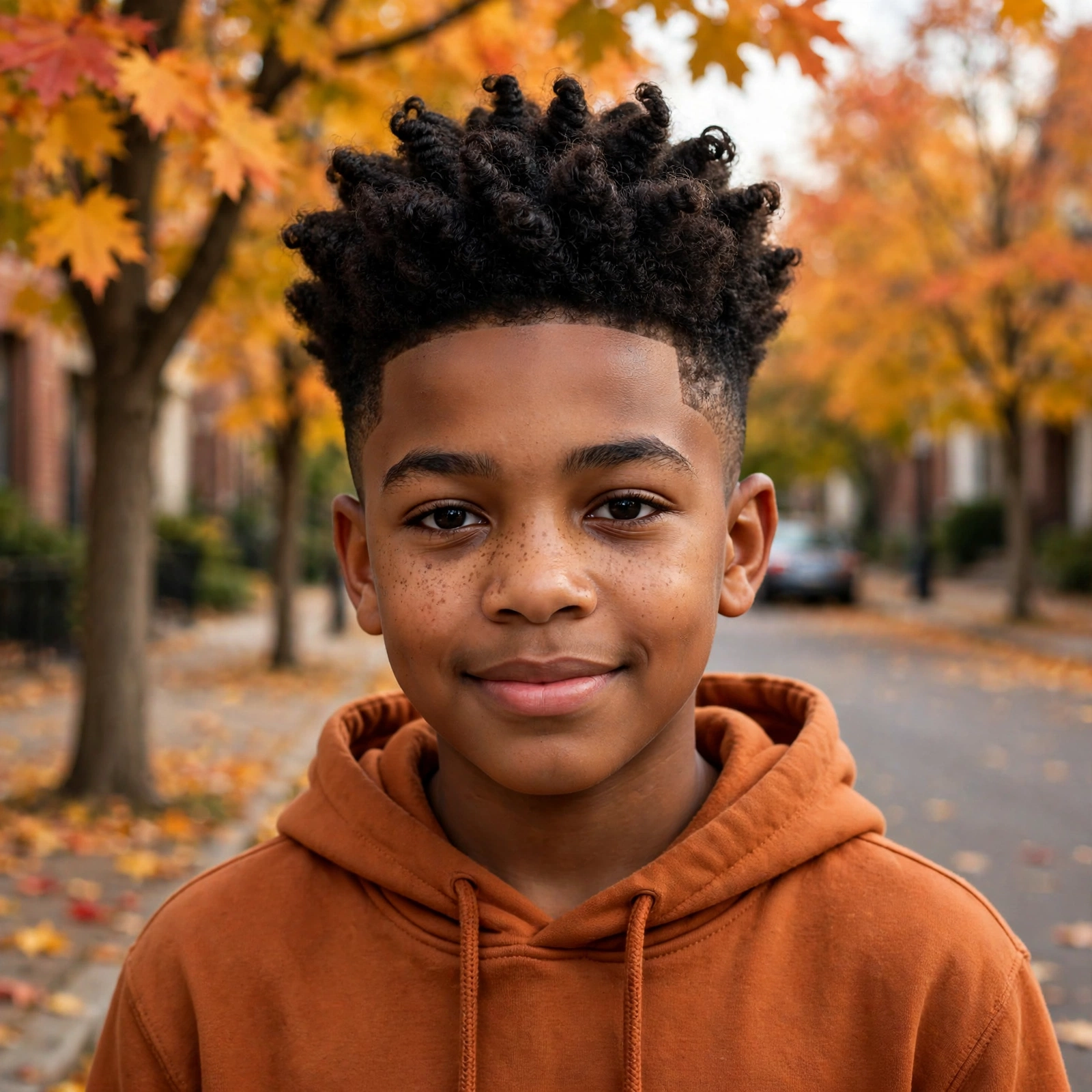
4. Defined Coily High-Top Fade
The modern high-top: coils shaped into a rounded, sculpted crown on top, blended down into a crisp fade on the sides — bold, architectural, and completely school-appropriate when the shape is clean. It’s having a real moment in curly boys’ hair trends for 2026 because it turns natural volume into the main event instead of something to tame. The vibe is statement-making confidence: talent shows, holiday photos, and the kid who likes his hair to get compliments.
How to get it: Tell the barber: “High-top fade with a rounded shape on top — blend the sides down into a low or skin fade, keep the top full and shaped, not flat.” Bring a reference photo; “high-top” means different things to different barbers. At home: pick the top out with a wide-tooth afro pick for shape and height, smooth a light-hold cream over the surface to define the coils, and shape the silhouette with your hands. Shape matters more than product here.
Best for: Type 4B–4C coils with good density; ages 8–14; oval and oblong faces love the added height, and it balances longer face shapes beautifully.
Maintenance: Medium. Two minutes with the pick each morning to restore the shape; wrap in a satin durag at night to preserve it. Barber every 2–3 weeks — this cut lives or dies by its shape, so don’t stretch appointments.
Pro tip: Never use a fine-tooth comb on dry coils — it causes breakage and kills the shape. A wide-tooth pick, used from the ends upward, is the only tool this style needs. And a satin durag at night isn’t optional; it’s what keeps the shape from collapsing by Wednesday.
5. Two-Strand Twists with Low Fade
Neat individual two-strand twists across the top, faded low and clean on the sides — a protective style that looks sharp for two to three weeks straight. It’s the workhorse of fall protective styles for boys: the twists guard the ends from dry autumn air, survive sports and swimming (with a rinse), and unravel into a bonus twist-out when you’re done. The vibe is neat, athletic, low-drama — the style for busy school weeks when mornings need to be grab-and-go.
How to get it: Tell the barber: “Low fade on the sides and back first, then leave the top long for twists.” The twists themselves take one to three hours depending on size — smaller twists last longer and look neater; chunkier twists are faster to install. Install on clean, deep-conditioned hair with leave-in and a twisting cream or butter, twisting each section from root to tip. Keep for two to three weeks, moisturizing the twists every two to three days.
Best for: Type 4A–4C coils; ages 6–14; active kids, swimmers, and anyone who wants weeks of style from one sitting.
Maintenance: Low daily (five minutes to moisturize and go), medium for the install session. Oil the scalp two to three times a week; sleep in a satin bonnet. Barber edge-ups between installs keep the fade fresh.
Pro tip: Don’t keep twists past three to four weeks — buildup at the roots and tension at the hairline cause more damage than the style prevents. When you take them down, detangle gently with conditioner before washing, and enjoy the twist-out as a free second style.
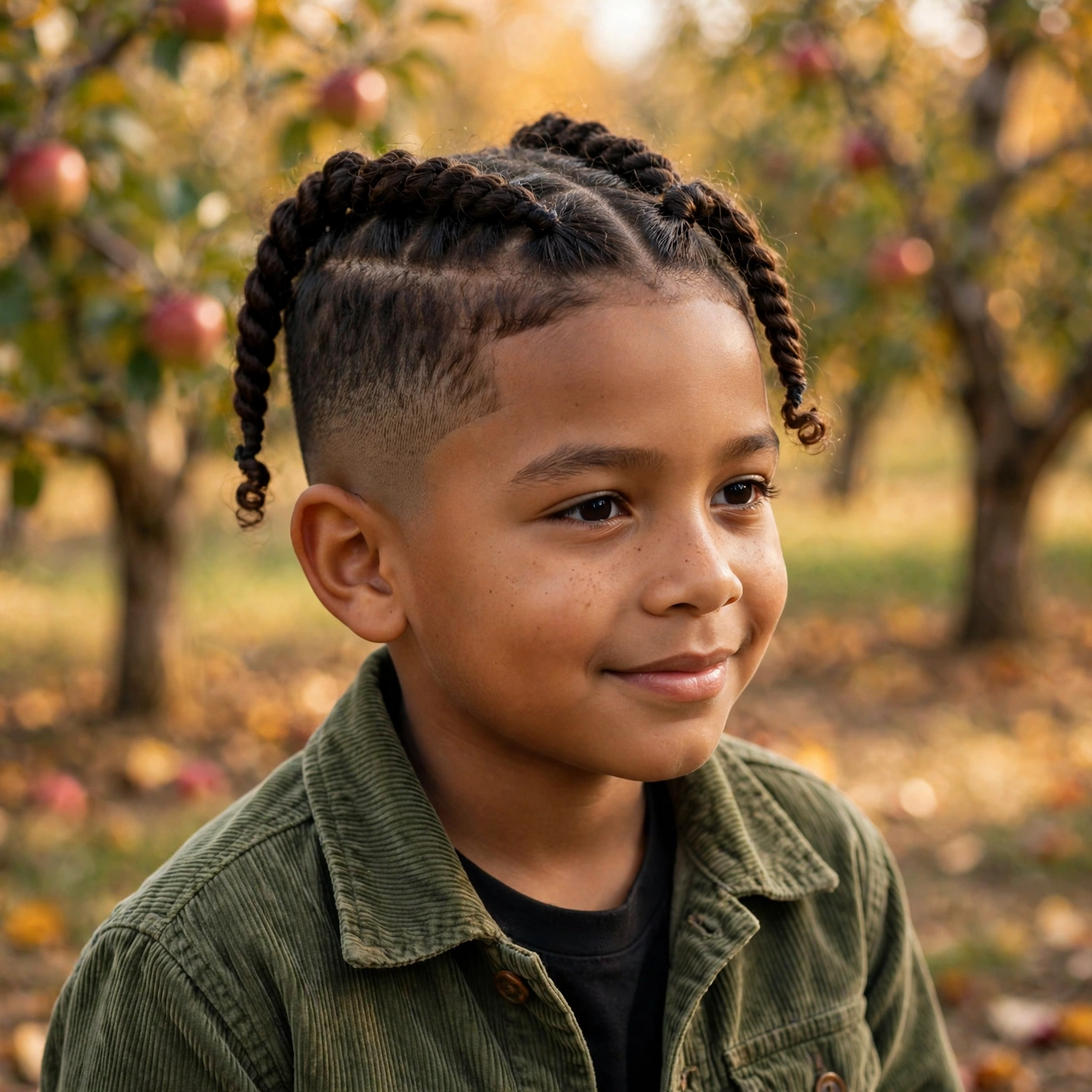
6. Curly Frohawk
A strip of defined curls running front to back down the center, with the sides faded or tapered tight — all the attitude of a mohawk, softened into curls and completely wearable for school. It’s the personality pick of fall curly hairstyles for boys in 2026: bold enough to feel like a statement, shaped enough to stay neat. The vibe is fun and fearless — Halloween season, school spirit days, and the kid who picks his own haircut.
How to get it: Tell the barber: “Faded or tapered sides, keep a wide strip of length down the middle — shaped and rounded, not spiky.” At home: define the center curls with curl cream on damp hair, scrunch for definition, then lift at the roots with a pick for that signature height. The contrast between the tight sides and the full center is the whole look, so keep the fade fresh.
Best for: Type 3B–4B curls and coils with enough density for the center strip; ages 7–14; kids who want edge without going full mohawk.
Maintenance: Low to medium. Five to ten minutes each morning to revive the center curls; the sides need a barber touch-up every 3–4 weeks.
Pro tip: Sleep in a satin bonnet or on a satin pillowcase — the center strip is the first thing to flatten overnight, and satin preserves the lift so mornings take half the time. A quick root-pick in the morning does the rest.
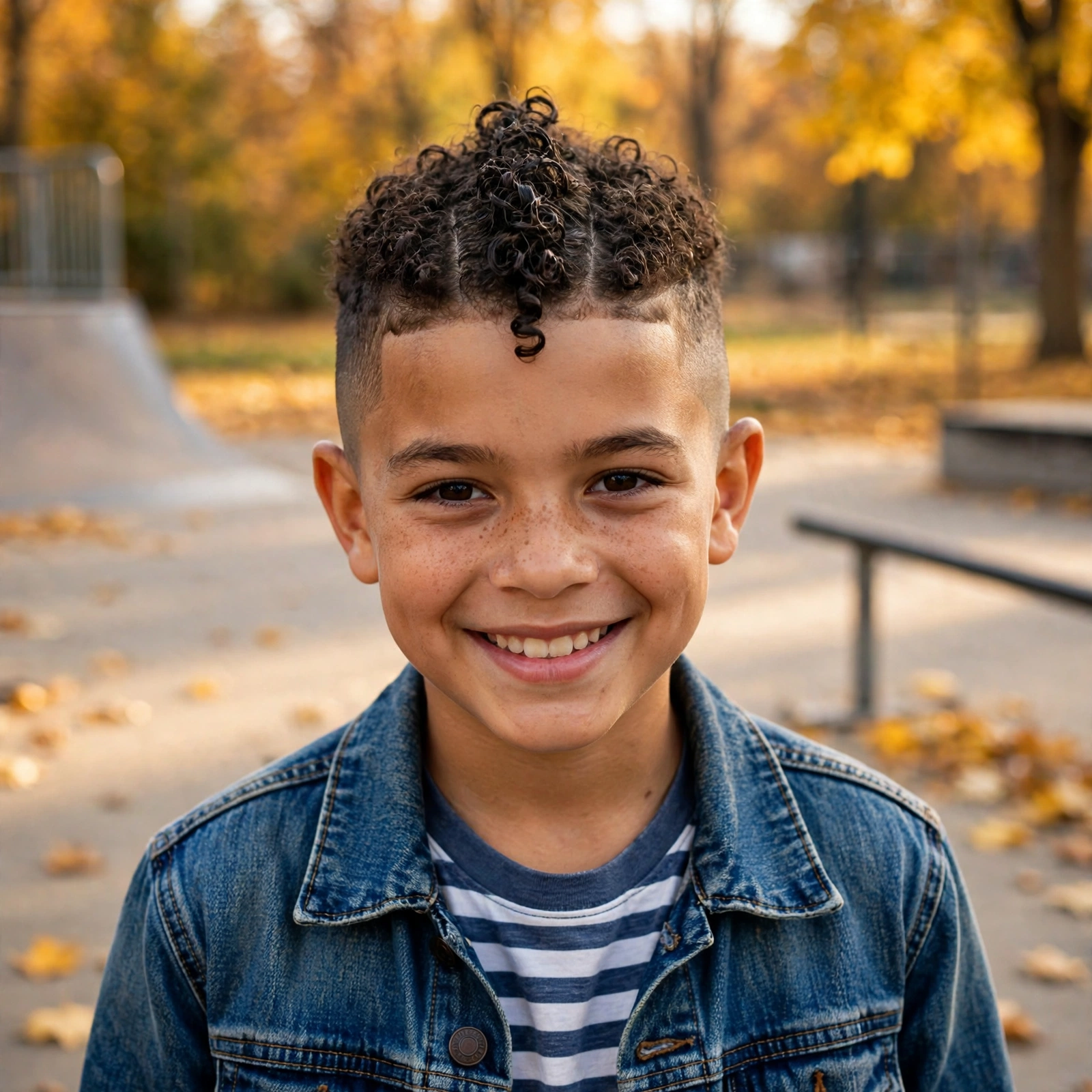
7. Wash-and-Go Curly Crop
Short all over — one to two inches — with the curls left to do exactly what they do naturally: the simplest routine on this entire list. It’s the answer for families who want great-looking curls with a three-minute morning: wash, condition, apply product, shake, go. In fall it shines because short curls dry fast (less time for dry air to steal moisture mid-routine) and the shape stays neat under hats and hoods. The vibe is clean, sporty, no-fuss — early school mornings, swim team, and kids who’d rather be anywhere than in a styling chair.
How to get it: Tell the barber: “Even crop, about one to two inches all over, with the hairline and neckline shaped up — keep it rounded to follow the head shape.” At home: on soaking-wet hair, rake a leave-in through, follow with a light gel or curl cream, give the head a gentle shake side to side to encourage the curl pattern, and air-dry without touching. That’s the whole routine.
Best for: Type 3A–4A curls; ages 4–12; low-effort households and kids who are rough on their hair (it bounces right back).
Maintenance: Low. Three to five minutes each morning; a water mist revives day-two curls. Barber every 4–6 weeks for the shape-up.
Pro tip: Apply product to soaking-wet hair, not towel-dried — water is what forms the curl clumps, and product just locks them in. The “shake and go” only works when the hair is wet enough to clump; on damp hair you’ll get frizz instead of definition.

8. Finger Coils with Tapered Sides
Each section of hair hand-twisted around a finger into perfect, uniform ringlets — the maximum-definition style on this list, and the one that photographs like a dream. Paired with tapered sides, it’s polished enough for holiday portraits and family events while still being 100% his natural texture. It’s a defined curly hairstyle for boys that turns heads: the coils catch light beautifully, and the shape holds for days with the right nighttime routine. The vibe is special-occasion sharp — picture day, weddings, holiday cards.
How to get it: Tell the barber: “Tapered sides, keep the top long enough to coil — two to four inches.” At home: on damp, conditioned hair, work in small sections, apply a curl-defining cream to each section, and twirl it tightly around your finger from root to tip, sliding the coil off when it holds. It takes 45–60 minutes the first time, faster with practice. Let the coils dry completely before touching them.
Best for: Type 3C–4C curls and coils; ages 6–14; special occasions and photo season, or any kid who loves a crisp, defined look.
Maintenance: Medium to high. The install is the work (weekly, 45–60 minutes); daily upkeep is five minutes of refresh misting. Satin bonnet at night is mandatory to keep coils intact. Barber every 4–6 weeks for the taper.
Pro tip: Use a curl-defining cream with real hold — something like SheaMoisture’s Coconut & Hibiscus Curl Enhancing Smoothie gives coils definition without crunch. And coil in the same direction every time; mixed directions unravel into frizz by day two.
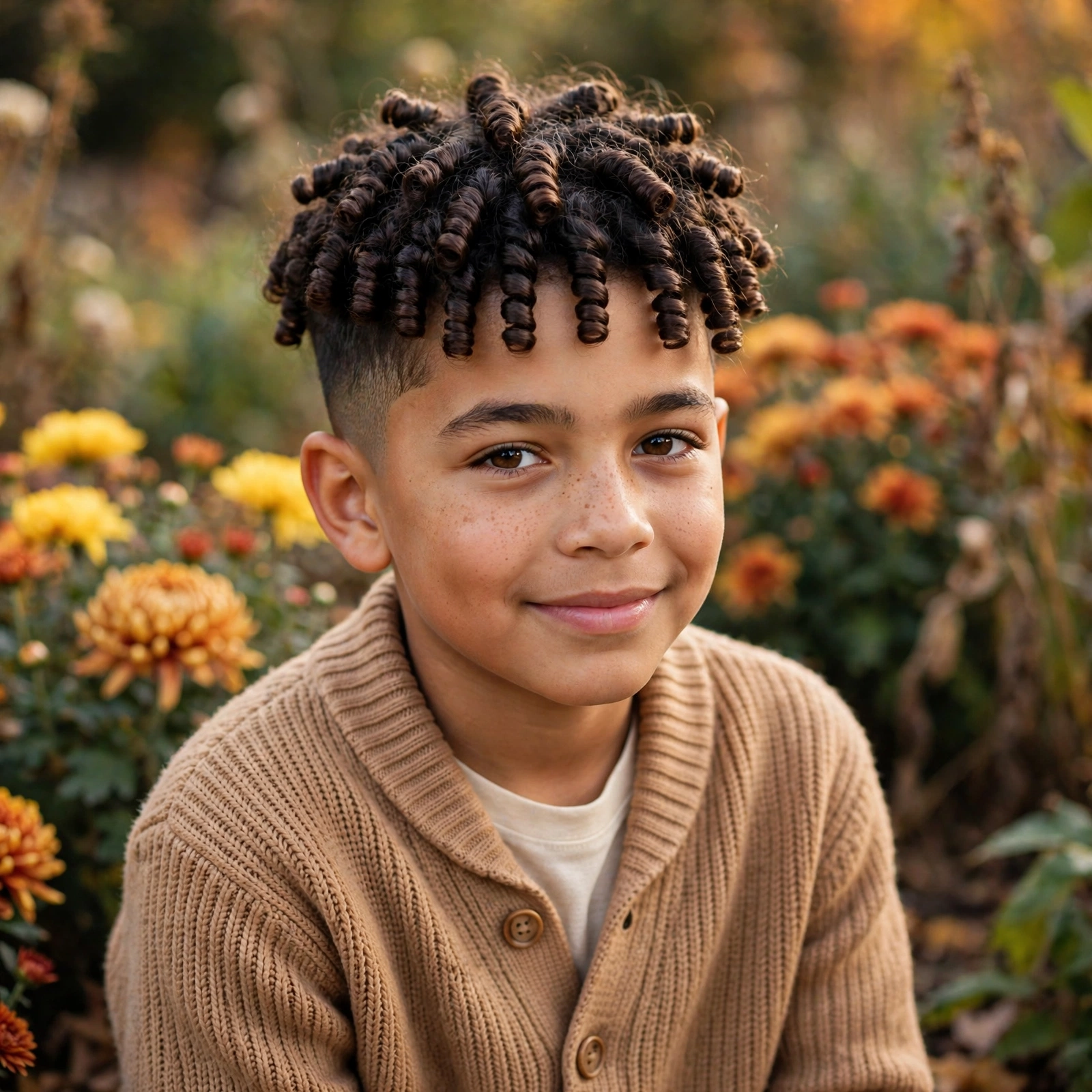
9. Curly Fringe with Low Fade
Longer curls swept forward over the forehead, falling into a soft, textured fringe, with a low fade keeping the sides and neckline clean — the trendiest silhouette in boys’ curly haircuts for 2026. It’s the cut all over social feeds this fall: relaxed, a little romantic, and surprisingly easy to style once the length is there. The vibe is effortlessly cool — middle school hallways, weekend hangouts, and the “I woke up like this” aesthetic that actually takes ten minutes.
How to get it: Tell the barber: “Low fade on the sides and back, leave real length through the front — I want the curls falling forward into a fringe.” At home: scrunch curl cream into the damp fringe, then dry it forward with a diffuser on low heat and low speed to build volume at the roots. Air-drying works too, but the fringe can fall flat without that root lift.
Best for: Type 2C–3C wavy-curly hair with enough length up front; ages 8–14; oval and oblong faces especially — the fringe shortens a long face beautifully.
Maintenance: Medium. About ten minutes to style the fringe properly; the rest is wash-and-go. Barber every 4–5 weeks — the fringe length is the part that needs managing.
Pro tip: Always dry the fringe forward and lifted at the roots — never let it air-dry plastered against the forehead, or you’ll get a flat curtain instead of a bouncy fringe. A diffuser’s prongs lifting from underneath for thirty seconds is all it takes.
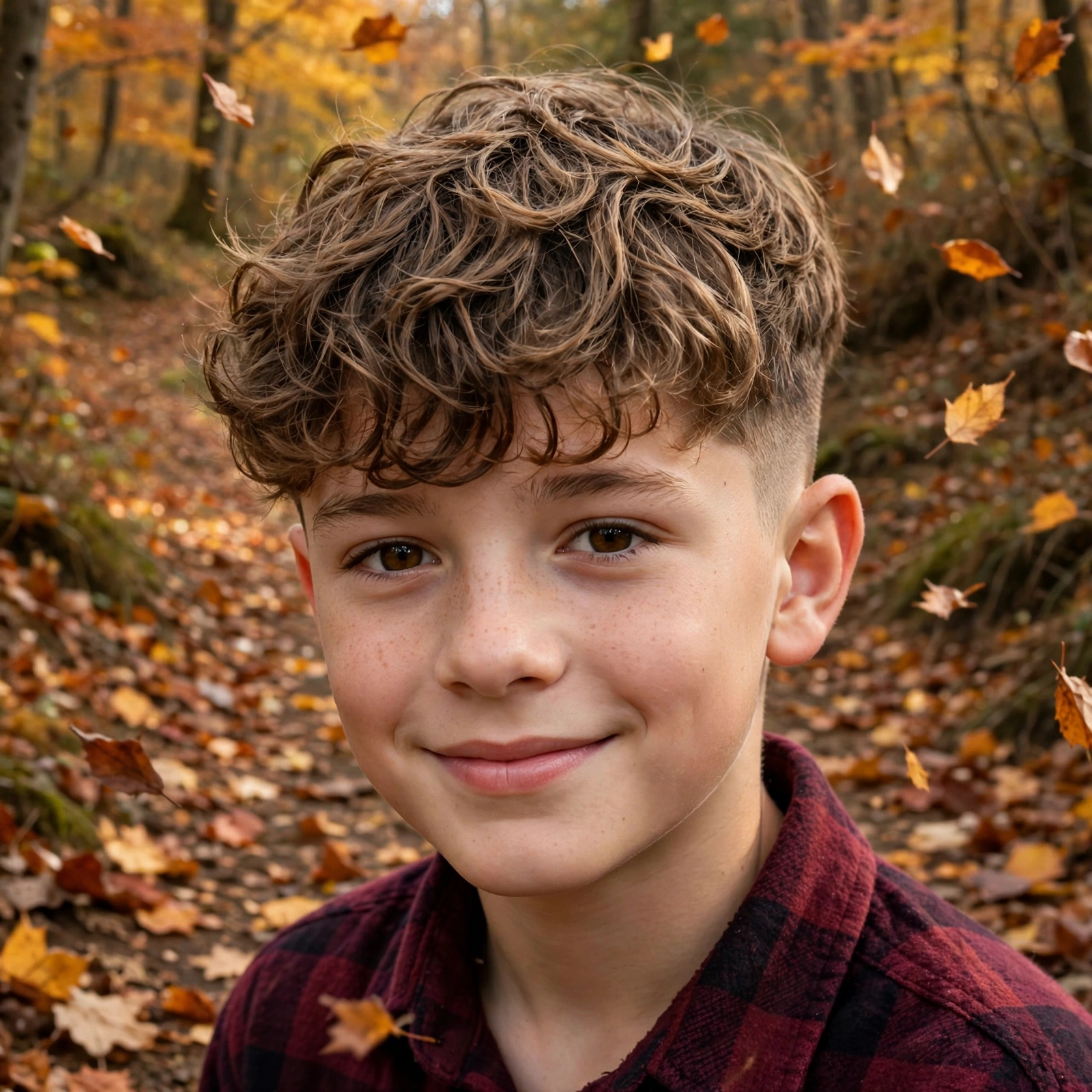
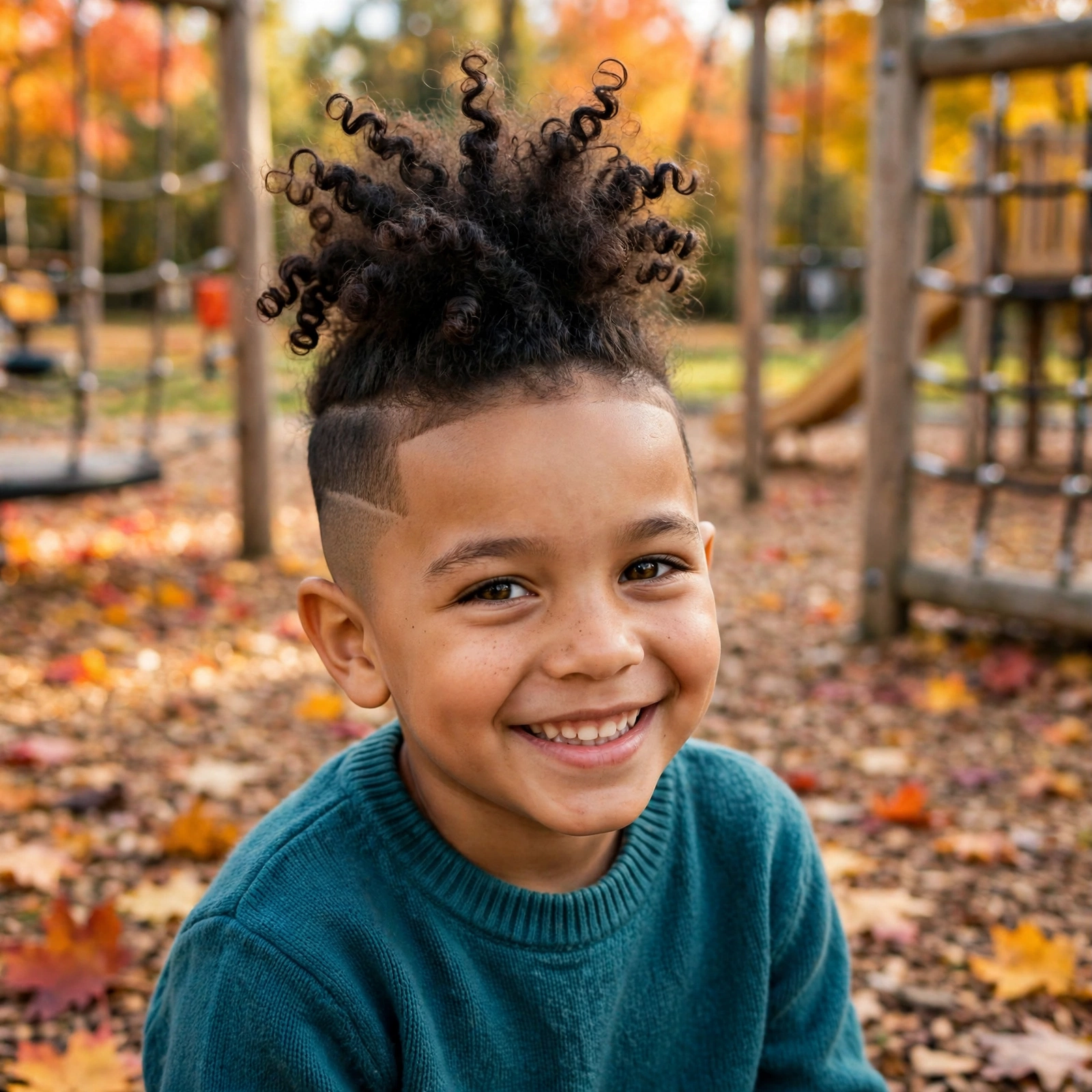
10. Pineapple Puff with Undercut
All the length gathered into one high, joyful puff of curls sitting on top, with the sides and back cut into a clean undercut — maximum fun, minimum effort. It’s the happiest style on this list and a genuine morning-saver: the puff takes minutes, keeps curls off the neck under scarves and coat collars, and the undercut means the sides always look intentional even on lazy days. The vibe is playful and proud — spirit weeks, family outings, and kids who love big hair.
How to get it: Tell the barber: “Undercut on the sides and back — disconnected and clean — keep all the length on top.” At home: on stretched hair (twists overnight, or a gentle blow-dry on low), gather the top up high with a satin scrunchie — never a tight elastic — and fluff the puff into shape with your fingers. Loosen the front edge slightly for a soft, natural hairline.
Best for: Type 3C–4C curls and coils with medium length on top; ages 5–12; round faces love the height, which elongates beautifully.
Maintenance: Low. Five minutes each morning to re-gather; take it down and re-puff nightly (never sleep in a tight puff — it stresses the hairline). Barber every 4–6 weeks for the undercut.
Pro tip: Stretch the hair before puffing — twists overnight or a low-heat stretch gives you a puff twice as big and round as one made on shrunken hair. And the satin scrunchie is non-negotiable: regular elastics snap curls at the gathering point.
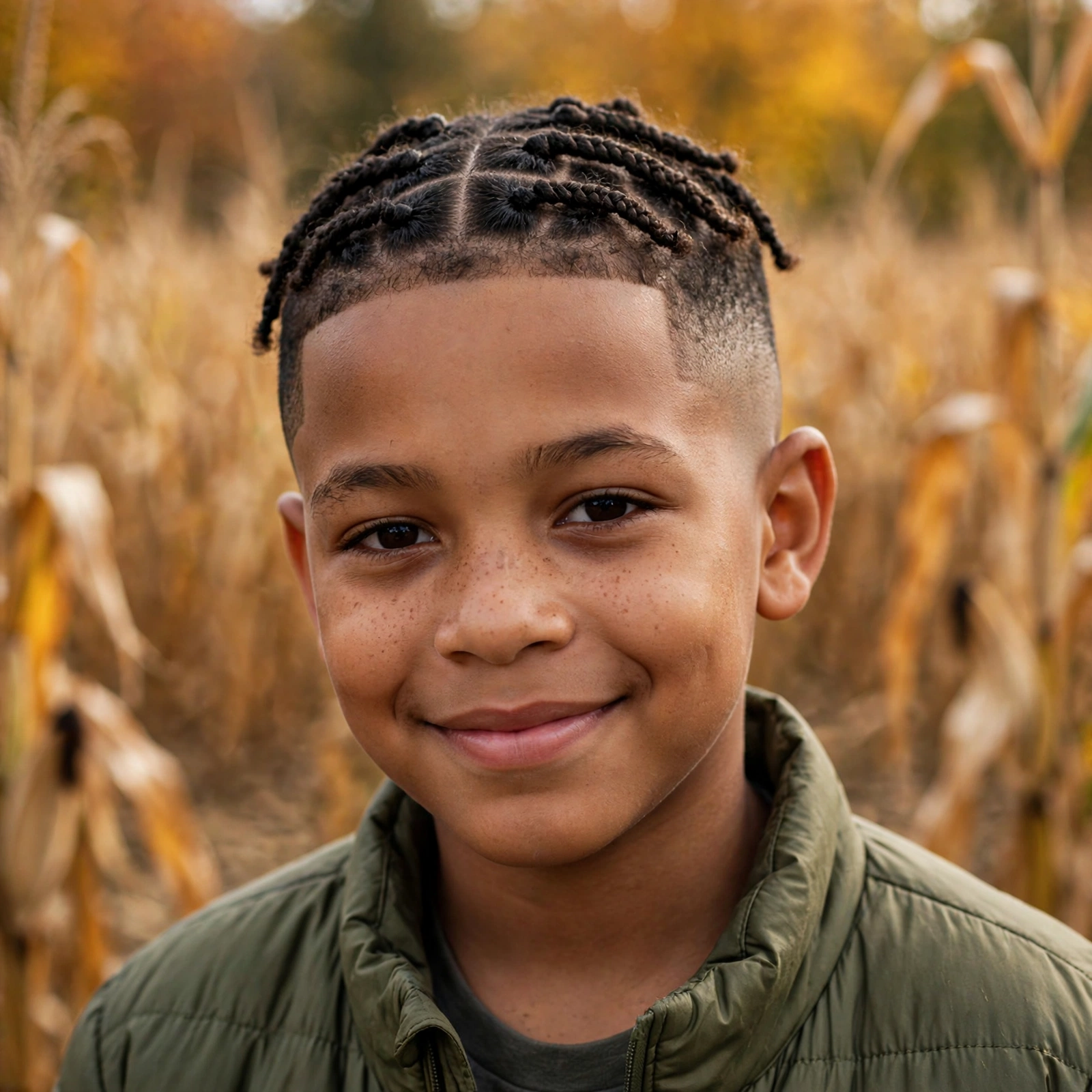
11. Short Box Braids with Fade
Neat individual box braids across the top, faded sharp on the sides — the longest-wearing style on this list at two to four weeks of clean, consistent looks. It’s the ultimate fall protective style for boys: braids shield the ends from dry air, handle sports and playgrounds without daily restyling, and the fade keeps everything looking fresh between braid appointments. The vibe is neat and confident — the whole school term, travel weeks, and any stretch when you need hair to just behave.
How to get it: Tell the barber: “Fade the sides and back first, then braid the top — keep the braids short to medium length.” Install on clean, deep-conditioned, stretched hair; braids should be snug but never painful (pain means tension damage at the roots — speak up). Moisturize the scalp with a light oil two to three times a week and keep the braids for two to four weeks max.
Best for: Type 4A–4C coils; ages 6–14; busy school weeks, athletes, and anyone who wants maximum longevity from one styling session.
Maintenance: Low daily — a quick scalp oil and you’re done. The install takes a few hours; plan barber edge-ups between installs to keep the fade crisp.
Pro tip: Set a hard removal date at four weeks, no matter how good they still look. Past that point, buildup at the roots mats into the new growth and takedown becomes a breakage risk. Mark it on the calendar the day they’re installed.
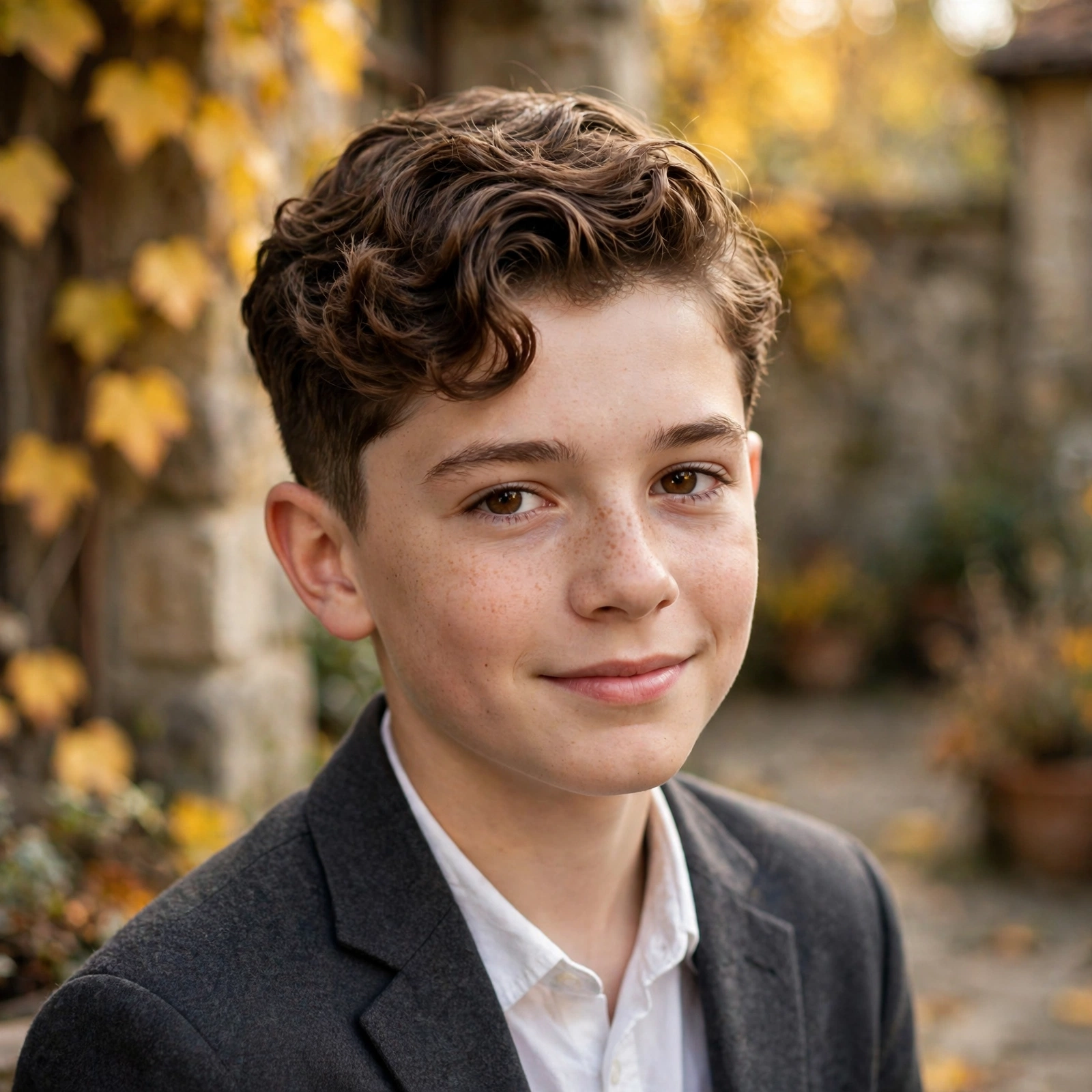
12. Curly Side Part with Taper
A classic side part worn soft and natural — curls swept to one side with real texture, tapered neatly through the sides. It’s the most polished style on this list without being stuffy: timeless enough for weddings and holiday dinners, relaxed enough for everyday wear. In fall 2026 it’s trending as the “grown-up” curly cut for boys — the one that looks intentional in every photo. The vibe is smart and timeless — family portraits, formal events, and the kid who likes looking sharp.
How to get it: Tell the barber: “Tapered sides, defined side part, keep the length on top swept to the side — textured, not slicked.” At home: find his natural part on damp hair (comb everything back and let it fall where it wants), apply curl cream, and sweep the curls to the side with your fingers, encouraging the part. Let it set without touching — the part deepens as it dries.
Best for: Type 2B–3B wavy-curly hair; ages 6–14; weddings, holidays, and picture days — or everyday for a kid who likes a neat look.
Maintenance: Low to medium. Five to ten minutes to set the part and define the sweep; refresh with mist on later days. Barber every 4–6 weeks.
Pro tip: Never force a part where the hair doesn’t want one — find the natural fall first by combing damp hair straight back and watching where it splits. Fighting the natural part means fighting the curl pattern all day, every day; working with it means the style practically holds itself.
Fall Curly Hairstyles for Boys: FAQs
How do I stop my son’s curls from getting dry and frizzy when fall air turns cold?
Moisture-layering is the whole game: on soaking-wet hair, apply leave-in, light oil, then curl cream — the LOC method. Water is the actual moisturizer; products just seal it in. On non-wash days, mist with water and add a touch of leave-in instead of more product. Deep-condition every week or two, switch to a satin pillowcase, and choose satin-lined beanies. In our testing, the satin pillowcase alone cut morning tangles roughly in half.
How often should I wash my curly-haired kid’s hair in the fall?
Less than you think: once or twice a week is the sweet spot for most curly and coily kids in fall. Over-washing strips the natural oils curls need, which makes fall dryness worse. Between washes, refresh with a water mist and a touch of leave-in, and use a shower cap on bath days. Signs you’re overwashing: a tight, itchy scalp and straw-like curls even after conditioning. This guide to how often curly hair should be washed breaks down the signals to watch for.
My son hates detangling — how do I do it without tears?
Three rules change everything: never detangle dry hair, always detangle with conditioner or leave-in in it, and start from the ends working up. Detangle in sections with a wide-tooth comb or your fingers — fingers are gentler and kids tolerate them better. For tender heads, detangle in twists, one small section at a time. And timing matters: detangle before he’s overtired, with a show on — wash day goes far better when it doesn’t feel like punishment.
What curly hairstyles actually survive sports, swimming, and playgrounds?
Contained styles win every time: two-strand twists, short box braids, and the pineapple puff keep curls secure through practice and play. For swimmers, the routine matters more than the style — wet the hair with clean water and apply leave-in before he gets in (saturated hair absorbs less chlorine), rinse immediately after, and shampoo that evening. For daily sports, styles gathered with satin scrunchies or rubber band hairstyles hold up far better than loose curls, and braided styles keep everything neat through doubleheaders double as protective styling through the whole season. Avoid tight ponytails pulled hard every single day — constant tension at the hairline causes breakage over time.
How do I deal with shrinkage and the awkward grow-out phase?
First, reframe it: shrinkage is proof of healthy, elastic curls, not a problem. Stretched styles — twist-outs, two-strand twists, banded ponytails — show length while protecting hair, which helps kids who feel it “isn’t growing.” Between cuts, keep the sides cleaned up every few weeks so the top looks intentional at any length. And resist straightening just to “check the length” — heat on dry fall hair sets progress back fast.
The Bottom Line
The best fall curly hairstyles for boys aren’t the most complicated — they’re the cuts that celebrate his natural texture, survive real school mornings, and pair with a moisture routine that beats dry autumn air. Pick one cut and one care habit, give them a two-week trial — the same trial our editors ran — and let this be the fall his curls finally feel easy. And when Halloween rolls around, our Halloween hairstyles for boys guide has costume-ready ideas that work with curls, not against them. Happy fall, and happy hair days ahead.